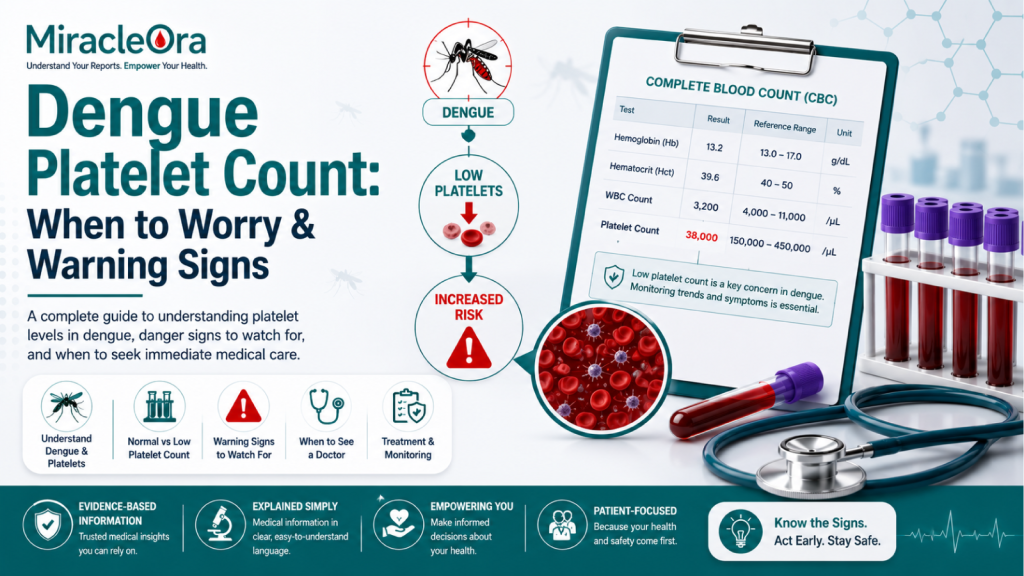
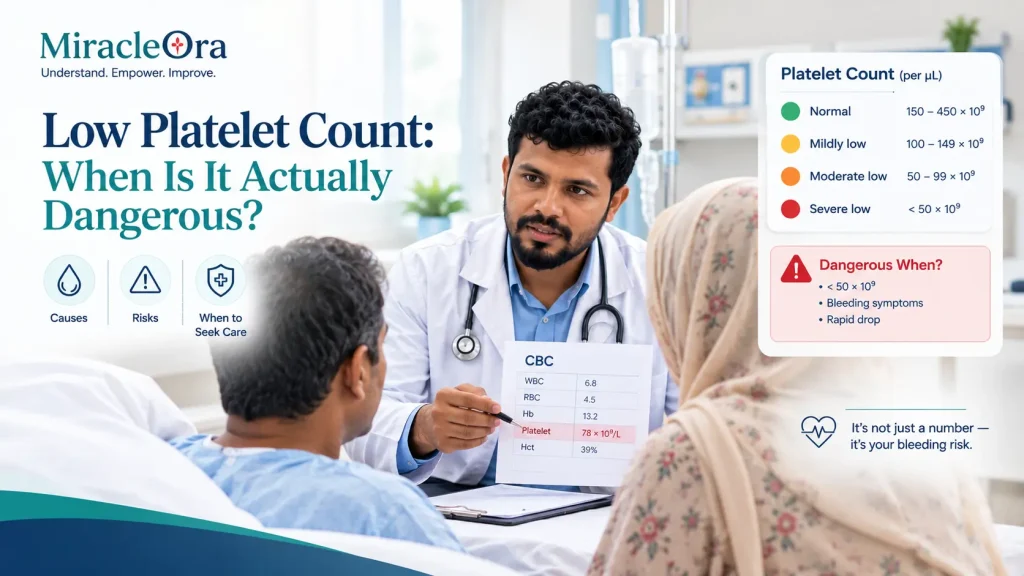
Short answer: A platelet count and clotting tests answer different questions. The platelet count, part of a complete blood count, tells how many platelets are in your blood. MedlinePlus (updated August 15, 2024, read September 24, 2026) separates count tests from platelet function tests, which check how well platelets form clots. Clotting tests such as the prothrombin time (PT, often reported with an INR) and the partial thromboplastin time (PTT or aPTT) measure how long the liquid part of the blood takes to clot. One can be normal while another is not, so the clinician who ordered them reads them together.
A laboratory report should not create fear. It should create understanding. When a platelet count arrives next to a column of seconds and ratios, it is easy to assume they all measure the same thing. They do not, and knowing which test covers which job makes the whole report easier to follow.
When bleeding needs care now
The numbers matter less than what is happening to the person. The National Heart, Lung, and Blood Institute's page on immune thrombocytopenia (last updated July 24, 2025) and its page on thrombocytopenia (last updated February 18, 2025), both read September 24, 2026, give the same urgent rule: seek immediate medical care for bleeding that does not stop when you apply pressure. The thrombocytopenia page says to call 9-1-1 in that situation.
The NHLBI also lists signs that can come with a low platelet count: petechiae (small, flat red spots under the skin), purpura (bleeding under the skin that leaves red, purple or brownish-yellow spots), nosebleeds, and prolonged bleeding from minor injuries. If you notice any of these, or unusual bleeding while taking a blood thinner, contact the clinician who ordered your tests or prescribed the medicine promptly.
If you feel too unwell to wait for an appointment, go to the nearest emergency department.
Two jobs, two kinds of test
Stopping a bleed needs two things to work together. The NHLBI describes platelets as tiny blood cells that "stick together to form a plug, called a blood clot, that seals your wound." Its bleeding disorders page (last updated August 3, 2023) describes clotting factors as "proteins in the blood that work with small cells, called platelets, to form blood clots," and states that "Any problem that affects the function or number of clotting factors or platelets can lead to a bleeding disorder."
That one sentence explains why there are several tests. Some look at platelets: how many there are, and how well they work. Others look at clotting factors: whether the protein side of clotting runs on time. No single test covers both.
Platelet count vs clotting tests: the side-by-side view
| Test | What it measures | One published reference range |
|---|---|---|
| Platelet count | How many platelets are in the blood | 150,000 to 450,000 per microliter in adults (NHLBI) |
| Platelet function tests, such as closure time or aggregometry | How well platelets form a plug or clump together | Ordered separately; results depend on the method |
| Bleeding time | How long bleeding takes to stop after small cuts | Rarely used now (see below) |
| Prothrombin time (PT) with INR | How long plasma, the liquid part of blood, takes to clot | PT 11 to 13.5 seconds; INR 0.8 to 1.1, for people not taking blood thinners (MedlinePlus) |
| Partial thromboplastin time (PTT or aPTT) | The function of a part of the clotting system | 25 to 35 seconds (MedlinePlus) |
Sources, all read September 24, 2026: NHLBI thrombocytopenia page (updated February 18, 2025); the MedlinePlus platelet tests page (updated August 15, 2024); MedlinePlus pages on the PT and PTT tests (review date February 3, 2025). MedlinePlus notes that normal values vary slightly among different labs, so the range printed on your own report is the one that applies. Our guide to why your lab's reference range differs from charts online explains why.
If the abbreviations on your report do not match these exactly, our guide to CBC abbreviations such as PLT, WBC and Hb covers the blood count side.
What each test can and cannot tell you
The platelet count: how many, not how well
MedlinePlus explains that platelet count tests measure the number of platelets, while platelet function tests check their ability to form clots. A lower-than-normal count is called thrombocytopenia and a higher-than-normal count thrombocytosis.
A count says nothing about whether each platelet works properly. The NHLBI adds a calming point about low counts: "You may not have serious bleeding until your platelet count is very low." Our pillar page on when a low platelet count is actually dangerous covers how clinicians think about severity.
PT and INR: timing the clotting proteins
MedlinePlus describes the PT as a test of "the time it takes for the liquid portion (plasma) of your blood to clot," and notes that most of the time the result is also given as an INR, short for international normalized ratio. It lists the test's uses as monitoring the blood thinner warfarin, finding the cause of abnormal bleeding, checking liver function, and looking for clotting or bleeding disorders.
It lists bleeding disorders, disseminated intravascular coagulation (DIC), liver disease and vitamin K deficiency among the reasons for a raised INR. For people taking warfarin, MedlinePlus notes that the provider chooses a target INR range above the usual one, so a "high" INR in that setting may be exactly what was intended.
PTT or aPTT: a different part of the system
MedlinePlus says the PTT "measures the function of a part of the coagulation (clotting) system" and may be used to monitor people taking heparin, another blood thinner. Its list of reasons for a prolonged PTT includes bleeding disorders, DIC, liver disease, malabsorption, low vitamin K, heparin use, and the presence of lupus anticoagulant.
The PT and PTT lists overlap on some causes, such as liver disease, low vitamin K and DIC, but each also includes causes the other does not, such as warfarin for the PT and heparin for the PTT. That is one reason the two often appear side by side on a report.
Bleeding time: mostly retired
MedlinePlus describes bleeding time as a measure of "how long it takes for bleeding to stop after small cuts are made." A StatPearls chapter on bleeding time by Russeau, Vall and Manna (2023, read September 24, 2026) states that its sensitivity and specificity for platelet problems are low, that the platelet function assay (PFA-100) "has largely replaced bleeding time," and that "Many hospitals and health systems have removed the test without any demonstrated harm." If a bleeding time does appear on your report, the clinician who ordered it can explain why it was chosen.
Why one normal result does not settle another
This is the point most explanations skip, and it matters because it is where false reassurance and false alarm both come from.
A normal platelet count does not test platelet function. MedlinePlus notes that for someone taking an anti-platelet medicine such as aspirin, a platelet function test shows how well the medicine is working. That is a question about how platelets behave, which a count of how many there are cannot answer.
Normal PT and PTT do not rule out every bleeding problem. The CDC's page on diagnosing von Willebrand disease (updated May 15, 2024, read September 24, 2026) states: "Screening tests are often normal in VWD, and more specific tests are required." It names the complete blood count, APTT, PT and fibrinogen as screening tests, then lists more specific ones, including factor VIII activity and von Willebrand factor tests. It adds that tests often need repeating because clotting factor levels vary with stress, pregnancy and infections.
What the first round of tests is for. The NHLBI's 2007 guideline on von Willebrand disease (read September 24, 2026) describes an initial evaluation of a CBC and platelet count, PTT and PT, and says this testing "neither 'rules in' nor 'rules out' VWD, but it can suggest whether coagulation factor deficiency or thrombocytopenia might be the potential cause of clinical bleeding." In other words, the first set of results points the clinician in a direction. Which further tests follow, if any, is the clinician's decision.
Why these results often arrive together
MedlinePlus lists finding the cause of abnormal bleeding among the reasons a PT is ordered, and both the CDC and the NHLBI guideline describe the CBC, PT and PTT being used side by side as a first round of testing. So a person being checked for bruising or bleeding may well see the platelet count and the clotting times on one report. Each answers its own question, and the combination is what gives the clinician the picture.
On medicines: MedlinePlus notes that PT is used to monitor warfarin and PTT to monitor heparin, and that in people taking warfarin, abnormal results can be linked to alcohol or to interactions with other medicines, vitamins, supplements or foods. Any change belongs with the prescriber. No medicine should be started, stopped or changed because of a blood result and a web page.
Questions to bring to your clinician
- Which of these tests were ordered, and what question was each one meant to answer?
- Is my platelet count in range, and is my platelet function being checked separately?
- Are my PT, INR and PTT in range for my own situation, including any blood thinner I take?
- Do any results need repeating or following up with more specific tests?
- Which symptoms should bring me back sooner?
Frequently asked questions
Is a platelet count a clotting test?
Not in the usual sense. The platelet count is part of a complete blood count and measures how many platelets you have. Clotting tests such as PT and PTT time how long plasma takes to clot, which depends on clotting factor proteins. MedlinePlus also separates platelet count tests from platelet function tests.
Can you have a normal platelet count and still bleed easily?
It can happen. The NHLBI states that problems with either the function or the number of platelets or clotting factors can lead to a bleeding disorder, and the CDC notes that screening tests are often normal in von Willebrand disease. That is why a clinician may order more specific tests.
What is the difference between PT and PTT?
Both time how long blood takes to clot, but they look at different parts of the clotting system. MedlinePlus lists PT for monitoring warfarin and PTT for monitoring heparin, and gives separate lists of reasons for an abnormal result.
Is the bleeding time test still used?
Rarely. A StatPearls chapter (2023) states that the platelet function assay has largely replaced bleeding time and that many hospitals have removed the test without any demonstrated harm.
The short version
- The platelet count tells how many platelets there are; platelet function tests tell how well they work.
- PT with INR and PTT or aPTT time how long plasma takes to clot, which depends on clotting factor proteins.
- Bleeding time has largely been replaced by newer platelet function tests.
- A normal result in one test does not settle the others; the CDC notes that screening tests are often normal in von Willebrand disease.
- Bleeding that does not stop with pressure needs immediate care. Your ordering clinician interprets the full set of results.