To prepare for a doctor appointment about a blood test, bring four things: the full printed report with its own reference ranges, any earlier reports of the same test, a complete list of everything you take including over-the-counter medicines and supplements, and a short written list of your questions. MedlinePlus advises making "a list of the questions and concerns you want to talk about" and lists of "all the medicines, herbs, vitamins, and supplements you take." Ten minutes is a short appointment. What you bring into the room decides how much of it is spent reading the paperwork and how much is spent answering you.
This page covers what to bring, what to write down, the questions that tend to produce useful answers, and one thing that matters more than most guides admit.
If something feels urgent, the appointment is the wrong queue
Preparation assumes you have time to prepare. Some situations do not wait for a scheduled visit.
MedlinePlus's guide to understanding your lab results (last updated September 4, 2025, read October 3, 2026) makes a related point that cuts the other way too: "A test result that is within a reference range isn't always a guarantee of good health," and additional testing may be needed when symptoms are present despite normal numbers. New, severe or rapidly worsening symptoms belong with urgent care or your local emergency service on the day, not on a list for next Tuesday. If your report carried a result the laboratory flagged as critical, the clinician who ordered it is usually contacted directly, and a call to that practice is more useful than waiting.
For results that are flagged but not alarming, the rest of this page applies.
What to bring to the appointment
A short, physical set of items does most of the work.
- The full printed report, not a photograph of one line. This is the item people most often get wrong, and the reason is covered in its own section below.
- Earlier copies of the same test. A single value is a point; two or three values are a direction. MedlinePlus notes that when tracking results over time it helps to use the same laboratory, because methods differ between labs.
- A complete medicine list. MedlinePlus's talking with your doctor page (last updated October 5, 2024, read October 3, 2026) advises making lists of "all the medicines, herbs, vitamins, and supplements you take," and of any allergies. Over-the-counter painkillers, iron tablets and sleep aids belong on that list, because they are exactly the things people forget to mention and exactly the things that can bear on a blood count.
- A short symptom note. MedlinePlus suggests writing down when a symptom started and what makes it better or worse. A few dated lines beat a recollection under pressure.
- Your written questions. The same page advises making a list of the questions and concerns you want to discuss.
- Someone with you, if you want one. MedlinePlus suggests asking "a trusted friend or family member to come to the appointment with you." Two people remember more of a consultation than one.
How to prepare for a doctor appointment about a blood test, step by step
Working backward from the appointment makes this quick.
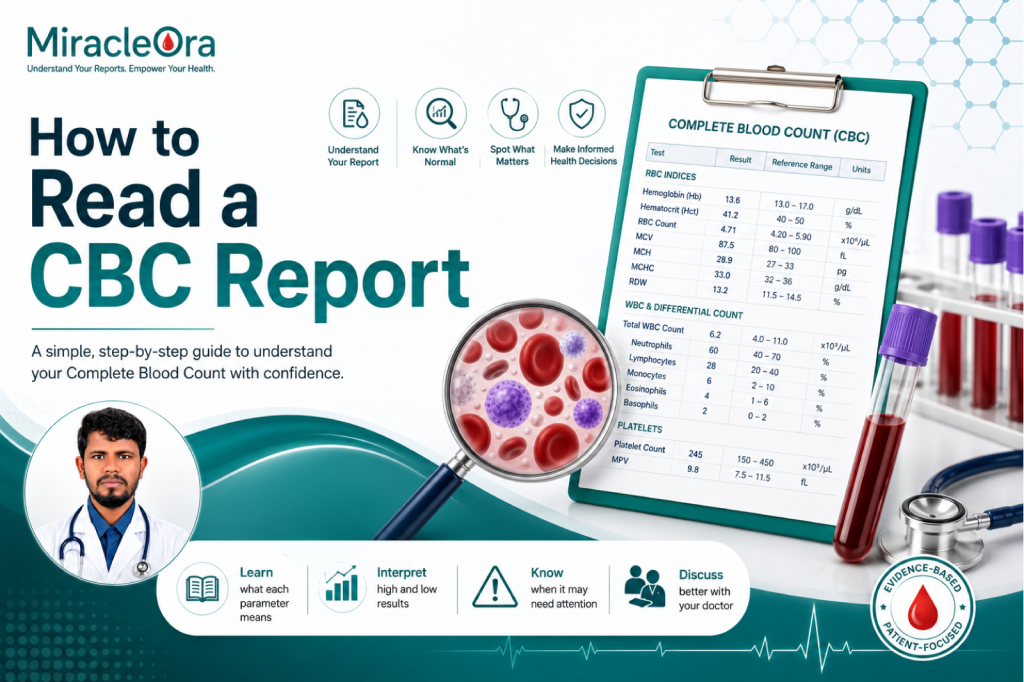
A few days before. Request a complete copy of the result if you do not already hold one, and read it once without searching every abbreviation. Our plain-language guide to reading a CBC report walks through the layout if the printout is unfamiliar territory.
The day before. Write the questions. Three is a realistic number for a standard appointment, so put the one that matters most at the top. Add the medicine list and the symptom note to the same page, so the whole thing is one sheet rather than a folder.
On the day. Take the printed report, the earlier reports and that sheet. MedlinePlus advises taking notes during the visit and asking questions "until you do understand." It also advises being honest rather than saying what you think the clinician wants to hear, which matters on questions about alcohol, supplements and whether medicines were actually taken as prescribed.
Before you leave the room. Ask what happens next and how you will be told. MedlinePlus advises finding out what to do if you need more information later, and learning how to access your own records.
Why the printed report beats a photo of the flagged line
Here is the detail that most appointment-preparation advice leaves out, and it is specific to laboratory results.
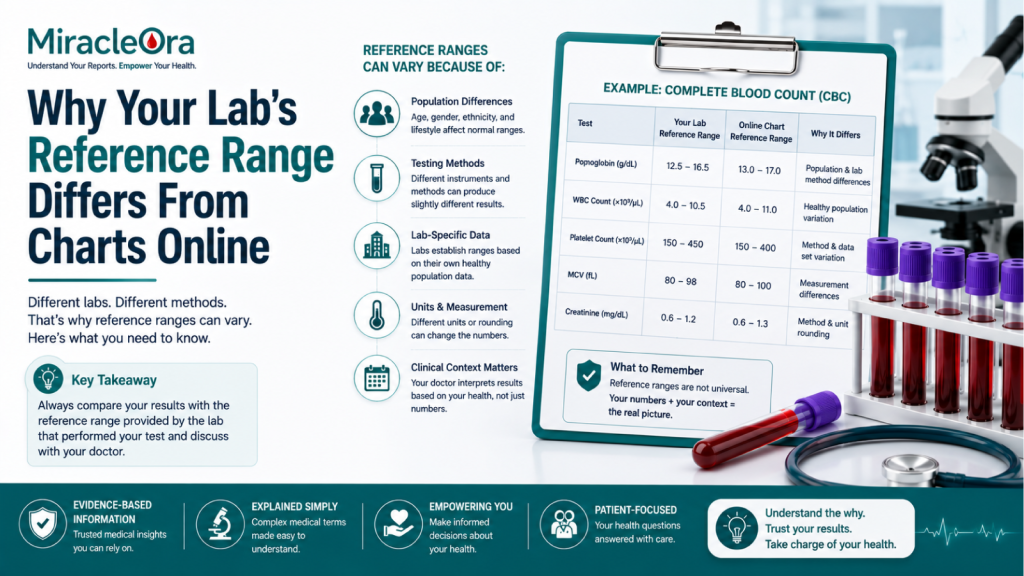
A reference range is not universal. MedlinePlus states plainly: "To find out how your test results compare with the normal range, you need to check the reference range listed on your lab report," and "You can't compare test results from different labs." Ranges are set by each laboratory for its own methods and population. A hemoglobin or platelet value that is flagged high at one laboratory can sit inside the range at another, and the only way a clinician can see which applies is to see the range the laboratory printed next to your number.
A cropped photograph of one flagged line removes exactly that context. It also removes the units, the collection date, the method note and the rest of the panel, and a blood count is read as a panel. Our article on why two laboratories give different numbers explains the mechanics, and why your lab's reference range differs from the charts online explains why the chart you found while searching is not the one that applies to you.
The practical version: bring the whole page, every page, with the ranges intact.
The questions that produce useful answers
Open questions tend to get general answers. Specific ones tend to get specific ones.
| Instead of | Ask |
|---|---|
| "Is this bad?" | "What was tested, and what was not?" |
| "Is my result normal?" | "Is this number different from my last one, and in which direction?" |
| "Should I be worried?" | "What would make you want to repeat this test, and when?" |
| "What do I do?" | "What is the next step, and who contacts whom?" |
| "What does this letter mean?" | "Does this flagged value change anything in my care, or is it being watched?" |
The first row is the one worth memorizing. "What was tested, and what was not" is respectful, takes seconds to answer, and is the question that separates a normal complete blood count from a clean bill of health. MedlinePlus's complete blood count page (last updated October 14, 2024, read October 3, 2026) sets out the values that test reports, the platelet count among them. Thyroid function, iron stores and vitamin levels are separate tests and do not appear on that list, which is a frequent source of confusion after a result comes back unremarkable. Our piece on an abnormal blood test when you feel fine covers the opposite situation, where the number moves and the person does not notice anything at all.
What not to bring
Two things make an appointment harder rather than easier.
The first is a printed stack of search results with values circled on a chart from another country's laboratory. The ranges will not match, and time goes into explaining why rather than into your actual question. One page of your own questions carries further.
The second is a self-made diagnosis presented as a conclusion. A clinician works from your history, your examination and the whole panel, which is more information than a web page has. Bringing what you read as a question ("I read that iron deficiency can do this, is that worth checking here?") keeps it useful. Our CBC test FAQ is written for exactly that purpose: to turn what people read into a question worth asking rather than into a conclusion to defend.
This article is general information about preparing for an appointment. It cannot interpret your results, and nothing here replaces the judgment of the clinician who ordered your test.
Frequently asked questions
What should I bring to a doctor appointment about blood test results?
The full printed report with its reference ranges, any earlier copies of the same test, a list of all medicines, supplements and vitamins you take, a short dated note of symptoms, and your written questions. MedlinePlus advises the medicine list, the question list and the symptom detail, and suggests bringing a trusted friend or family member if you want one.
Should I read my blood test results before the appointment?
Reading them is reasonable and often useful, because it gives you specific questions instead of general worry. MedlinePlus notes that a result inside a reference range is not a guarantee of good health and that it is still important to talk with your provider to learn what your results mean for you.
How many questions should I prepare?
Enough to cover what matters, ordered so the most important one is asked first. MedlinePlus advises making a list of your questions and concerns and asking until you understand the answer, which in a short appointment usually means a small number of well-chosen questions rather than a long list.
Can I just show my doctor a photo of the result on my phone?
A photo of a single flagged line removes the laboratory's own reference range, the units and the rest of the panel, and MedlinePlus states that you need the reference range listed on your own report to know how your result compares. The complete report, including earlier ones, is the more useful thing to bring.