A complete blood count (CBC) is a blood test that measures the amounts and sizes of your red blood cells, hemoglobin, white blood cells and platelets, as reported by Cleveland Clinic. It is one of the most commonly ordered blood tests, it usually needs no special preparation, and it produces a report of numbers compared against a reference range printed by the laboratory that ran it. This page answers the practical questions people ask at each stage: before the test, at the blood draw, while waiting, and when the report finally arrives.
This is general health education, not medical advice. None of these answers can interpret your own results. Take your report to your doctor for that.
Before the test
Do I need to fast before a CBC?
Usually not. As reported by Mayo Clinic, if your blood sample is being tested only for a complete blood count, you can eat and drink normally beforehand. Fasting instructions usually come from other tests ordered at the same time, such as glucose or a lipid panel. Follow whatever your requesting clinician told you, and if you are unsure, ask the laboratory before you arrive. Our full explainer covers whether you need to fast for a CBC.
Should I drink water before the blood draw?
Being reasonably hydrated makes the draw easier, because veins are simpler to find. Hydration status can also shift some values slightly, since a blood count measures cells in a volume of plasma. If you were told to fast, plain water is usually still allowed, but confirm that with the team who ordered the test.
Does exercise before the test matter?
It can. Strenuous exercise shortly before a draw can transiently shift white cell counts and some other values. This is one reason a single unexpected result is often repeated rather than acted on immediately.
Should I stop my medicines first?
Do not stop any prescribed medicine to prepare for a blood test unless the clinician who prescribed it tells you to. Instead, tell the laboratory and your doctor what you take, including supplements, because some medicines genuinely affect blood counts and your doctor needs that context to read the report.
Can I request a CBC myself?
This depends entirely on where you live and how your health system works. In some places direct-access laboratory testing is available; in others a request from a clinician is required. The more useful question is what you would do with the result, since a number without clinical context is difficult to act on. Our page on what a CBC test is used for explains the situations where the test genuinely adds information.
At the blood draw
How much blood is taken?
A small amount, typically one tube for a CBC. The tube contains an anticoagulant (EDTA) that stops the sample clotting before the analyzer can count the cells. If several tests were ordered, you may see several tubes with different colored caps, because different tests need different additives.
Does it hurt?
Most people describe a brief sharp scratch and nothing more. Some bruising at the site afterward is common and settles on its own. Tell the person taking the sample if you have fainted during blood draws before, since lying down for the procedure prevents most of those episodes.
Why did they have to take blood twice?
Usually for a technical reason rather than a worrying one. A vein that stops flowing, a tube that did not fill to the required level, a sample that clotted, or a result the laboratory wants to confirm before releasing it can all trigger a second draw. A redraw is a quality-control step, and it is more often a sign the laboratory is being careful than a sign something is wrong.
Waiting for results
How long do CBC results take?
The analysis itself is fast. What varies is everything around it: whether the sample is run on site or transported, how busy the laboratory is, whether a manual review is triggered, and how quickly a clinician reviews and releases the report. Because this differs so much between laboratories, ask yours rather than relying on a number you read online. Our page on how long CBC results take explains what drives the wait.
Does a delay mean bad news?
It usually means a process, not a finding. Weekends, transport schedules, batching, and the need for a manual smear review all add time. If you are worried by a delay, call and ask for a status update. That is a reasonable request and a normal one.
Why did nobody call me?
Many services only contact patients when a result needs action, and treat “no news” as normal. That is not a reason to assume you have been cleared. You are entitled to see your own results, so ask for a copy and a brief explanation of what they showed. Reading the report with your doctor is how the number becomes information.
Reading the report
What do all the abbreviations mean?
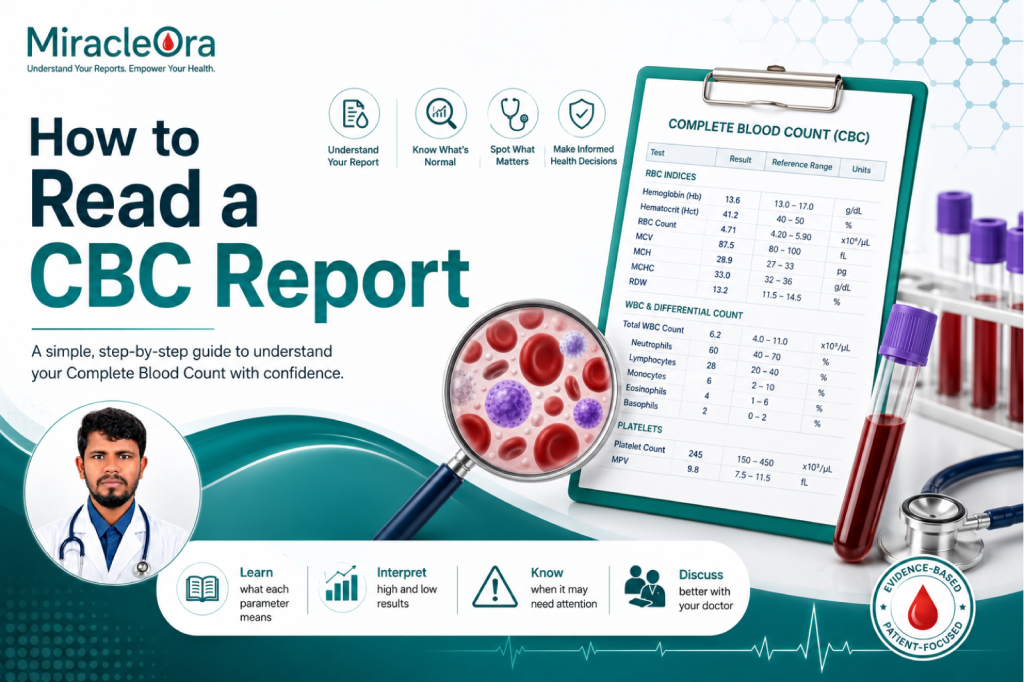
RBC, Hb, Hct, MCV, MCH, MCHC, RDW, WBC and PLT each measure a different property of your blood: how many red cells you have, how much hemoglobin they carry, how large they are, how much their size varies, and how many white cells and platelets are present. Our pillar guide to reading a CBC report walks the report top to bottom and decodes each abbreviation in plain language.
What does the H or L next to my result mean?
It means the value sits above (H) or below (L) the reference range that laboratory uses. It is a comparison, not a diagnosis. A flag is the report saying “this fell outside the band we compare against”, and mildly flagged values are common in healthy people.
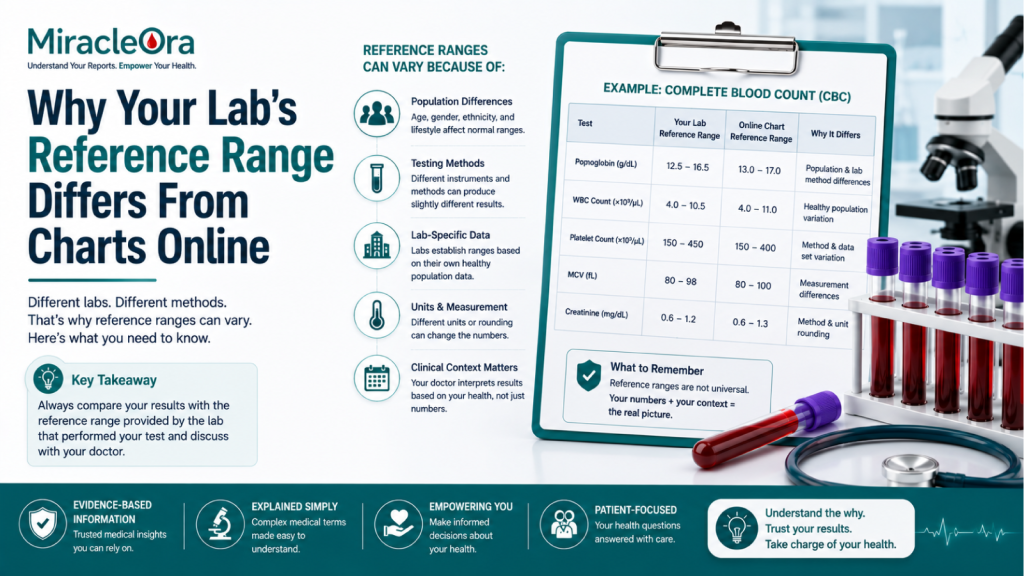
Why does my lab’s reference range differ from a chart I found online?
Because a reference range belongs to the laboratory that produced it. Ranges depend on the analyzer, the method, and the population the laboratory derived them from. Compare your value only to the range printed on your own report. Our CBC reference range chart gives sourced general figures for orientation, with the same caution attached.
One value is out of range. Is that a problem?
Not necessarily, and often not. A reference range is built so that a proportion of perfectly healthy people fall outside it, which is why an isolated mild flag is so common. What doctors weigh is how far out the value is, whether more than one value moved together, whether it is a change from your previous results, and how you actually are.
What happens to your sample between the needle and the report
This is the part no CBC page explains, and it is where a surprising number of confusing results are created.
After the draw, your tube is labeled, transported, and mixed so the anticoagulant is evenly distributed. It is then run through an automated hematology analyzer, which counts and sizes cells electronically. If the analyzer detects something it cannot classify, or a value crosses the laboratory’s internal alert rules, the sample is pulled for a manual step: a technologist prepares a blood film and looks at the cells under a microscope.
Several ordinary things can go wrong along the way, and each produces a result that means nothing about your health:
- A clotted sample. If blood begins to clot in the tube, cell counts become unreliable, and the laboratory asks for a fresh sample.
- Hemolysis. If red cells break during or after the draw, certain results are affected and the laboratory will flag or reject the sample.
- Platelet clumping. Platelets sometimes stick together in the EDTA tube, so the analyzer counts fewer than are really there. This produces a falsely low platelet count that resolves on a repeat using a different tube.
- Delayed transport. Cells change appearance over time, so a sample that sat too long may be rerun or reviewed manually.
- A confirmation run. Many laboratories automatically repeat a strikingly abnormal value before releasing it, and compare it against your previous result.
The practical takeaway is that a request to repeat a test is frequently about the sample rather than about you. If a value looks dramatically out of keeping with how you feel, asking your doctor “could this be a sample issue” is a legitimate question, and one they consider routinely.
When to see a doctor
A CBC report is a document, not an emergency service. Book an appointment to review your results if any value is flagged, if a previously stable value has changed, or if you have symptoms such as ongoing fatigue, breathlessness on exertion, unexplained bruising or bleeding, recurrent fevers, or unexplained weight loss.
Seek urgent or emergency care for chest pain, severe or sudden shortness of breath, fainting, bleeding that will not stop, vomiting blood or black tarry stools, a rash that does not fade under pressure, confusion, or a fever in anyone receiving chemotherapy or known to have a low neutrophil count. As reported by Cleveland Clinic and Mayo Clinic patient resources, these features are treated as time-critical and should not wait for a laboratory report.
Frequently asked questions
Does a CBC check for everything?
No. It counts and describes blood cells. It does not assess kidney or liver function, glucose, cholesterol, thyroid, vitamins or infection-specific organisms, all of which need their own tests. A normal CBC is not a general health clearance.
Is a CBC the same as “a blood test”?
“Blood test” is a category, not a test. A CBC is one member of it, often ordered alongside others on the same draw. That is why one needle can produce several different reports.
Do children have different normal ranges?
Yes. Reference ranges shift with age, and values normal for a young child can look flagged against an adult chart. Compare a child’s result with a pediatric range, and with the range printed on their own report.
Can I compare my results with someone else’s?
It is rarely useful. Ranges differ by sex, age, pregnancy, altitude and laboratory method, so two reports are often not directly comparable. Your own previous results are the most informative comparison you have.
Will I need to repeat the test?
Sometimes, and it is routine. A repeat can confirm an unexpected value, check whether a change is a trend or a blip, or monitor something already known. Being asked to repeat a CBC is not in itself a sign of bad news.
Medical disclaimer: This content is for general education only and is not a substitute for professional medical advice, diagnosis, or treatment. It cannot interpret your individual results. Always talk to a qualified healthcare provider about your own report, and seek urgent care for the emergency features described above. See our full Medical Disclaimer.