Petechiae are tiny flat red spots caused by blood leaking from small vessels under the skin, and a low platelet count is one of the recognized reasons they appear. The National Heart, Lung, and Blood Institute (NHLBI) lists petechiae, along with purpura and bruising from small injuries, among the signs of thrombocytopenia, a platelet count that is too low. It is not the only reason. MedlinePlus lists injury, certain medicines, viral infections and serious infections among the causes of bleeding into the skin as well. The spots indicate that a blood count is worth checking; they cannot tell you the number.
This page explains what the skin signs are, what a low platelet count has to do with them, which causes have nothing to do with the count, and what a clinician usually checks next.
When these skin signs need attention the same day
The escalation rule comes first, because a visible symptom is why most readers are here.
MedlinePlus's page on bleeding into the skin (reviewed April 1, 2025, read October 3, 2026) advises contacting a provider if "you have sudden bleeding into the skin for no apparent reason" or if you notice "unexplained bruising that does not go away."
NHLBI's thrombocytopenia page (updated February 18, 2025, read October 3, 2026) sets the emergency line: "Call 9-1-1 to seek immediate medical care if you have bleeding that does not stop when you apply pressure." Readers outside the United States would use their own emergency number.
NHLBI also lists signs that belong in the same conversation with a clinician: bleeding that lasts a long time even from small injuries, nosebleeds, bleeding gums, blood in urine or stool, and heavy menstrual bleeding. New spots appearing alongside fever, or spreading quickly, is a reason to be seen rather than to read further.
Petechiae, purpura and bruises: three words for different sizes
MedlinePlus describes all three as the same event at different scales: "Bleeding into the skin can occur from broken blood vessels that form tiny red dots (called petechiae). Blood also can collect under the tissue in larger flat areas (called purpura), or in a very large bruised area (called an ecchymosis)."
| Term | What MedlinePlus describes | What people usually call it |
|---|---|---|
| Petechiae | Tiny red dots from broken blood vessels | Pinprick spots, a rash that is not itchy |
| Purpura | Blood collecting under the tissue in larger flat areas | Purple patches |
| Ecchymosis | A very large bruised area | A bruise |
NHLBI adds the color detail for purpura: bleeding under the skin "that can cause red, purple, or brownish-yellow spots." Its description of petechiae is "small, flat red spots under the skin caused by blood leaking from blood vessels."
Why the vocabulary matters: a report or a clinic letter may use one of these words without explaining it, and the word chosen is largely about size and flatness rather than about severity. The cause determines the seriousness, not the label.
What a low platelet count has to do with it
Platelets are the cells involved in clotting. MedlinePlus describes platelets, also called thrombocytes, as small blood cells that form in the bone marrow and are essential for blood clotting. When the count is too low, NHLBI's list of signs includes the skin bleeding above and bleeding that lasts a long time from small injuries.
NHLBI groups the causes of a low count into a few mechanisms: the bone marrow not producing enough platelets, the body destroying or using them faster than it makes them, and the spleen holding too many of them. It names medications, infections, autoimmune diseases, cancer, pregnancy and surgery among the situations in which this occurs.
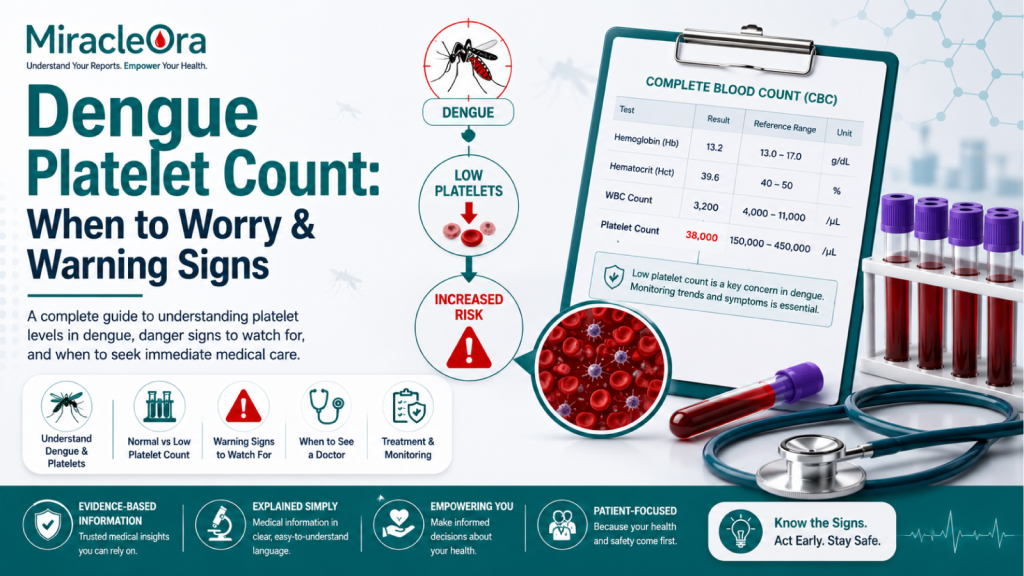
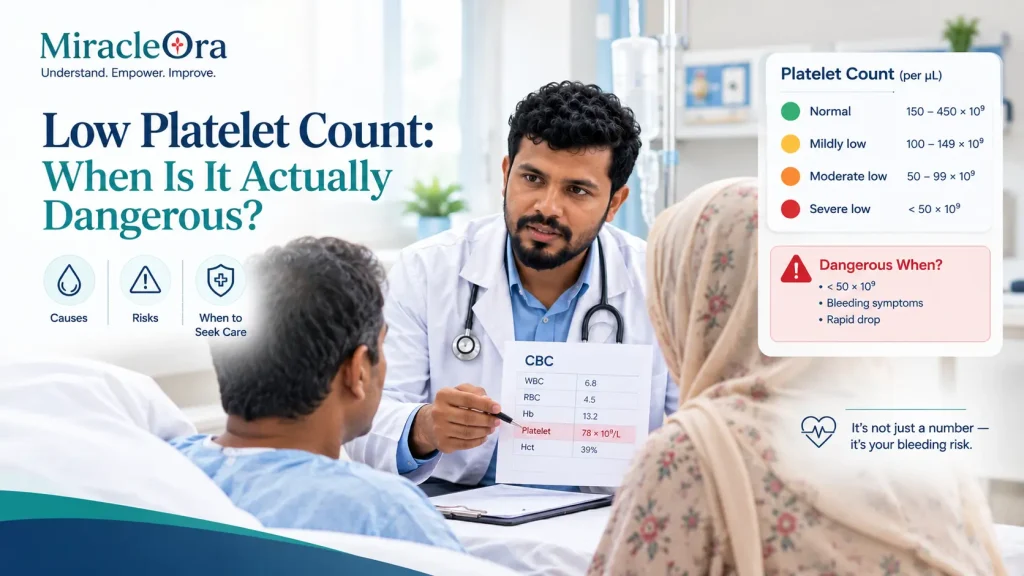
If a count has already come back low on your own report, our guide to when a low platelet count is actually dangerous covers how clinicians think about the thresholds, and the dengue platelet count question covers the fever context where a falling count worries people most.
The part that gets left out: the spots do not report a number
Most pages on this topic move straight from petechiae to low platelets, as though one proved the other. The source lists do not support that step, and understanding why saves a lot of unnecessary fear.
MedlinePlus's own list of causes of bleeding into the skin includes injury, allergic reactions, viral infections that affect clotting, low platelet counts, certain medicines including anticoagulants, aspirin and steroids, and serious infections such as septicemia. Only one item on that list is the platelet count itself. Several of the others can produce visible skin bleeding in someone whose count is entirely normal, which is why a complete blood count is a first step rather than a formality.
The reverse is also true and is worth stating plainly: a low platelet count often produces no visible sign at all. NHLBI's description of thrombocytopenia is a condition defined by the count, not by the skin, and people are frequently told about one on a routine report with nothing on their arms to look at. Visible spots and a low number are related, and neither is a reliable test for the other.
So the honest reading of a new patch of petechiae is: something caused small vessels to leak, there is a short list of candidate reasons, and the test that starts narrowing it down is a blood count. Our CBC abbreviations guide explains where the platelet line, usually printed as PLT, sits on that report.
What a clinician usually checks next
MedlinePlus states that providers may order coagulation studies, complete blood counts with platelet analysis, and bone marrow biopsies to identify the underlying cause of bleeding into the skin. In practice the first of those is the common starting point, and the last is reserved for situations the earlier tests do not explain.
A full history matters as much as the tests. The medicine list is part of it, because MedlinePlus names anticoagulants, aspirin and steroids among the causes. Recent illness is part of it, because viral infections appear on the same list, and our article on whether a CBC can detect infection explains what a blood count shows and does not show in that situation.
Two things not to do while waiting for an appointment: stopping a prescribed medicine on your own, and treating a reassuring article as a reason to delay being seen. Decisions about any medicine belong with the clinician who prescribed it.
Reading the report when it arrives
If a count has been run, the number arrives with a reference range beside it. That range belongs to the laboratory that ran the sample, which is why a value flagged as low at one laboratory can sit inside another laboratory's range. Our piece on why your lab's reference range differs from the charts online explains how that happens and why the printed range on your own report is the one that applies.
This article is general information about what skin bleeding and a platelet count can mean. It cannot tell you what caused your own spots or bruising. That assessment belongs with a clinician who can examine you and see the whole report.
Frequently asked questions
Do petechiae always mean low platelets?
No. NHLBI lists petechiae among the signs of a low platelet count, but MedlinePlus's list of causes of bleeding into the skin also includes injury, allergic reactions, viral infections that affect clotting, certain medicines such as anticoagulants, aspirin and steroids, and serious infections such as septicemia. A blood count is how a clinician begins to tell them apart.
What is the difference between petechiae and purpura?
Size and spread. MedlinePlus describes petechiae as tiny red dots from broken blood vessels and purpura as blood collecting under the tissue in larger flat areas, with a very large bruised area called an ecchymosis. NHLBI describes purpura as showing red, purple or brownish-yellow coloring.
Can you have a low platelet count without bruising?
Yes. Thrombocytopenia is defined by the platelet count rather than by visible signs, and NHLBI describes it as a condition that develops when the count in the blood is too low. Many people learn about a low count from a routine blood test rather than from a symptom.
What tests are done for unexplained bruising and petechiae?
MedlinePlus states that providers may order coagulation studies, complete blood counts with platelet analysis, and in some cases bone marrow biopsies, to identify the cause of bleeding into the skin. Which of these is appropriate depends on the history and examination, and is the clinician's decision.
When should unexplained bruising be seen urgently?
MedlinePlus advises contacting a provider for sudden bleeding into the skin for no apparent reason or unexplained bruising that does not go away. NHLBI advises calling emergency services for bleeding that does not stop when pressure is applied.