The short answer: a hemoglobin electrophoresis test sorts the hemoglobin in your red cells by type and measures how much of each is present. It is usually ordered when a CBC shows small red cells or another pattern that iron deficiency alone may not explain, to check for inherited differences such as thalassemia trait, sickle cell trait or hemoglobin C. The MedlinePlus Medical Encyclopedia says it is used when a provider "suspects that you have a disorder caused by abnormal forms of hemoglobin." Being tested is a step in finding an answer, not a sign that something serious has been found.
First: when to seek care sooner
Being sent for this test is not, by itself, a reason for alarm. It is a routine next step when earlier results leave a question open.
Cleveland Clinic's hemoglobin electrophoresis page (last reviewed January 13, 2026, read on September 27, 2026) advises contacting your provider if symptoms of a blood disorder get worse.
Chest pain, fainting, severe breathlessness, a racing heart at rest, severe pain, confusion, black or bloody stools, or very heavy bleeding call for emergency care rather than waiting for a test result. This page explains what the test measures. It cannot interpret your results, which belongs to the clinician who ordered it.
What the test actually measures
Hemoglobin is the protein inside red cells that carries oxygen. There is more than one kind. An adult's blood is mostly one type, with small amounts of others, and some inherited conditions add unusual types or change the balance.
Cleveland Clinic describes the method simply: dissolved red cells are placed on a strip, electricity is applied, and the different hemoglobin types separate into bands that are compared with normal values. Each type moves at its own speed, which is why they separate. Cleveland Clinic also notes that "you don't need to prepare for this blood test," and that it can be drawn from a vein, a finger stick or, in babies, a heel stick.
Why a CBC leads here
A CBC does not name hemoglobin types. It measures size, count and color of red cells. When those numbers form a pattern that could be either a shortage or an inherited trait, electrophoresis is one of the tests that can tell the two apart.
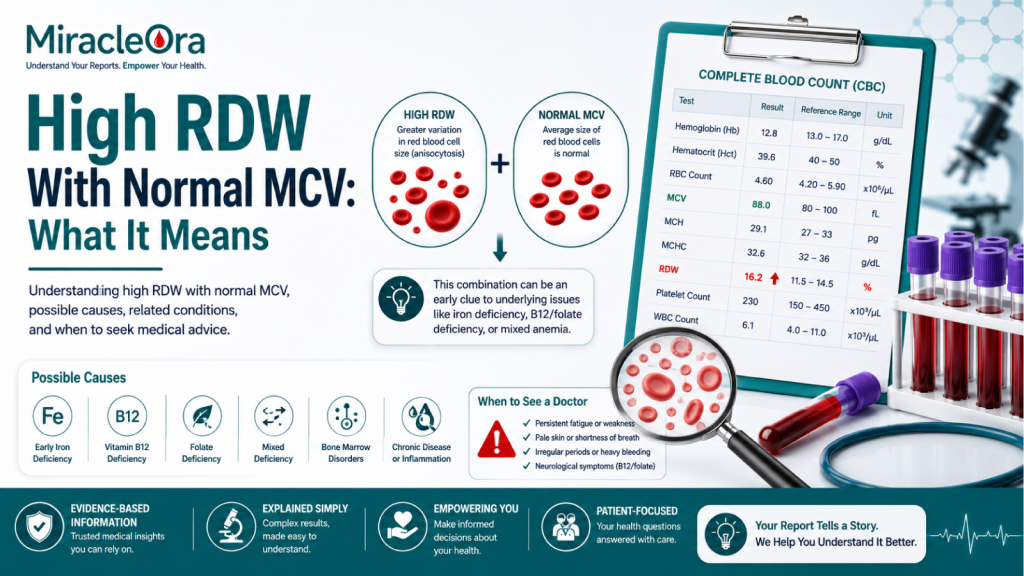
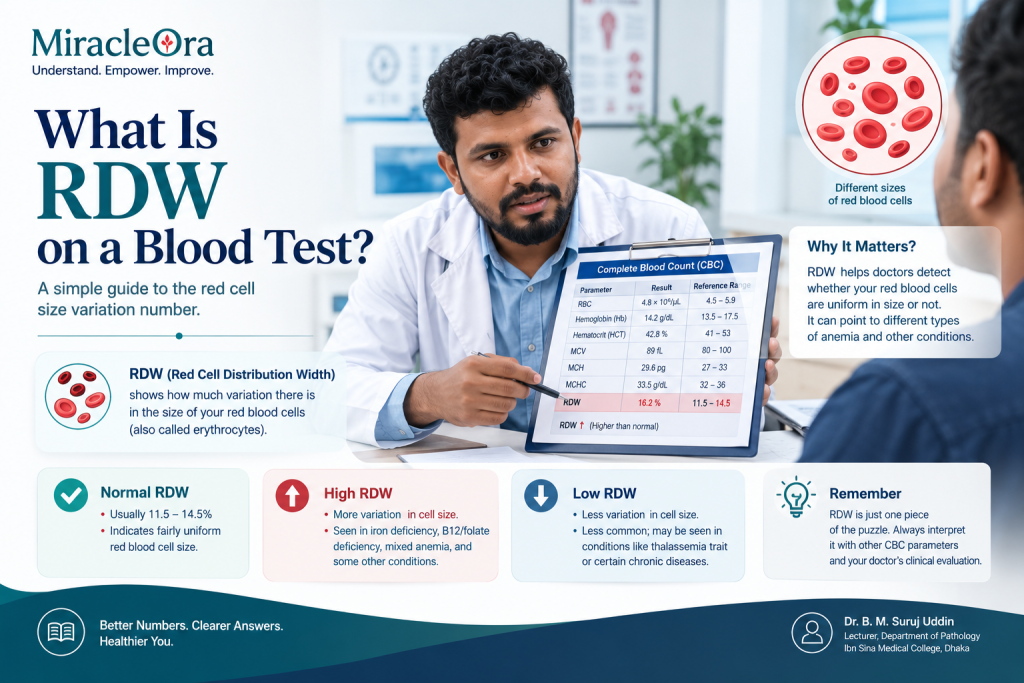
The most common trigger is small red cells. A 2009 review in American Family Physician on alpha and beta thalassemia (read on September 27, 2026) notes that "a microcytic anemia with a normal RDW will almost always be because of thalassemia," and that the MCV "is usually less than 75 fl with thalassemia and rarely less than 80 fl in iron deficiency until the hematocrit is less than 30 percent." Patterns like these are what move a clinician from the CBC toward electrophoresis. Our guide to thalassemia trait vs iron deficiency explains how the CBC points in each direction.
A smear comment can also play a part. Target cells, for example, are linked by hematology teaching sources to thalassemia and hemoglobin C and E disease, which is why they sometimes appear on the same report as a request for this test. Our explainer on the peripheral blood smear covers how smear findings are reported.
The hemoglobin electrophoresis test results, type by type
The MedlinePlus Medical Encyclopedia entry on hemoglobin electrophoresis (review date February 27, 2026, read on September 27, 2026) lists these normal adult values, and cautions that "normal value ranges may vary slightly among different laboratories."
| Hemoglobin type | Normal adult value (MedlinePlus) | What it is |
|---|---|---|
| HbA | Over 95% | The main adult hemoglobin |
| HbA2 | 2% to 3% | A minor adult type |
| HbF | 0.8% to 2% | Fetal hemoglobin, high before and soon after birth |
| HbS, HbC, HbE | Absent | Variant types linked to inherited conditions |
Your own report will carry your lab's ranges. Those are the ones that apply to you.
Children read differently
MedlinePlus gives HbF values of 50% to 80% in newborns, about 8% at 6 months, and 1% to 2% over 6 months. Cleveland Clinic notes that high HbF levels "are normal in fetuses, babies and children up to 3 years old." A child's result is therefore read against age, never against an adult chart. Our guide to how anemia ranges differ in children covers the wider picture.
What abnormal results can point to
According to MedlinePlus, higher levels of abnormal hemoglobins may point to hemoglobin C disease, thalassemia, a rare hemoglobinopathy, or sickle cell anemia or trait. Cleveland Clinic adds that raised HbF in older children and adults may point to thalassemia or other disorders.
The AFP review describes the typical beta thalassemia trait pattern: "reduced or absent HbA, elevated levels of HbA2, and increased HbF."
A word about "trait." MedlinePlus lists sickle cell anemia and sickle cell trait as separate possibilities, and the same distinction runs through thalassemia. A trait and a disease are not the same thing. Which one a result shows is one of the most important questions to ask your clinician, because the meaning for your own health and for family planning can differ.
When a normal result does not close the question
This is the section most explanations leave out.
Alpha thalassemia trait can look normal. The AFP review states that "the hemoglobin electrophoresis is usually normal in adults with alpha thalassemia trait." A normal result after a CBC that showed small cells does not always end the search, and a clinician may consider other testing.
Iron deficiency can mask beta thalassemia trait. The same review warns that "a normal concentration of HbA2 does not rule out beta thalassemia trait, especially if there was coexistent iron deficiency, which can lower HbA2 levels into the normal range." This is one reason iron status matters when reading the result. Our explainer on iron studies walks through what those tests measure.
A recent transfusion can distort the result. MedlinePlus notes: "You may have false normal or abnormal results if you have had a blood transfusion within 12 weeks of this test." Mention any transfusion to the person ordering the test.
Ranges vary by lab. Both MedlinePlus and UCSF Health state that normal ranges vary slightly between laboratories.
Cleveland Clinic sums it up: "These test results are just one piece of information your healthcare provider will consider."
What usually happens next
It depends on the result, your history and your family. Some results close the question. Others lead to more testing, and inherited results sometimes lead to a conversation about relatives or family planning. MedlinePlus notes the test's risks are those of any blood draw, such as minor bleeding, fainting, bruising or infection at the site.
Which step fits you is your clinician's decision. This page does not suggest starting, stopping or changing any medicine or supplement, including iron, based on an electrophoresis result.
Questions worth bringing to the appointment
- What pattern on my CBC led to this test?
- Were my iron levels checked, and could they affect this result?
- Does my result show a trait, a condition, or neither?
- If the result is normal, is the original question answered?
- Does this result matter for my relatives or for family planning?
The honest limits of this page
A laboratory report should not create fear. It should create understanding. Hemoglobin electrophoresis is a precise way of sorting hemoglobin types, and it answers a narrow, important question. It also has blind spots, which is why it is read alongside your CBC, iron status and history. Only the clinician who ordered it can say what your own result means.
Frequently asked questions
What is a hemoglobin electrophoresis test used for?
It identifies and measures the types of hemoglobin in your blood. MedlinePlus says it is ordered when a provider suspects a disorder caused by abnormal forms of hemoglobin, such as thalassemia or sickle cell disease.
Do I need to fast for hemoglobin electrophoresis?
Cleveland Clinic states that you don't need to prepare for this blood test. Follow any instructions your own clinic gives, since other tests may be drawn at the same time.
What are normal hemoglobin electrophoresis values?
MedlinePlus lists adult HbA over 95%, HbA2 2% to 3% and HbF 0.8% to 2%, with no HbS, HbC or HbE. It notes ranges vary slightly by laboratory, and children's HbF values are higher.
Can a normal electrophoresis rule out thalassemia?
Not always. A 2009 American Family Physician review notes the test is usually normal in adults with alpha thalassemia trait, and iron deficiency can lower HbA2 enough to hide beta thalassemia trait.
Can a blood transfusion affect the result?
Yes. MedlinePlus warns of false normal or abnormal results if you had a transfusion within 12 weeks of the test.