The short answer: there is no single MCV normal range for children, because red cell size changes as a child grows. A 1998 CDC report states that "MCV is highest at birth, decreases during the first 6 months of life, then gradually increases during childhood to adult levels." A 2001 American Family Physician table lists an MCV of 108 fL at birth, 78 fL between 6 months and 2 years, and 86 fL between 6 and 12 years. A child's result should be read against the age-based range on their own lab report, never an adult chart, and your child's pediatrician interprets it.
First: when to call the pediatrician sooner
An MCV outside a range is rarely urgent by itself. How your child looks and behaves matters more than one number.
The 2001 American Family Physician review, "Anemia in Children" by Irwin and Kirchner, notes that children with acute anemia "often present more dramatically," with findings that include jaundice (yellow skin or eyes), fast breathing, a fast heart rate, an enlarged spleen, blood in the urine and heart failure.
A child who is struggling to breathe, unusually hard to wake, fainting, very pale or gray, or bleeding heavily needs emergency care, not more reading. For anything else that worries you, the pediatrician who ordered the test is the right first call. This page cannot assess any child.
Why a child's red cells change size
Newborns start with more hemoglobin and larger red cells than adults. The American Family Physician table below shows it: at 1 to 3 days old, it lists hemoglobin of 18.5 g/dL and an MCV of 108 fL, both well above the adult figures in the same table.
The Irwin and Kirchner review explains what happens next: "during the first weeks of life, erythropoietin synthesis abruptly decreases," and over the following six to eight weeks, hemoglobin "reaches a low point of 9 to 11 g per dL." Erythropoietin is the hormone that signals the marrow to make red cells. This expected dip is often called the physiologic anemia of infancy. Over the same months, the average cell size falls, reaching 76 fL at 6 months in the table.
From late infancy onward, the CDC report describes MCV gradually rising through childhood toward adult levels. So the same number can be typical at one age and flagged at another.
The MCV normal range for children, by age
The table below is adapted by American Family Physician in "Anemia in Children" (published October 15, 2001, read on September 27, 2026) from The Harriet Lane Handbook, a standard pediatric reference. It lists these values for each age.
| Age | MCV (fL) | Hemoglobin (g/dL) | MCHC (g/dL) |
|---|---|---|---|
| Term newborn (cord blood) | 108 | 16.5 | 33.0 |
| 1 to 3 days | 108 | 18.5 | 33.0 |
| 2 weeks | 105 | 16.6 | 31.4 |
| 1 month | 101 | 13.9 | 31.8 |
| 2 months | 95 | 11.2 | 31.8 |
| 6 months | 76 | 12.6 | 35.0 |
| 6 months to 2 years | 78 | 12.0 | 33.0 |
| 2 to 6 years | 81 | 12.5 | 34.0 |
| 6 to 12 years | 86 | 13.5 | 34.0 |
| 12 to 18 years, male | 88 | 14.5 | 34.0 |
| 12 to 18 years, female | 90 | 14.0 | 34.0 |
| Adult | 90 | 15.5 male, 14.0 female | 34.0 |
Two things are worth knowing about this table. First, these are reference points for each age group, not pass or fail cut-offs; your child's lab sets its own range, and that range is the one printed on the report. Second, the table notes that in the first month of life, capillary hemoglobin (from a heel or finger stick) exceeds venous hemoglobin, by as much as 3.6 g at 1 hour of age. How the blood was collected can shift a newborn's numbers.
For the full set of children's CBC ranges, including white cells and platelets, see our guide to CBC normal ranges for children vs adults.
Why adult charts can mislead on a child's report
This is the gap most explainers skip. Cleveland Clinic's MCV page (last reviewed January 19, 2023, read on September 27, 2026) gives an adult normal MCV of 80 to 100 fL. Now look at the table above: the value listed for a healthy child between 6 months and 2 years is 78 fL.
If you compare a toddler's report with an adult chart found online, a perfectly ordinary result can look low. The reverse happens in the first weeks of life, when a newborn value above 100 fL would look high against the same adult chart.
An H or L flag on a report is set against the range the lab printed beside it. Our explainer on what H and L mean on a blood test covers how those flags work. If the range on a child's report looks like an adult one, that is a fair question to ask the pediatrician.
The other red cell indices in children
MCHC, the concentration of hemoglobin inside red cells, stays fairly steady in the American Family Physician table, mostly between about 31 and 35 g/dL across ages. It changes much less than MCV does.
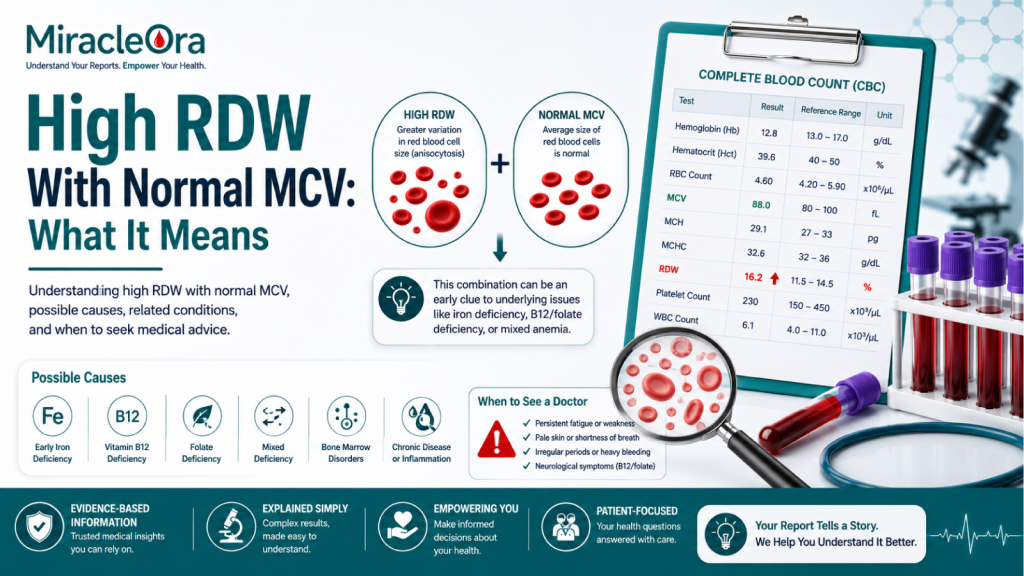
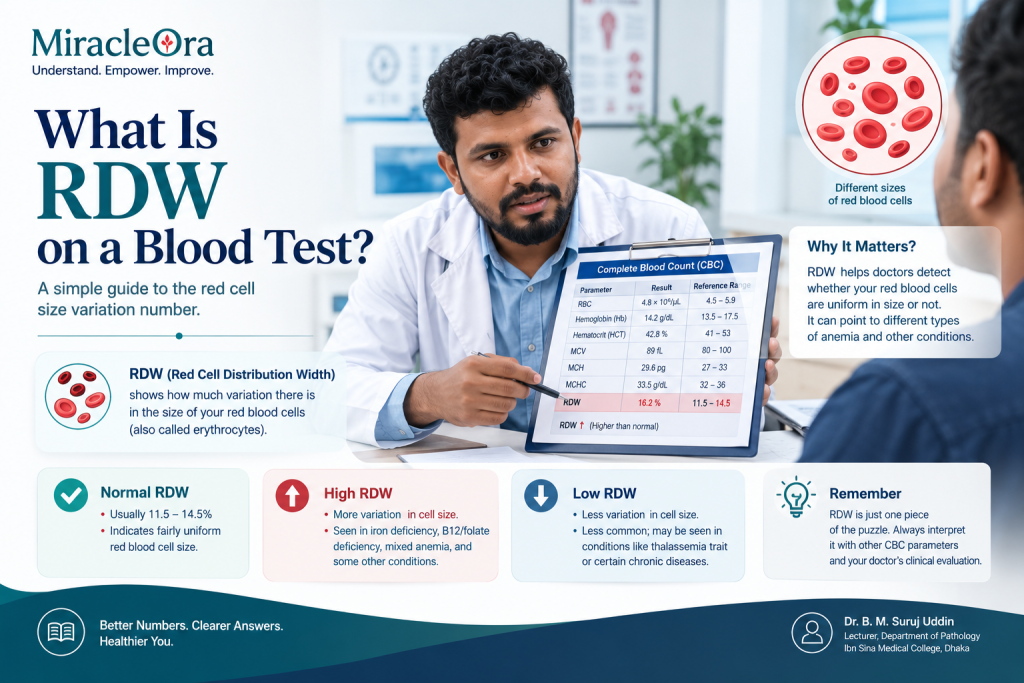
RDW, the spread of cell sizes, appears in the CDC report, which states that "a high RDW is generally set at greater than 14.0%," and adds that "the RDW value obtained depends on the instrument used." That is one more reason to read the lab's own range.
Hemoglobin has its own age curve, including the expected dip in early infancy. Our guide to anemia in children and how the ranges differ goes through it.
When a child's MCV is low for age
A low MCV means the red cells are smaller than expected for the child's age. The Irwin and Kirchner review states that "a low MCV and elevated red cell distribution width (RDW) suggest iron deficiency."
Clinicians sometimes use a simple ratio called the Mentzer index. The same review explains that it is calculated by dividing the MCV by the red cell count: "When the quotient is less than 13, thalassemia is more likely, and if the quotient is greater than 13, iron deficiency is more likely." A 2009 American Family Physician review on thalassemia describes the index as a tool for children in particular. It is a pointer used by clinicians, not a diagnosis, and it is not meant for parents to work out at home. Our guide to thalassemia trait vs iron deficiency explains why the difference matters.
The Irwin and Kirchner review adds that referral "is appropriate for cases in which the diagnosis is unclear and for treatment of the more severe types of anemia." Which tests come next is the pediatrician's call.
This page does not suggest giving a child iron or any other supplement based on an MCV result. Several causes of small red cells are not iron deficiency, and the cause is confirmed first.
Questions worth bringing to the pediatrician
- Was my child's result compared with an age-based range?
- Is the MCV out of range for my child's age, or only against an adult chart?
- Is hemoglobin also out of range, or just the index?
- How does this compare with any earlier counts?
- Are further tests planned, and what would each one tell us?
It also helps to mention diet, prematurity, any family history of anemia or thalassemia, and every medicine or supplement your child takes.
The honest limits of this page
A laboratory report should not create fear. It should create understanding. A child's red cells genuinely change size as they grow, and that alone explains many results that look odd against an adult chart. The values on this page are general reference points from named sources. What your own child's result means depends on their age, their lab's range, their history and their pediatrician's judgment.
Frequently asked questions
What is the MCV normal range for children?
It depends on age. A 2001 American Family Physician table, adapted from The Harriet Lane Handbook, lists 108 fL at birth, 78 fL from 6 months to 2 years, 81 fL from 2 to 6 years and 86 fL from 6 to 12 years. Your child's lab range is the one that applies.
Why is MCV high in newborns?
Newborns have large red cells. The CDC notes that MCV is highest at birth and decreases during the first 6 months of life before rising again through childhood.
Is an MCV of 78 low for a toddler?
Against an adult chart of 80 to 100 fL it looks low, but the American Family Physician table lists 78 fL for ages 6 months to 2 years. Only the age-based range on your child's report, read by the pediatrician, answers this for your child.
What does a low MCV in a child usually point to?
The American Family Physician review states that a low MCV with a high RDW suggests iron deficiency, while a Mentzer index below 13 makes thalassemia more likely. Further tests confirm the cause.
When does a child's MCV reach adult levels?
The CDC describes MCV rising gradually through childhood to adult levels. In the American Family Physician table, teenage values of 88 to 90 fL sit close to the adult figure of 90 fL.