The short answer: microcytic vs macrocytic anemia is a difference in red cell size, read from the MCV (mean corpuscular volume) line on a blood count. StatPearls, on the NIH's NCBI Bookshelf, describes a normal MCV as 80 to 100 fL, microcytic as below 80 fL and macrocytic as above 100 fL. Small cells most often point toward problems making hemoglobin, such as iron deficiency or thalassemia. Large cells point toward vitamin B12 or folate deficiency, liver disease or alcohol, among other causes. Normocytic anemia, the third family, sits in between. The family narrows the search. It does not name the cause, and reading it belongs to the clinician.
First: when anemia symptoms need care soon
The MedlinePlus Medical Encyclopedia entry on anemia (review date January 29, 2026, read on September 27, 2026) says to "Contact your provider if you have any symptoms of anemia or unusual bleeding." Among the symptoms it lists are feeling weak or tired more often than usual, headaches, lightheadedness when standing up, pale skin, and "Shortness of breath with mild activity or even at rest."
Fainting, chest pain, a racing heart, severe breathlessness, or bleeding that is heavy or will not stop are reasons for emergency care rather than a routine appointment. So is vomiting blood or passing black, tarry stools. This page cannot triage anyone. A clinician or emergency service can.
Why anemia is sorted by cell size at all
"Anemia" on its own tells a clinician that there is less hemoglobin than expected. It says nothing about why. There are many possible reasons, and testing for all of them at once would be slow and wasteful.
Cell size is a natural first sorting step because it is already on the report and costs nothing extra. It also reflects how the red cells were built. Small cells line up with causes that affect hemoglobin production, such as iron deficiency and the thalassemias. Large cells in the megaloblastic group reflect a problem with DNA synthesis as cells divide: the StatPearls chapter on Macrocytic Anemia (Killeen and Adil, last updated April 4, 2025, read on September 27, 2026) explains that without adequate DNA, red cell production becomes ineffective, "resulting in larger erythrogenic precursors with abnormal nuclei." Many other problems, including ones where cells are lost or destroyed, leave size in the normal range.
StatPearls' chapter on Mean Corpuscular Volume (Maner, Killeen and Moosavi, last updated July 27, 2024, read on September 27, 2026) sets out the three-way split, and the rest of this page follows it.
The three families at a glance
| Family | MCV, per StatPearls | What it usually reflects | Causes StatPearls names |
|---|---|---|---|
| Microcytic | Below 80 fL | A problem making hemoglobin | Iron deficiency anemia, thalassemias, sideroblastic anemia, anemia of chronic disease |
| Normocytic | 80 to 100 fL | Many different problems, often outside the building blocks | Early iron deficiency, early anemia of chronic disease, aplastic anemia, some hemolytic anemias, certain malaria infections |
| Macrocytic | Above 100 fL | Often a problem with DNA synthesis as cells divide | Vitamin B12 deficiency, folate deficiency, liver disease, chronic alcohol use, and rarer causes |
One caution before going further. The 80 and 100 fL figures are the ones StatPearls uses. Your own laboratory prints its own MCV interval, and it is that interval, not a textbook number, that decides whether your MCV is flagged. Where an MCV sits very close to either edge, a clinician reads it in context rather than as a hard switch.
Microcytic anemia: small cells
StatPearls names iron deficiency anemia, the thalassemias and sideroblastic anemia as common causes of microcytosis, along with anemia of chronic disease.
The two that come up most often in everyday reports are iron deficiency and thalassemia trait. Both produce small cells, and on a quick look they can resemble each other closely. They are handled very differently, which is why a clinician usually wants more information than the MCV alone before drawing any conclusion. How a CBC can point one way or the other is covered in thalassemia trait versus iron deficiency.
The practical question in this family is usually "is iron low, or is something else making the cells small?" Tests of iron status answer the first half of that question. Whether and which tests are ordered is the clinician's decision.
Macrocytic anemia: large cells
StatPearls divides macrocytic anemia into two groups:
- Megaloblastic, where DNA synthesis is impaired as cells divide. The MCV chapter lists folate deficiency and vitamin B12 deficiency here, along with a rare inherited condition, orotic aciduria.
- Non-megaloblastic, where the cells are large for other reasons. The Macrocytic Anemia chapter lists alcohol consumption, hereditary spherocytosis, hypothyroidism, liver disease and "marked reticulocytoses," among others.
That last item is easy to overlook, and it is not a deficiency at all. Young red cells, called reticulocytes, are larger than mature ones. The MCV chapter notes that the reticulocyte MCV "is typically elevated compared to mature RBCs." When the marrow is releasing many young cells, for example while recovering from blood loss, the average size can drift up.
The Macrocytic Anemia chapter lists initial studies including a peripheral blood smear, a reticulocyte count, serum vitamin B12, and, where liver or thyroid disease is suspected, liver enzymes and thyroid stimulating hormone. What vitamin B12 and folate results look like on a report is explained in vitamin B12 deficiency and your blood count.
Normocytic anemia: the family people forget
Normocytic anemia has normal-sized cells and is, in some ways, the hardest family to read, because the MCV offers no clue about direction.
The StatPearls chapter on Anemia (Regalla and Killeen, last updated July 5, 2026, read on September 27, 2026) lists causes including anemia of inflammation, anemia related to chronic kidney disease, aplastic anemia, pure red cell aplasia, multiple myeloma and related conditions, and mixed nutritional deficiencies. The MCV chapter adds that early iron deficiency and early anemia of chronic disease can both begin in the normocytic range, and that hemolytic anemias, where red cells are broken down faster than usual, can sit here too.
The word "early" matters. It means the family is a snapshot, not a fixed label. A person whose iron is steadily running low may show a normal MCV on one test and a low MCV on a later one.
Microcytic vs macrocytic anemia: when the average hides two problems
This is the point most classification pages leave out, and it is the most important one for anyone reading their own report.
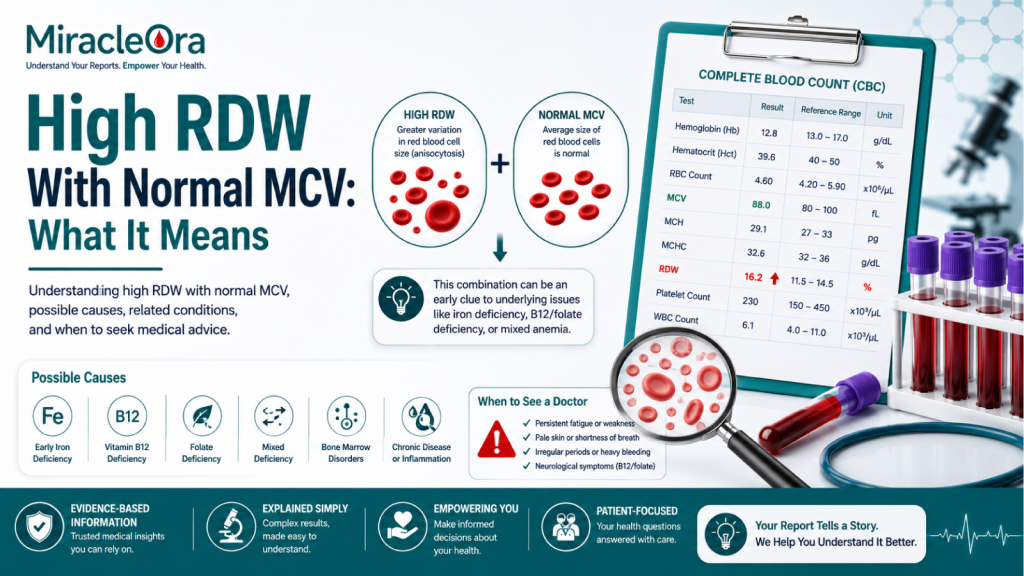
The MCV is an average. It describes the typical cell, not every cell. If a blood sample holds two populations at once, some small and some large, the average can land in the middle and look normal.
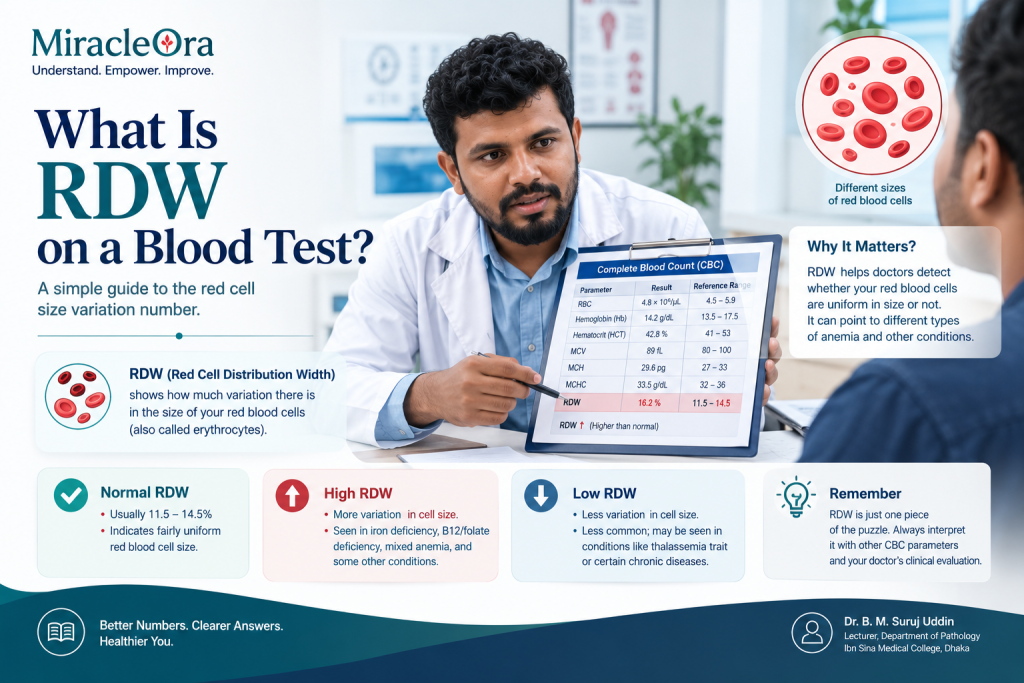
The StatPearls Anemia chapter says this directly: "iron and vitamin B12 deficiencies occurring together can result in a normal MCV." The same chapter adds that "Increased red cell distribution width (RDW) indicates the presence of different red blood cell populations."
In plain terms: a microcytic cause and a macrocytic cause can cancel each other out on the MCV line, while the RDW line, which reflects how much the cells vary in size, can give the mix away. That is the pattern described in high RDW with normal MCV, and it is why clinicians rarely read the MCV alone.
Two practical consequences follow:
- A normal MCV does not rule out a deficiency. It only says there is no single, dominant size shift.
- A family can appear to change over time. If one of two overlapping problems is corrected, the other may become visible, and the MCV can move in a direction that surprises the patient. That movement is information for the clinician, not proof that something new has gone wrong.
Where the reticulocyte count fits
In the normocytic family especially, the MCV cannot say whether the marrow is under-producing or whether cells are being lost or destroyed. The reticulocyte count helps with that question. The StatPearls Anemia chapter describes a calculation called the reticulocyte production index and states that "An RPI less than 2 generally suggests an inadequate marrow response, whereas an RPI greater than 3 supports an appropriate marrow response."
That is a clinician's tool, adjusted for the degree of anemia, and not something to calculate from a report at home. It is mentioned here because it explains why a reticulocyte count so often appears on the next set of results.
For a wider, less technical tour of anemia types, types of anemia, explained in plain language covers the ground without the size framework.
Making the appointment more useful
A few notes before the visit help the clinician place the result in its family and read it in context:
- Any past blood counts, so a change in MCV over time is visible
- Every medicine and supplement you take
- Diet, including whether you eat meat or other animal products
- Alcohol intake, described honestly
- Any heavy periods, digestive symptoms or known bleeding
- Any family history of thalassemia or other inherited blood conditions
This list is for describing what is happening. Decisions about testing and treatment belong to the clinician, and this page does not suggest any treatment or dose.
The honest limits of this page
A laboratory report should not create fear. It should create understanding. This page cannot tell you which family your result belongs to, what is causing it, or what should happen next. It can explain why cell size is the first sorting step, what StatPearls lists in each family, where the 80 and 100 fL figures come from, and why an ordinary-looking MCV can still hide two things at once.
Frequently asked questions
What is the difference between microcytic and macrocytic anemia?
It is a difference in red cell size. StatPearls describes microcytic as an MCV below 80 fL and macrocytic as above 100 fL. Small cells often reflect problems making hemoglobin, such as iron deficiency or thalassemia; large cells often reflect vitamin B12 or folate deficiency, liver disease or alcohol.
What is normocytic anemia?
Anemia with normal-sized red cells, an MCV of 80 to 100 fL in StatPearls' terms. Causes StatPearls lists include anemia of inflammation, chronic kidney disease, aplastic anemia, and early iron deficiency before cells have become small.
Can you have a normal MCV with a deficiency?
Yes. StatPearls states that iron and vitamin B12 deficiencies occurring together can result in a normal MCV, because the average hides two populations. A raised RDW can be the clue that different cell populations are present.
Is the MCV cutoff the same at every laboratory?
No. The 80 and 100 fL figures are textbook values from StatPearls. Each laboratory prints its own MCV interval, and the one on your report is the one that applies to your result.
Which is more serious, microcytic or macrocytic anemia?
Neither family is more serious by definition. Seriousness depends on the cause, how low the hemoglobin is, and how quickly it changed, which the clinician weighs. MedlinePlus advises contacting a provider for any symptoms of anemia or unusual bleeding.