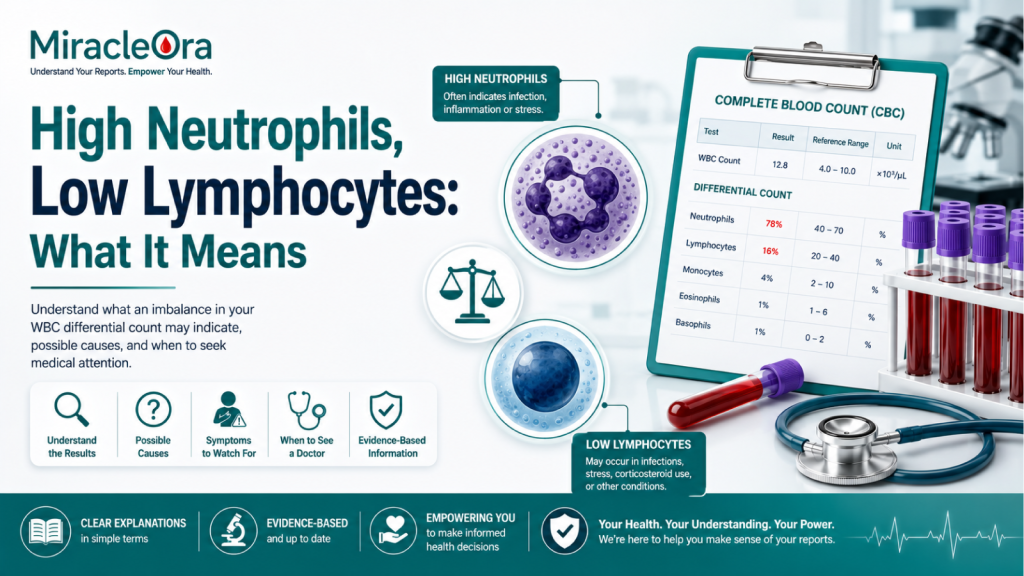
Neutrophils and lymphocytes are two types of white blood cell with different jobs. Neutrophils are the immune system's first responders, and they often rise during a bacterial infection or inflammation. Lymphocytes handle viral infections and build long-term immune memory. So on a blood count, high neutrophils with low lymphocytes commonly points toward a bacterial or inflammatory process rather than a typical viral one. That pattern is a general clue about the kind of immune response happening, not a diagnosis. Only a doctor can interpret your specific numbers alongside your symptoms and history. This article explains the two cells, what the balance can suggest, and why context decides everything.
What neutrophils and lymphocytes each do
Both are white blood cells, but they fight in different ways.
Neutrophils are the most abundant white blood cell in your body and your first line of defense against infection and injury. They travel quickly to a problem area and destroy bacteria, fungi, and foreign debris by engulfing them, a process called phagocytosis (Cleveland Clinic). They are short-lived, surviving only hours to a few days, which is part of why their numbers can swing quickly.
Lymphocytes are the specialists of your adaptive immune system. They come in two main types: B cells, which make antibodies to neutralize specific invaders, and T cells, which either help coordinate the response (helper T cells) or directly kill infected cells, often virus-infected ones (killer T cells) (MedlinePlus; Cleveland Clinic). Lymphocytes also form immune memory, so some can live for years. They usually make up about 20 to 40 percent of your white blood cells.
In short: neutrophils are the fast, broad, front-line crew. Lymphocytes are the precise, memory-keeping specialists. Your body dials each one up or down depending on the threat.
Typical ranges (yours will differ)
Reference ranges vary by laboratory, by age, and by sex, so always read the ranges printed on your own report rather than a chart online. As a general guide, sources such as the Cleveland Clinic report:
| White blood cell | General adult reference range (per microliter) | Main job |
|---|---|---|
| Neutrophils | About 1,450 to 7,500 | First responders; bacteria, fungi, debris |
| Lymphocytes | About 1,000 to 4,800 | Viral defense, antibodies, immune memory |
If your value sits a little outside these numbers, that does not automatically mean disease. It is one data point that a clinician reads together with everything else. For a walk through every line on the report, see our guide on how to read a full CBC report.
What "high neutrophils, low lymphocytes" commonly suggests
When neutrophils are raised (neutrophilia) and lymphocytes are reduced (lymphopenia) at the same time, the most common general explanation is an acute bacterial infection or an inflammatory condition (Cleveland Clinic). The body has surged its fast-acting crew.
This is where the familiar heuristic comes from:
- Neutrophil-predominant shift often accompanies bacterial infections and inflammation.
- Lymphocyte-predominant shift often accompanies viral infections.
The heuristic is genuinely useful, and doctors keep it in mind. But it is a starting point, not a conclusion. Plenty of real situations break the rule, which is the part most short explainers leave out.
The honest part: many everyday things move this balance
The neutrophil-to-lymphocyte balance is sensitive. Several ordinary, non-infectious factors can push neutrophils up, lymphocytes down, or both, and none of them mean you have a serious disease:
- Physical or emotional stress. Surgery, injury, a hard workout, or even a very stressful stretch can temporarily raise neutrophils.
- Corticosteroid medication. Steroids such as prednisone can raise neutrophils and lower lymphocytes at the same time, producing exactly this pattern without any infection.
- Smoking. Chronic smoking is associated with a higher neutrophil count.
- Severe or systemic illness. Serious infections and critical illness can drive lymphocytes down.
- Viral infections, including COVID-19. Some viral illnesses, notably COVID-19, are known to lower lymphocytes, which cuts against the simple "viral means high lymphocytes" rule.
This is the honest caveat the thin blogs skip. The same reading can come from a chest infection, a course of steroids, or a stressful week. That is why the number is a clue about the type of immune response, not a verdict about why it is happening.
The neutrophil-to-lymphocyte ratio (NLR), briefly
Some reports, or your doctor, may mention the neutrophil-to-lymphocyte ratio (NLR), which is simply neutrophils divided by lymphocytes. It is used as a rough marker of systemic inflammation and physiological stress. In generally healthy adults it is often reported to sit in the low single digits (commonly cited around 1 to 3), and a higher ratio tends to reflect more inflammation or stress on the body.
Two honest cautions: there is no single universally agreed cutoff, and the NLR is a general signal, not a diagnostic test. It rises and falls with many of the everyday factors listed above. Treat it as one more piece of context that a clinician weighs, not a score to interpret on your own.
Pattern to what a doctor may consider (educational only)
This table is a general educational map, not a way to diagnose yourself. The same pattern can have several explanations, and only a clinician who knows your history can decide which applies.
| Pattern on the differential | What it may broadly suggest | What a doctor also weighs |
|---|---|---|
| High neutrophils, low lymphocytes | Bacterial infection or inflammation; also stress, steroids, smoking | Symptoms, fever, exam findings, medications, how sudden the change was |
| High lymphocytes, lower neutrophils | A viral infection (with some exceptions like COVID-19) | Timeline of illness, other blood counts, exposure history |
| Both broadly normal | An immune system at rest | Whether symptoms are present despite normal counts |
| Persistently or markedly abnormal | Needs medical evaluation, not self-interpretation | Repeat testing, trend over time, full clinical picture |
The differential is one part of a bigger report. Other patterns, such as high RDW with a normal MCV or a falling platelet count, tell their own separate stories and are read together, not in isolation.
When to seek medical review
A white blood cell pattern is not something to interpret alone. See a healthcare professional, and seek prompt or urgent care if you have warning signs such as:
- A high or persistent fever, shaking chills, or feeling very unwell
- Shortness of breath, chest pain, or confusion
- Signs of a spreading infection, such as increasing redness, swelling, or pus
- Unexplained bruising, bleeding, or tiny red skin spots (petechiae), which relate to platelets rather than white cells but always warrant review. In dengue-prone areas this matters especially; see our note on platelet counts in dengue
- Any result your doctor has asked you to act on, or symptoms that worry you
If you are unsure, the safe move is always to ask the doctor or lab that ordered your test. Please also read our Medical Disclaimer: this article is general education, not personal medical advice, and it cannot interpret your own result.
FAQ
Does high neutrophils always mean a bacterial infection?
No. A raised neutrophil count often accompanies bacterial infection or inflammation, but stress, injury, surgery, smoking, and steroid medications can raise it too. It is a clue about the type of immune response, and a doctor confirms the cause using your symptoms and history.
What is a normal neutrophil-to-lymphocyte ratio (NLR)?
There is no single agreed cutoff, and it depends on the lab and the person. In generally healthy adults the NLR is often reported around 1 to 3, with higher values reflecting more inflammation or physiological stress. It is a general marker, not a diagnostic test, so read it in context with your doctor.
Can a virus cause low lymphocytes instead of high?
Yes. While many viral infections raise lymphocytes, some, notably COVID-19, are known to lower them. This is one reason the "bacterial versus viral" pattern is a helpful starting point rather than a firm rule.
Do neutrophils and lymphocytes have different normal ranges?
Yes. As a general guide, adult neutrophils run roughly 1,450 to 7,500 per microliter and lymphocytes roughly 1,000 to 4,800 per microliter (Cleveland Clinic), but your own lab's printed ranges are the ones that apply to you.
Should I worry if my numbers are slightly outside the range?
A value a little outside the reference range is common and often not a sign of disease. What matters is the whole picture: your symptoms, your history, and the trend over time. Discuss any result with the doctor or lab that ordered the test.
Sources: Cleveland Clinic (White Blood Cells; Neutrophils; Lymphocytes; Neutrophilia), U.S. National Library of Medicine MedlinePlus (Lymphocytes). Reference ranges are general examples and vary by laboratory. This content is for general education only and is not a substitute for professional medical advice, diagnosis, or treatment.