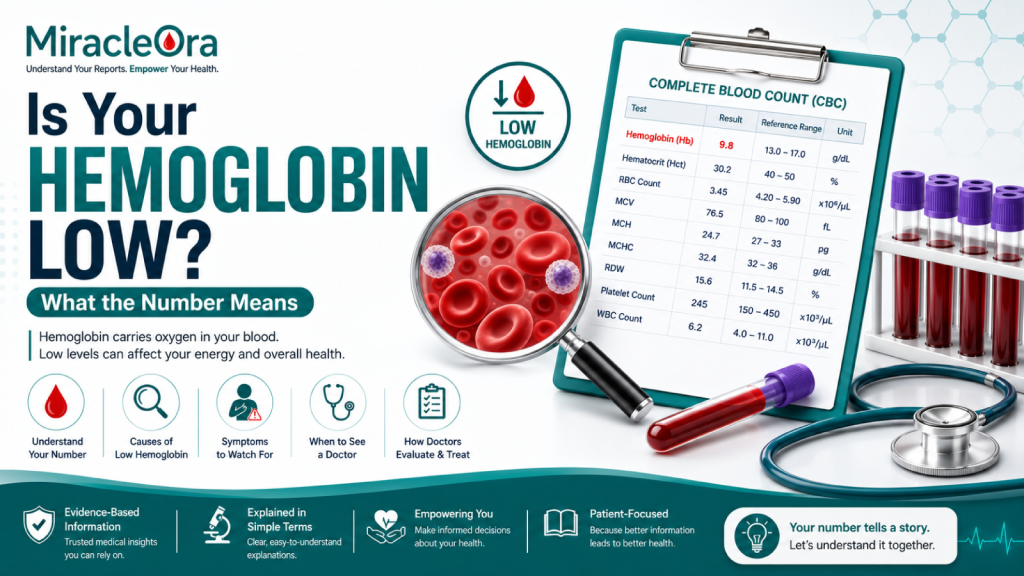
Anemia is not a single disease. It is one finding, a hemoglobin level below the expected range, that has many possible causes. Doctors sort those causes in two ways at once: by the size of your red blood cells (microcytic, normocytic or macrocytic, read from the MCV on your report) and by the mechanism (your body is making too few cells, losing them through bleeding, or destroying them too quickly). As reported by Cleveland Clinic, more than 400 types of anemia have been described, which is why every list you find online is a selection rather than a complete set. Knowing the two systems is more useful than memorizing names.
This is general health education, not medical advice. It cannot tell you which type of anemia you have. Only a doctor with your full results, history and examination can do that.
The first split: cell size
The most practical starting point is the MCV, or mean corpuscular volume, which is the average size of your red blood cells. As reported by NIH/NCBI StatPearls, the normal MCV range is generally 80 to 100 femtoliters (fL), although your own laboratory prints the range it uses.
That one number divides anemia into three families:
- Microcytic (MCV below the range): the cells are smaller than expected. Iron deficiency is the most common reason worldwide. Thalassemia traits and some chronic conditions also sit here.
- Normocytic (MCV inside the range): the cells are a normal size but there are not enough of them. Recent blood loss, anemia of chronic disease, kidney disease and some hemolytic anemias belong to this group.
- Macrocytic (MCV above the range): the cells are larger than expected. Vitamin B12 and folate deficiency are the classic causes, along with some medicines, thyroid disease, liver disease and alcohol use.
This is why your doctor looks at hemoglobin and MCV together rather than at hemoglobin alone. Our guide to reading a CBC report shows where both values appear on the page.
The second split: made, lost, or destroyed
The size classification tells you what the cells look like. The mechanism classification tells you what is happening to them, and it is the one that determines treatment.
Not enough are being made. The bone marrow is the factory. It can fall short because a raw material is missing (iron, vitamin B12, folate), because a hormone signal is reduced (the kidneys produce erythropoietin, which signals the marrow), because inflammation from a chronic illness suppresses production, or because the marrow itself is affected, as in aplastic anemia.
Too many are being lost. Bleeding removes whole red cells and the iron in them. It can be obvious, as with heavy menstrual periods, surgery or injury, or hidden and slow, as with bleeding in the digestive tract.
Too many are being destroyed. In hemolytic anemias red cells break down faster than they are replaced. This can be inherited, as in sickle cell disease and some enzyme or membrane disorders, or acquired, as in autoimmune hemolytic anemia where the immune system attacks the cells.
Every named type of anemia has a place in both systems. Iron deficiency anemia, for example, is microcytic by size and an underproduction problem by mechanism, often driven by loss. That is the map most articles leave out.
Find your row: reading MCV and RDW together
RDW, the red cell distribution width, describes how much your cell sizes vary. Read alongside MCV, it narrows the picture further. The table below is orientation, not diagnosis. It shows the direction doctors think in when they see a combination, and each row has exceptions.
| MCV | RDW | Families doctors commonly consider |
|---|---|---|
| Low (microcytic) | High | Iron deficiency is the classic pattern here |
| Low (microcytic) | Normal | Thalassemia trait and some chronic-disease anemias are considered |
| Normal (normocytic) | Normal | Recent blood loss, anemia of chronic disease, kidney-related anemia |
| Normal (normocytic) | High | An early or mixed deficiency picture is considered |
| High (macrocytic) | High | B12 or folate deficiency, and some hemolytic pictures |
| High (macrocytic) | Normal | Alcohol use, liver disease, thyroid disease and some medicines |
MCV reference range as reported by NIH/NCBI StatPearls; the groupings above reflect the standard morphologic approach used in clinical references such as StatPearls and Cleveland Clinic patient material.
Two cautions belong with that table. First, categories overlap, and the same person can shift between rows over time. Second, a pattern points toward a family of causes, not to a diagnosis. The confirmation comes from further tests, which is exactly why your doctor orders them. Our explainers on a high RDW with a normal MCV and low hemoglobin with a normal MCV cover two of the most confusing combinations in detail.
The types you will see named most often
- Iron deficiency anemia. The most common type worldwide. Caused by low intake, poor absorption, or blood loss. The pattern on a CBC is distinctive enough to be worth its own page: see iron deficiency anemia on a blood test.
- Vitamin B12 deficiency anemia and folate deficiency anemia. Both vitamins are needed to build red cells. Shortfalls produce large, immature cells, described as megaloblastic. Pernicious anemia is a specific cause of B12 deficiency in which the body cannot absorb the vitamin properly.
- Anemia of chronic disease (also called anemia of inflammation). Long-running inflammation, infection, kidney disease or cancer can suppress red cell production and lock iron away from the marrow. It is usually normocytic and can be mildly microcytic.
- Aplastic anemia. A rare condition in which the bone marrow does not produce enough of any blood cell type.
- Hemolytic anemias. A family in which red cells are destroyed prematurely, including autoimmune hemolytic anemia.
- Anemia of pregnancy. Blood volume expands during pregnancy, so hemoglobin readings normally fall somewhat, and iron demand rises. Pregnancy has its own reference thresholds rather than the general adult ones.
Inherited anemias and why they matter regionally
Some anemias are inherited rather than acquired. Sickle cell disease alters the shape of red cells and impedes blood flow. Thalassemias affect how much normal hemoglobin the body can build. Fanconi anemia is a rare inherited condition affecting the marrow.
Thalassemia trait deserves specific mention, because it is common across South Asia, the Mediterranean, the Middle East and parts of Africa and Southeast Asia, and it produces small red cells that look like iron deficiency on a quick reading. Someone with thalassemia trait may be given iron repeatedly with no benefit, since iron is not the problem. Distinguishing the two takes further testing, and that distinction is one of the more valuable things a careful review of a CBC can prompt.
Why no two lists of anemia types agree
If you compare five articles you will get five different lists, and this is not sloppiness. With more than 400 described types, as reported by Cleveland Clinic, any patient-facing list is an editorial choice about which handful matters most. Some authors group by cause, some by cell size, some by treatment. That is why the classification systems are more useful than the lists: once you know that anemia is sorted by size and by mechanism, any list you meet can be placed on the map.
When a mixed picture hides the type
Here is the honest limitation, and it is the reason a classification is a starting point rather than an answer.
If someone has iron deficiency (which shrinks cells) and B12 deficiency (which enlarges them) at the same time, the average cell size can land squarely in the normal range. The MCV then looks unremarkable while two things are wrong. The usual clue is a raised RDW, which reveals that the cells vary widely in size even though their average is normal.
Similar blurring happens when a chronic illness sits on top of iron deficiency, after a recent transfusion, or when a deficiency is early and only partly established. This is why doctors do not stop at the MCV, and why they follow up with tests such as ferritin, iron studies, B12, folate, a reticulocyte count and a blood film. It is also why comparing your own numbers to a table online cannot substitute for the workup. Our Cluster 2 pillar on what a low hemoglobin number really means covers how the number itself is interpreted.
When to see a doctor
Any anemia found on a report deserves a conversation, because the type determines what happens next and the causes are managed in completely different ways. Book an appointment if your report shows a low hemoglobin, if you have ongoing tiredness, breathlessness on exertion, dizziness, pale skin or a fast heartbeat, if you have heavy menstrual periods, or if you have a family background in which thalassemia or sickle cell traits are common.
Seek urgent or emergency care for chest pain, severe or sudden breathlessness, fainting or near-fainting, an irregular or very fast heartbeat, or visible signs of significant bleeding such as vomiting blood or black, tarry stools. As reported by Cleveland Clinic and Mayo Clinic patient resources, these can indicate a rapid drop in hemoglobin or a serious underlying cause and are assessed without delay.
Frequently asked questions
What is the most common type of anemia?
Iron deficiency anemia. It is the most common cause worldwide and typically produces small (microcytic) red cells with a raised RDW. It is still confirmed with iron studies rather than assumed from the CBC alone.
How do doctors decide which type of anemia someone has?
They read hemoglobin with the MCV and RDW to establish the family, then order targeted tests. Ferritin and iron studies, B12 and folate, a reticulocyte count, kidney and thyroid tests, and a blood film are the common next steps, chosen according to which family the pattern suggests.
Can you have more than one type of anemia at once?
Yes, and it is not rare. Combined deficiencies can push the MCV toward normal from both directions, which can make the picture look milder than it is. A raised RDW is often the clue that something mixed is going on.
Is anemia a diagnosis?
No. Anemia describes a state, that the blood’s oxygen-carrying capacity is below the expected range. The diagnosis is whatever is causing it. That is why “you are anemic” is the beginning of a workup rather than the end of one.
Does the type of anemia change how it is treated?
Entirely. Iron helps iron deficiency and does nothing for B12 deficiency or thalassemia trait. Treating the wrong mechanism wastes time and can hide the real cause. This is why identifying the type comes before any treatment, and why supplements should not be started on your own.
Medical disclaimer: This content is for general education only and is not a substitute for professional medical advice, diagnosis, or treatment. It cannot tell you which type of anemia you have or what to take for it. Always talk to a qualified healthcare provider about your own results, and seek urgent care for the emergency features described above. See our full Medical Disclaimer.