Hematocrit is the proportion of your blood volume made up of red blood cells, reported as a percentage. If your hematocrit is 42%, then 42% of your blood by volume is red cells and the rest is mostly plasma.
That word “proportion” is the whole key to reading it, and it is why hematocrit can move without anything happening to your red cells at all.
This is general health education, not medical advice. It cannot tell you what your own result means, and it is not a reason to start or stop anything. That conversation belongs with your doctor.
The Commonly Cited Ranges, and Why They Are Not Yours
Reference intervals commonly used for adults, as given in StatPearls on the NCBI Bookshelf:
| Hematocrit | Hemoglobin | |
|---|---|---|
| Adult men | 40% to 54% | 13 to 18 g/dL |
| Adult women, not pregnant | 36% to 48% | 12 to 16 g/dL |
| Pregnancy | lower limit usually decreased to 10 g/dL |
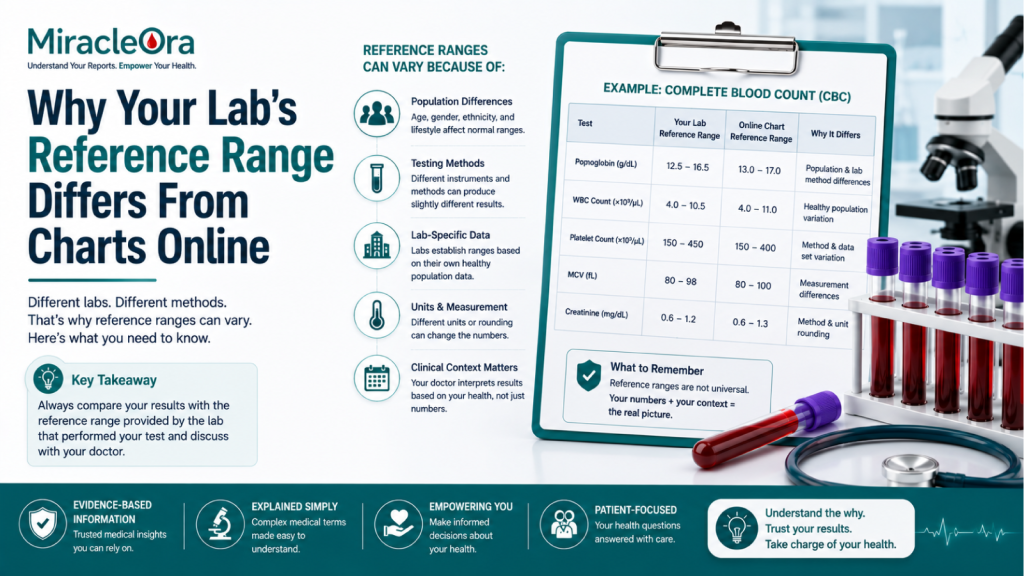
Now the important part, which comes from the same source. It states plainly that “though commonly utilized reference intervals are provided, all are lab-specific in practice,” and that “the local laboratory guidelines apply when interpreting a CBC.”
So the range printed on your own report outranks the table above. Your laboratory sets its own interval, based on the instruments it runs and the population it serves, and the international standards body for clinical labs recommends exactly that. This is why the same blood can be flagged at one lab and not at another, which is the subject of why lab reference ranges differ and getting different results from two labs.
Read your number against your report’s range, not against anything you find online. Including this page.
Why Dehydration Raises It Without Adding Red Cells
This is the single most useful thing to understand about hematocrit, and it follows directly from it being a proportion.
Hematocrit is red cells as a share of total blood volume. There are two ways to raise a share: increase the top number, or decrease the bottom one.
Dehydration decreases the bottom one. You lose plasma volume, the red cells stay where they are, and the proportion goes up. Your hematocrit reads higher and you have not gained a single red blood cell.
The reverse is also true. Anything that expands plasma volume dilutes the same red cells into more fluid and the proportion falls, which is why a low reading does not always mean fewer red cells.
This is why the circumstances of the blood draw matter, and it is covered more fully in how dehydration affects blood test results. The related question of whether the time of day or recent exercise changed your number is in time of day and blood test results and exercise before a blood test.
Hematocrit and Hemoglobin Travel Together
You will almost always see both on the same report, and they usually move in the same direction, because they are two ways of measuring closely related things: hemoglobin measures the oxygen-carrying protein, hematocrit measures the space the cells occupy.
When one is flagged and the other is not, that is worth a question rather than an alarm. It can happen for ordinary reasons including where the value sits relative to its own range, and it is one of the things a doctor reads in context rather than in isolation. If yours is the hemoglobin side, why hemoglobin runs low covers the mechanisms.
What Moves It, Broadly
Not a diagnostic list. These are categories, and the point is that the same reading has several possible explanations.
Things that can raise the proportion: loss of plasma volume including dehydration, living at high altitude over time, and conditions or medications that increase red cell production.
Things that can lower it: blood loss, reduced red cell production, red cells being destroyed faster than replaced, and dilution from expanded plasma volume, which is why pregnancy has its own reference expectations. Pregnancy values are covered in CBC in pregnancy, and children have different expectations again in CBC normal range for children.
Which of those applies to you is not something a number can answer, and it is not something this page can narrow down.
A Result Just Outside the Range
Two things worth knowing, and neither is reassurance or alarm.
A reference interval is a statistical range, not a boundary between healthy and ill. It is built to contain most results from a reference population, which means some healthy people sit outside it and some unwell people sit inside it.
A single value is one point. What a clinician does with a borderline result usually involves looking at the rest of the panel, at your history, and at whether the number has moved compared with previous tests. The source cited above emphasizes that an examination of a peripheral blood smear is essential in assessing any abnormal CBC result, which is a reminder that the automated number is the beginning of the assessment rather than the end of it. That test is explained in what a peripheral blood smear means.
If your report has flagged the value with a letter, what H means on a blood test explains the notation. And if you feel entirely well with a flagged result, that combination is common enough to have its own page: an abnormal blood test when you feel fine.
What To Do With Your Result
Take it to the person who ordered it. A result exists in the context of why the test was requested, and that context is the largest part of what it means.
Bring previous results if you have them. A direction of travel is more informative than a single point, and you are the only person guaranteed to have your own history in one place.
Do not start supplements on the strength of a number. Iron in particular is not harmless, and taking it without knowing why a value moved can both cause harm and obscure the reason.
Note the circumstances of the draw if anything was unusual: an illness that week, a long flight, unusual heat, a heavy training session, or simply having had very little to drink. Those are facts your doctor cannot get anywhere except from you.
The Short Version
- Hematocrit is a proportion of blood volume, not a count.
- Commonly cited adult intervals are about 40 to 54% for men and 36 to 48% for women, but the source giving those figures states that all such intervals are lab-specific in practice.
- Your own report’s range is the one that applies.
- Dehydration raises hematocrit without adding red cells, because it removes plasma from the bottom of the fraction.
- Hemoglobin and hematocrit usually move together. A split between them is a question, not a diagnosis.
- A value just outside a range is not a verdict. Reference intervals are statistical, and a clinician reads the whole panel.