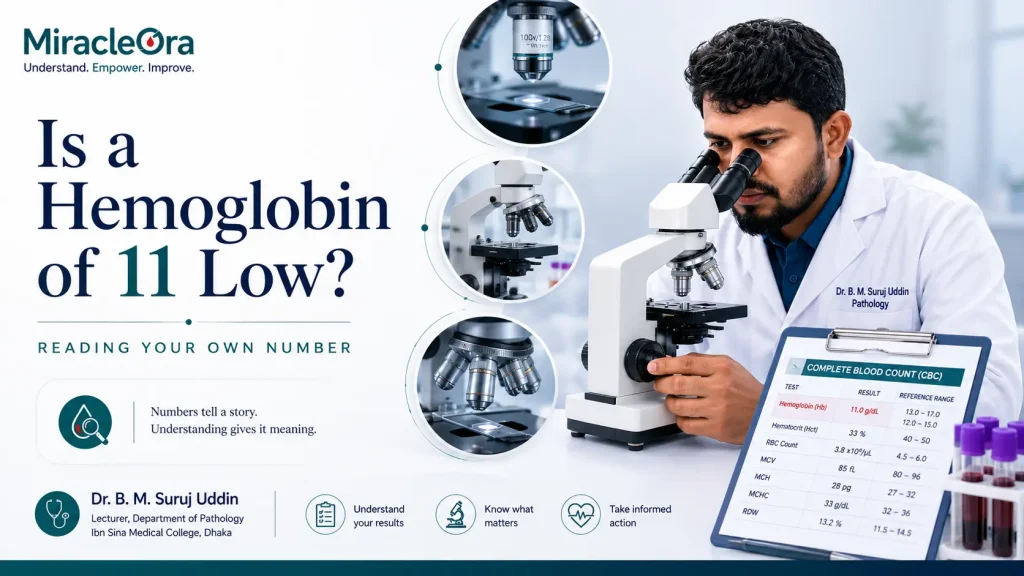
A hemoglobin of 11 g/dL is below the cutoff the World Health Organization uses to define anemia in adults, which is 12.0 g/dL for non-pregnant women and 13.0 g/dL for men. It is exactly at the WHO cutoff for the first and third trimesters of pregnancy, 11.0 g/dL. It is above the WHO cutoffs for children under 5. So 11 is not one answer. It is a different answer depending on who is holding the report, and what it means for you is a question for the clinician who ordered the test.
This is general health education, not medical advice. It cannot tell you what your own result means, and it is not a reason to start or stop anything.
Is 11 Low for You? Where the Number Falls, Group by Group
The World Health Organization published new hemoglobin cutoffs in 2024, its first major revision of these thresholds since 1968. WHO states them in grams per liter, so 110 g/L is the same value as 11 g/dL.
| Group | WHO 2024 cutoff for anemia | Where exactly 11.0 g/dL sits |
|---|---|---|
| Men, 15 years and older | below 13.0 g/dL | below the cutoff |
| Non-pregnant women, 15 years and older | below 12.0 g/dL | below the cutoff |
| Pregnant, first trimester | below 11.0 g/dL | at the cutoff, not below it |
| Pregnant, second trimester | below 10.5 g/dL | above the cutoff |
| Pregnant, third trimester | below 11.0 g/dL | at the cutoff, not below it |
| Children 12 to 14 years | below 12.0 g/dL | below the cutoff |
| Children 5 to 11 years | below 11.5 g/dL | below the cutoff |
| Children 24 to 59 months | below 11.0 g/dL | at the cutoff, not below it |
| Children 6 to 23 months | below 10.5 g/dL | above the cutoff |
Source: World Health Organization, Guideline on haemoglobin cutoffs to define anaemia in individuals and populations (2024).
WHO also recommends adjusting hemoglobin for the elevation someone lives at and for smoking, and recommends no adjustment for inflammation, infection, or ancestry. Those adjustments are part of applying the cutoff correctly, and they are one more reason a bare number is hard to place.
The Number Does Not Settle It, and Here Is Who Does
The result belongs with the person who ordered the test. That is not a formality. MedlinePlus, the patient service of the US National Library of Medicine, puts it plainly: "Talk with your provider if you have questions about your results." Cleveland Clinic's guidance on low hemoglobin is that if you have a condition that affects your hemoglobin level, you should call your provider any time your symptoms worsen.
What the clinician has that a chart does not: the reason the test was ordered, your previous results, your history and examination, the rest of the panel, and the ability to order the next test. A hemoglobin value is one input into that, not a verdict that arrives ahead of it. Our companion page on what a low hemoglobin actually means covers the concept in more depth, and it reaches the same place: the cause matters more than the number.
Your Report's Own Range Outranks Every Chart, Including This One
Published "normal" figures do not agree with each other, and that is not a mistake anyone is making. MedlinePlus states that the normal range "may vary, based on the laboratory used and your age, race, and sex." Look at three respected sources side by side:
- Cleveland Clinic, on low hemoglobin: about 14.0 to 17.5 g/dL for men, 12.3 to 15.3 g/dL for women.
- Clinical Methods (NCBI Bookshelf): 14 to 18 g/dL for men, 12 to 16 g/dL for women.
- WHO 2024: a single anemia cutoff, 13.0 g/dL for men and 12.0 g/dL for non-pregnant women.
Those are three different objects. Two are two-ended reference ranges from different populations and methods, and one is a one-ended threshold for defining anemia in populations and individuals. Your laboratory prints its own interval next to your result, built on its own instruments and the population it serves, and that is the interval your 11 was flagged against. Why those intervals differ between labs is the subject of why your lab's reference range differs from charts online.
"How Far Below" Is a Fair Question, and the Answer Is Statistical
A reference interval is not a wall between well and unwell. A 2024 review of reference intervals in clinical chemistry describes them as "a selection of a set of results, usually the middle 95%, measured on a well-defined reference population," which means "5% of this disease-free population falls outside of the RI, with 2.5% above the upper reference limit and 2.5% below the lower reference limit."
Two things follow, and neither one is comfort and neither one is alarm. Being outside a range is not rare among people who are well. Being inside one is not proof that nothing is happening. That is why a clinician reads the distance from the limit, the direction of travel across previous tests, the rest of the count, and you, rather than the pass or fail flag alone. If your report marked the value with a letter, what H and L mean on a blood test explains the notation.
An 11 Today Is One Measurement, Not a Trend
Hemoglobin is a concentration, so it moves with the amount of fluid it is dissolved in. Clinical Methods states it directly: "If a patient is severely dehydrated, the hemoglobin and hematocrit will appear higher than if the patient were normovolemic; if the patient is fluid overloaded, they will be lower than their actual level." Nothing has to happen to your red cells for the printed number to shift.
The same review of reference intervals notes that repeat results tend to show regression to the mean: "if a single result is unusually large or small, it tends to be followed by a repeat measurement that is closer to the mean." This is one of the reasons a clinician may repeat a test rather than act on a single value. It is also why old reports are worth bringing to the appointment, since you are usually the only person who has your history in one place. The circumstances of the draw matter too, which is covered in how dehydration affects blood test results.
What an 11 Cannot Tell You: the Reason
The number describes a state. It does not name a cause. The National Heart, Lung, and Blood Institute describes anemia as a condition that develops when blood produces a lower than normal amount of healthy red blood cells, and notes it "may also be a sign of a more serious condition, such as bleeding in your stomach, inflammation from an infection, kidney disease, cancer, or autoimmune diseases." Those are investigated in completely different ways, which is the whole reason the workup exists.
This is also why a hemoglobin value is read next to the other red cell numbers rather than on its own. The average size of the red cells (MCV) and the variation in their size (RDW) change the shape of the question, and a low hemoglobin with normal sized cells leads somewhere different from a low hemoglobin with small ones. That specific combination has its own page: low hemoglobin with a normal MCV.
On supplements, one sourced caution is worth more than any encouragement: the NHS notes that iron tablets should be kept out of the reach of children, because an overdose of iron in a young child can be fatal. Which supplement, if any, belongs in your case is a clinical decision.
Symptoms Named by Named Sources
The NHLBI lists the symptoms that a shortage of oxygen carrying capacity can cause: feeling tired or weak, shortness of breath, dizziness, headaches, or an irregular heartbeat. Symptoms depend on more than the number, including how quickly it changed and what caused it, and two people with the same 11 can feel entirely different.
The NHS advice for people who think they might have iron deficiency anemia is simply to see a doctor. Cleveland Clinic's line is to call any time symptoms worsen. Neither this page nor any page can tell you which of your symptoms is urgent, and that judgment is exactly what clinicians and emergency services are for.
Frequently Asked Questions
Is a hemoglobin of 11 considered anemia?
Against the WHO 2024 cutoffs, 11.0 g/dL is below the adult thresholds of 12.0 g/dL for non-pregnant women and 13.0 g/dL for men, so it would meet the WHO definition of anemia for those groups. It is not below the WHO cutoff for the first or third trimester of pregnancy, which is 11.0 g/dL, nor for children under 5. Your own lab's reference interval and your clinician's reading of the whole report are what apply to you.
Is 11 g/dL the same as 110?
Yes. WHO and many countries report hemoglobin in grams per liter, where 110 g/L equals 11 g/dL. Some reports use different units again, so it is worth checking the unit printed next to your own number before comparing it with anything.
Is a hemoglobin of 11 low in pregnancy?
The American College of Obstetricians and Gynecologists, in Practice Bulletin 233 (2021), defines anemia in pregnancy as hemoglobin below 11 g/dL in the first trimester, below 10.5 g/dL in the second, and below 11 g/dL in the third. WHO's 2024 cutoffs use the same values. A pregnancy result belongs with the obstetric team that is following the pregnancy.
Why does my report say 11 is low when a chart online says it is normal?
Because the chart and your report are not measuring against the same population. MedlinePlus states that the normal range varies with the laboratory used and with age, race and sex, and laboratories set their own intervals from their own instruments and populations. The interval printed beside your result is the one that flagged it.
Does a hemoglobin of 11 need to be repeated?
Whether to repeat a test, and when, is a clinical decision. Published work on reference intervals notes that an unusually high or low single result tends to be followed by one closer to the average, which is one reason clinicians sometimes look at a second sample or at earlier reports before acting.
Medical disclaimer: This content is for general education only and is not a substitute for professional medical advice, diagnosis, or treatment. It cannot interpret your individual results. Talk to a qualified healthcare provider about your own hemoglobin level and your symptoms. See our full Medical Disclaimer.