The objection is completely reasonable. Anaemia gets explained as not having enough blood, so a reader who has not lost any concludes there has been a mistake.
The step that is missing from that reasoning is this. Hemoglobin is a balance between three things: how much is being made, how fast it is being destroyed, and how much is being lost. Bleeding affects only the third. A problem with either of the first two produces exactly the same result on the report, with nothing to see.
The three routes, plainly
Production. The bone marrow makes red cells continuously, and that process needs raw materials and a working factory. If either is short, fewer cells are produced. Nothing is lost anywhere; less is arriving.
Destruction. Red cells have a limited lifespan and are removed and replaced constantly. If they are being removed faster than usual, the count falls even though production is normal and nothing has left the body.
Loss. Blood leaving the circulation. This is the one people think of, and it is also the one that can be invisible, which is the next section.
Almost every cause on any authoritative list belongs to one of those three, and knowing which one applies is the entire content of the investigation that follows a low result.
What the named sources list
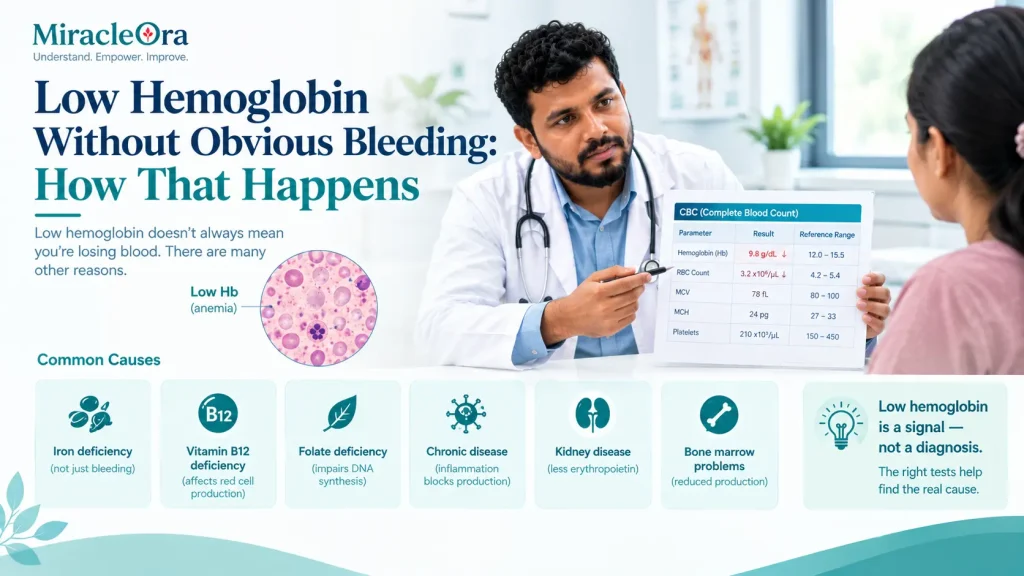
The World Health Organization's fact sheet "Anaemia", dated 10 February 2025, states: "Anaemia may be caused by several factors: nutrient deficiencies, inadequate diet (or the inadequate absorption of nutrients), infections, inflammation, chronic diseases, gynaecological and obstetric conditions, and inherited red blood cell disorders."
Notice how much of that list is not bleeding. Nutrient deficiencies and absorption problems are production. Inherited red cell disorders can be either production or destruction depending on the condition. Infections, inflammation and chronic diseases are their own mechanism.
MedlinePlus's Medical Encyclopedia entry "Anemia" (review/update 29 January 2026) lists iron deficiency, vitamin B12 deficiency, folate deficiency, certain medicines, destruction of red blood cells, chronic diseases, inherited forms, pregnancy, bone marrow problems and blood loss.
MedlinePlus's "Anemia" health topic page adds the same picture in different words, listing among the causes "A diet that does not have enough iron, folic acid or vitamin B12", "Inherited disorders", "Blood disorders such as sickle cell anemia and thalassemia, or cancer", "Aplastic anemia, a condition that can be inherited or acquired", and "G6PD deficiency, a metabolic disorder".
Blood loss appears once on each list, among many others. That is the answer to the question in the title, and everything else on this page is the detail behind it.
Bleeding that does not look like bleeding
Before ruling loss out, it is worth knowing what forms it takes, because two of them are routinely missed.
Slow loss from the digestive tract can be small enough per day that it produces no visible change and still add up substantially over months. It is not something a person can rule out by observation, which is why it is investigated rather than assumed absent.
Heavy menstrual bleeding is very frequently not counted as blood loss by the person experiencing it, because it is normal for them and they have nothing to compare it to. WHO's list names "gynaecological and obstetric conditions" as a cause category for exactly this reason.
The practical version: "I am not bleeding" is a reasonable belief and it is not a finding. It is worth saying to the clinician as an observation rather than as a conclusion.
The pregnancy exception
Pregnancy appears on MedlinePlus's cause list, and it is a genuinely different mechanism from the other three.
In pregnancy the volume of plasma rises more than red cell mass does, so hemoglobin, being a concentration, reads lower while the total amount in circulation has increased. Nothing was lost and nothing failed. The measurement is being taken in a larger volume.
That is the cleanest available illustration of the general point on this page: a falling number is not the same thing as a losing process.
Why the rest of the report matters more than the hemoglobin
A single low hemoglobin says something is off. It does not say which of the three routes is involved. The lines that begin to separate them are already printed on the same report.
Cell size is the first split, because deficiency states and inherited conditions tend to produce cells at different ends of the size range. The spread of cell sizes adds a second dimension. The other cell lines matter too: a low hemoglobin with normal white cells and platelets is a different picture from one where all three are low, and that distinction is often the most informative thing on the page.
The types of anemia covers how that classification works, and how to read a CBC report covers finding the relevant lines. If your result is flagged, why your lab's reference range is different is worth reading before comparing your figure to anything you found elsewhere.
The tests that usually follow
If iron is the question, a hemoglobin value on its own does not answer it, which is why a clinician will usually look at iron stores rather than at the hemoglobin alone. Ferritin covers the measurement most commonly used and the reasons it needs context, and iron deficiency anemia on a blood test covers the pattern as a whole.
If the picture points at production for another reason, the vitamins involved in making red cells are the usual next tests. If it points at destruction, different tests apply again.
None of that is something to arrange yourself. It is listed here so that a sequence of appointments makes sense rather than feeling like the system is casting around.
What this page will not do
No supplement, no dose, no diet, no target level.
The reason follows directly from everything above. Three different mechanisms produce the same low number, and a response aimed at one does nothing for the other two. A reader who addresses intake when the problem is absorption, or destruction, or slow loss, may reasonably believe they have handled something they have not, and the delay is the harm.
Establishing which mechanism applies is the job of the clinician who ordered the test. Why your hemoglobin might be low covers the same ground from the other direction and reaches the same conclusion.
The short version
- Hemoglobin is a balance of production, destruction and loss. Bleeding is one of the three.
- WHO (10 February 2025) and MedlinePlus (29 January 2026) both list many causes, most of which are not bleeding.
- Slow digestive loss and heavy periods are the two forms of bleeding most often not counted as bleeding.
- Pregnancy lowers the concentration by dilution. Nothing is lost.
- The other lines on the same report begin to separate the mechanisms.
- No dose or supplement here. Which mechanism applies decides everything, and that is a clinician's determination.