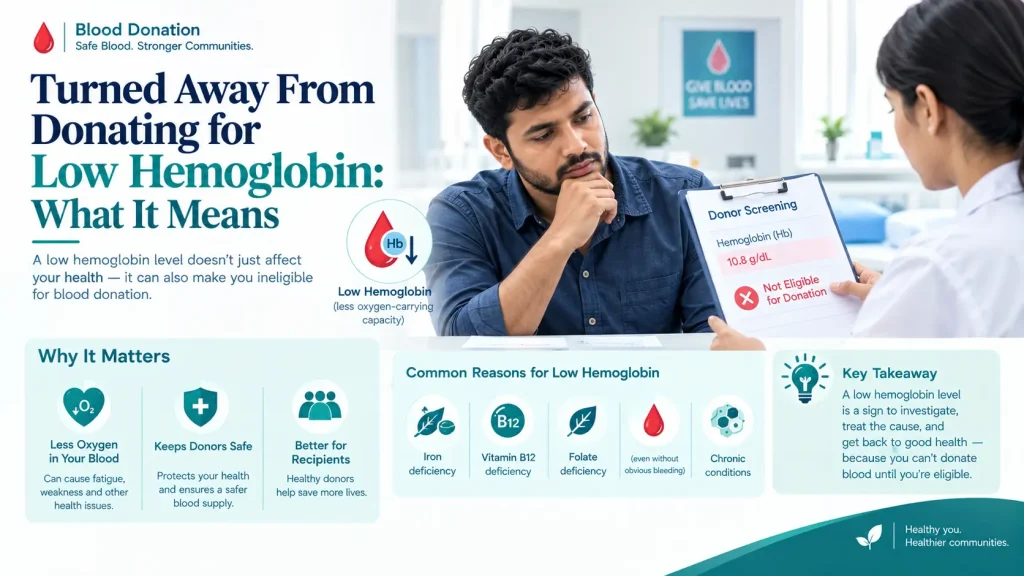
You turned up to give blood, they pricked your finger, and they sent you home. It takes about four minutes and it feels like being told something is wrong with you in a queue.
Here is the most useful reframing, and it holds regardless of which organisation collected the sample. A donation screening test asks whether it is safe for you to give blood today. It does not ask whether you are healthy, and the threshold it uses was not set to answer that question.
Two different tests, doing two different jobs
The screening at a donation session and a hemoglobin measurement in a clinical laboratory are not the same measurement used twice.
The donation test is a screen with a safety margin built in. Its purpose is to protect the donor. Giving blood removes red cells, so a threshold is set at a level that leaves a margin for the person walking out afterwards. A threshold designed to keep people safe on the day is, by design, more conservative than a threshold designed to identify disease.
A clinical hemoglobin is a diagnostic measurement. It is read against a reference interval derived from a healthy population, and it is interpreted alongside the rest of a blood count.
Those two thresholds are set by different people for different reasons, so a result can fall below the first and sit comfortably inside the second. That is the single most common explanation for a deferral in someone with no problem at all.
Being deferred is therefore not the same thing as being anaemic, and it is also not proof that you are not.
The threshold this page does not publish
We tried to read the American Red Cross page on iron and blood donation on 2026-08-28 so that any figure quoted here would come from the organisation itself. That request returned an HTTP 403 to our fetcher and we did not obtain the page.
That is our retrieval failing, and it is worth saying rather than filling the gap. The information is public; we did not reach it from this session.
There is a second reason no number appears even setting that aside. Donation thresholds differ between collecting organisations and between countries, and they can differ by donor sex. A figure lifted from one organisation and applied to a deferral at another is a comparison between two rules that were never the same rule.
If you want the threshold that applied to you, it belongs to the organisation that deferred you, and their own eligibility page or their staff will tell you. That is a better source than this page could be.
Why the finger-prick result can differ from a lab result
People are often deferred and then get a normal hemoglobin from their doctor a week later. This is common and it does not mean either measurement was wrong.
A capillary sample is not a venous sample. Blood from a finger prick and blood from a vein are drawn from different places and can give slightly different values.
Technique affects it. How the finger is prepared, whether the drop is squeezed, and which drop is used all influence a capillary reading.
Hydration moves the number. Hemoglobin is a concentration. Being dehydrated concentrates it upward and being well hydrated dilutes it downward, without anything having changed about your red cells.
Different devices and methods report differently. Two instruments measuring the same person can disagree slightly, which is a general property of laboratory measurement rather than a fault. This site covers that in why two labs gave different results, and the closely related question of why intervals themselves differ in why your lab's reference range is different.
The same concentration effect explains why hemoglobin and hematocrit move together when what changed was fluid rather than cells.
What a deferral is actually worth knowing
Not nothing. That is the other half of the point.
A donation screen is a real hemoglobin measurement, and a low one is a genuine observation even if the threshold it failed was conservative. What it deserves is follow-up rather than either dismissal or alarm.
The reasonable response is to have it checked properly, as part of a full blood count, by someone who can read it alongside everything else. That is a routine appointment, not an urgent one, unless you are unwell in some other way, in which case the reason to go is the way you feel rather than the deferral.
If your result comes back near a boundary, is a hemoglobin of 11 low covers how borderline values are read and why the answer depends on who you are and which interval applies.
The failure mode this page exists to prevent
There is an obvious wrong ending to this article, and it is the one most search results supply: take an iron supplement and come back in a few weeks.
This page does not say that, and the reason is worth stating.
A low hemoglobin has many possible causes. WHO's fact sheet "Anaemia" (10 February 2025) lists "nutrient deficiencies, inadequate diet (or the inadequate absorption of nutrients), infections, inflammation, chronic diseases, gynaecological and obstetric conditions, and inherited red blood cell disorders." MedlinePlus's "Anemia" entry (review/update 29 January 2026) lists iron deficiency, B12 deficiency, folate deficiency, certain medicines, destruction of red blood cells, chronic diseases, inherited forms, pregnancy, bone marrow problems and blood loss.
Iron is one item on those lists. Taking iron because a donation screen was low, without knowing which item applies, does two things: it may address nothing, and it may mask a finding that would otherwise have prompted an investigation. MedlinePlus is direct that taking more iron than the body needs can cause serious medical problems, and this site's ferritin and why your hemoglobin might be low pages both set the same line.
Whether iron is relevant to you, and whether anything is needed, is a determination made from a full blood count and iron studies by a clinician. It is not a determination made from a finger prick at a donation session.
What to do next
- Ask the collection organisation what their threshold is and what value you had. They are the correct source for both.
- Get a proper blood count through your own doctor, at ordinary speed.
- Mention the deferral, and mention anything else that might be relevant, including heavy periods, which are very commonly not reported because they seem normal to the person having them.
- Do not start a supplement on the basis of a screening result.
- Do not conclude you are ill. A conservative safety threshold did what it was designed to do.
The short version
- A donation screen asks whether it is safe to donate today. It is not a diagnostic threshold.
- No figure appears here. Our fetch of the Red Cross page returned a 403, and thresholds differ by organisation and country anyway.
- Finger-prick and venous samples can differ, and hydration moves the number.
- A deferral is a real observation worth following up at ordinary speed.
- It is not a reason to start iron. Which of many causes applies is what determines the response.