Two people arrive with the same low hemoglobin. On both reports the red cells are on the small side, and the numbers look similar enough that nothing on the blood count separates them.
One of them is short of iron. The other has plenty of iron and cannot get at it. Those are opposite situations that produce a similar-looking report, and telling them apart is one of the more consequential distinctions in this whole subject, because the responses differ.
The two mechanisms, side by side
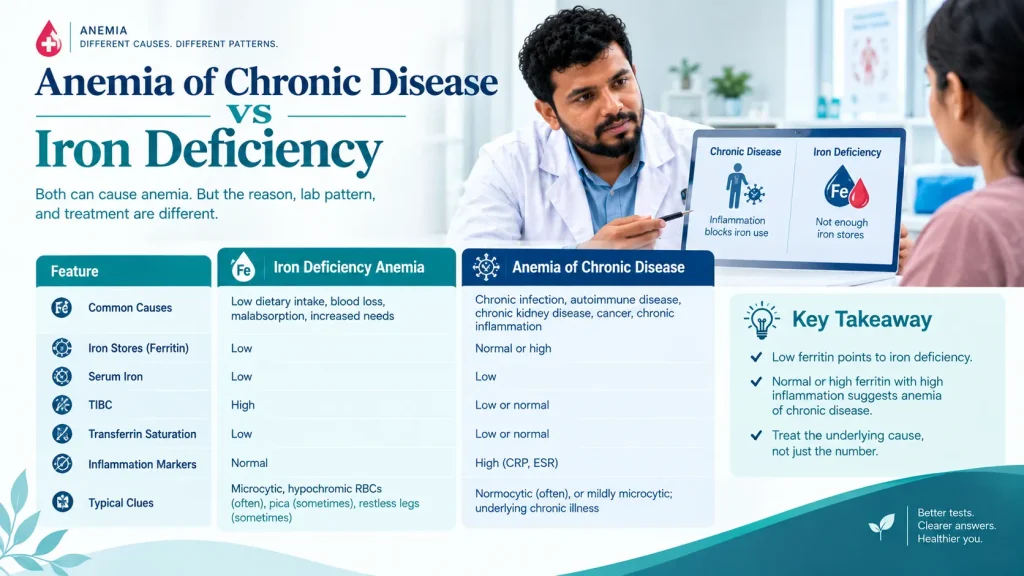
Iron deficiency. The body does not have enough iron. Stores are depleted, and there is not enough raw material to build hemoglobin. The shortage is real and it is at the supply end.
Anemia of chronic disease. Iron is present in the body in adequate quantity, but it is held in storage and not released into circulation for red cell production. The bone marrow behaves as though iron were short, because from its point of view it is, while the body's total iron is not low at all.
The second one is often called anemia of inflammation for that reason: the mechanism is a response to a persistent inflammatory state rather than a shortage.
MedlinePlus, in its Medical Encyclopedia entry "Anemia" (review/update 29 January 2026), lists "Anemia of chronic disease" as one of the types of anemia and names chronic kidney disease, cancer, ulcerative colitis and rheumatoid arthritis among the conditions that may cause it.
That page does not set out the mechanism or distinguish it from iron deficiency, and it is worth saying so rather than implying more attribution than exists. What it does establish, attributably, is that the entity exists, that it is recognised, and which kinds of conditions it accompanies.
The World Health Organization's fact sheet "Anaemia" (10 February 2025) puts the same items on its cause list in different words, naming "infections, inflammation, chronic diseases" alongside nutrient deficiencies and inherited disorders.
Why the blood count alone does not settle it
Both conditions can produce red cells at the smaller end of the size range, and MedlinePlus's "RBC indices" page (review/update 27 February 2026) defines MCV as "Average red blood cell size" with a normal range of 79 to 95 femtoliters, noting that "Normal value ranges may vary slightly among different labs."
A small average cell size is therefore a finding consistent with either, and with several other things besides. Anemia of chronic disease also commonly presents with cells of normal size, which removes even that clue in a proportion of cases. Low hemoglobin with a normal MCV covers that scenario, and the types of anemia covers the classification the index feeds into.
So the answer is not on the CBC. It is on the iron studies, which is why a clinician who sees this picture orders more tests rather than deciding from the count.
Where the distinction is actually made
The separating question is not "how much hemoglobin is there" but "what is the state of the body's iron".
That is what an iron studies panel is for. It looks at iron in circulation, at the capacity available to carry it, and at what is in storage, and the pattern across those measurements is what distinguishes a genuine shortage from iron that is present but unavailable. An iron studies blood test explained covers what each measurement in that panel is, and iron deficiency anemia on a blood test covers the pattern from the deficiency side.
This page publishes no ferritin value, no iron value and no cutoff, and that is a deliberate line rather than an omission. The reason is specific to this comparison and it is the next section.
The ferritin complication, which is the whole difficulty
Ferritin is the measurement most people have heard of, and it is the one that would seem to settle this immediately: low ferritin means low stores, so low ferritin means iron deficiency.
The complication is that ferritin is also an acute phase reactant. It rises during inflammation for reasons that have nothing to do with iron stores. So in exactly the situation where you most want it to distinguish the two conditions, the inflammatory state that produces anemia of chronic disease also pushes ferritin upward.
The practical consequence: a person can have both conditions at once, be genuinely iron deficient, and have a ferritin result that does not look low, because inflammation is lifting it. That combination is not rare, and it is why interpreting a ferritin value in isolation is unreliable in precisely this population.
This site's page on ferritin covers the measurement and the reasons it needs context. The short version for this article: a ferritin number without knowing whether there is inflammation is a number that cannot be read.
Why getting it wrong matters
If this were an academic distinction it would not need its own page. It matters because the two situations call for different responses, and the wrong one is not neutral.
Treating a shortage that does not exist adds iron a body already has and cannot use. MedlinePlus is direct in its iron material that taking more iron than the body needs can cause serious medical problems, and this site's iron pages carry that line.
Treating an inflammatory anemia as though it were a shortage also does something worse than nothing: it leaves the underlying condition unaddressed while the reader believes they have handled the anemia.
And in the overlapping case, where both are present, the answer is neither of the two simple ones.
That is why this page recommends no supplement, no dose and no diet. The distinction is the treatment decision, and it cannot be made from a hemoglobin value or from a single ferritin result read at home.
What a reader can usefully do
- Ask which one is being considered. If you have a chronic condition and an anemia, the question "is this anemia of chronic disease or iron deficiency, or both" is a good and specific one.
- Ask whether iron studies have been done, and whether inflammatory markers were looked at alongside them.
- Mention anything that could be causing blood loss, including heavy periods, because a person can have a chronic condition and an unrelated iron deficiency at the same time.
- Do not start iron on your own. In this specific comparison that is the intervention most likely to be both unnecessary and unhelpful.
Why your hemoglobin might be low covers the wider set of possibilities that a low result opens up, of which these two are only a part.
The short version
- Iron deficiency is a shortage. Anemia of chronic disease is iron that is present but held in storage.
- MedlinePlus (29 January 2026) lists the entity and names chronic kidney disease, cancer, ulcerative colitis and rheumatoid arthritis. It does not set out the mechanism, and this page does not pretend otherwise.
- The blood count does not separate them. Iron studies are where the distinction is made.
- Ferritin rises with inflammation, which is why it cannot be read alone in exactly this situation.
- Both can be present at once.
- No dose here. The distinction is the treatment decision and it belongs to a clinician.