Iron deficiency anemia and thalassemia trait both produce small, pale red blood cells, so a complete blood count often cannot separate them on its own. American Family Physician, in its review of microcytosis, names these two as the most common causes of small red cells and states that serum ferritin measurement is the first laboratory test recommended in the evaluation. The CBC narrows the question. Iron studies and, where indicated, hemoglobin analysis answer it. This article explains how clinicians approach that distinction. It cannot tell you what your own report means.
One thing belongs here rather than lower down. No one should start iron supplements because an MCV came back low. MedlinePlus, the patient service of the US National Library of Medicine, states that “taking more iron than your body needs can cause serious medical problems” and directs people to ask a health care provider how much to take and when. The NHS adds that “very high doses of iron can be fatal, particularly if taken by children”. Iron is a treatment for a documented deficiency, and iron studies plus a clinician’s instruction come before it. Someone who carries a thalassemia trait and takes iron for it is treating a problem they may not have.
This page is general health education, not medical advice. It does not interpret individual results, and it is not a reason to start or stop taking anything. The clinician who ordered the test is the person who reads it.
Why the two conditions look alike on a blood count
In iron deficiency, the raw material for hemoglobin is short. In beta thalassemia trait, the instructions are altered: MedlinePlus Genetics (updated May 1, 2023) describes thalassemia minor as the mild state that can occur in people carrying one variant of the HBB gene, inherited in an autosomal recessive pattern in most families. Two different mechanisms, one shared consequence on the machine that counts blood cells. The cells come out smaller than expected and carry less hemoglobin than expected.
That is why the microcytic picture is a starting point rather than a finding. MedlinePlus states the general case plainly on its CBC page (updated October 15, 2024): “A complete blood count is only one tool your provider uses to learn about your health.”
Beta thalassemia trait is not rare, and it is not evenly distributed. MedlinePlus Genetics states that beta thalassemia “occurs most frequently in people from Mediterranean countries, North Africa, the Middle East, India, Central Asia, and Southeast Asia”. We are not printing a carrier percentage for any country here, because we could not confirm a current figure from a named authority on the day this was written, and a stale prevalence number on a page like this is worse than none.
Thalassemia trait vs iron deficiency: what the CBC can and cannot separate
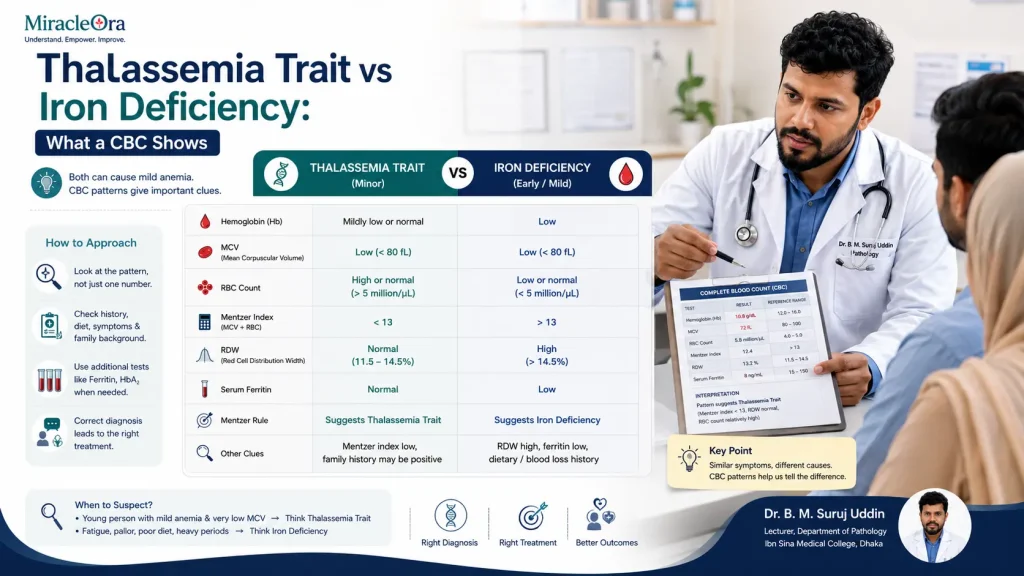
The table below summarizes what published sources describe about each condition as a group. It is a teaching summary, not a lookup table, and matching a report against a row is not something a web page can do.
| Feature | What sources describe in iron deficiency | What sources describe in beta thalassemia trait |
|---|---|---|
| The mechanism | Not enough iron to build hemoglobin | An inherited change in how the globin chains are made (MedlinePlus Genetics) |
| Red cell size and hemoglobin content | Reduced, and the degree tracks the deficiency | StatPearls describes carriers as having “increased red blood cell count with decreased MCV (60 to 70 fl), MCH (19 to 23 pg)” |
| Red cell count | Falls as the deficiency deepens | Described by StatPearls as increased, which is the counterintuitive part |
| RDW | American Family Physician: “often increased in persons with iron deficiency” | Frequently lower, but not reliably so, see the limitation below |
| Symptoms | Vary with severity | NHS: “Being a carrier will not generally cause you any health problems”, though mild anemia can occur |
| What settles it | Ferritin and iron studies | StatPearls: HbA2 quantification is “the most valuable test for definite diagnosis” |
That last row is the honest summary of the whole article. Every row above it describes a tendency across groups of patients. The last row describes a test.
For the wider red-cell picture behind those first rows, our explainer on how iron deficiency anemia shows up on a blood test covers the hemoglobin, MCV and RDW set as it is usually read together, and the types of anemia places both conditions inside the microcytic family.
The Mentzer index, and why clinicians do not stop there
Search this topic and you will quickly meet the Mentzer index. It is worth understanding, and it is worth understanding what it is for.
The formula, as stated in a 2024 study in Frontiers in Medicine, is “mean corpuscular volume (in fL) / RBC count (in millions per microliter)”, with scores below 13 pointing toward thalassemia trait and 13 or above toward iron deficiency anemia. It exists because it is free. It uses two numbers the analyzer already produced and it needs no extra sample.
Here is what the same paper found when it tested that index against confirmed diagnoses in children in Saudi Arabia. For beta thalassemia trait, the Mentzer index showed 74% sensitivity and 63% specificity, with a positive predictive value of 8%. For iron deficiency anemia, 61% sensitivity and 38% specificity. The authors concluded that “the Mentzer index is not a highly reliable discriminator index for differentiating between TT and IDA in children in the Kingdom of Saudi Arabia” and that confirmatory testing by hemoglobin electrophoresis remains necessary.
Reported performance for this index varies widely between published studies and populations, which is itself the point: a screening heuristic that performs differently in different groups is not a test. MDCalc, the clinical calculator site that hosts the index for doctors, labels it directly: “This score is non-diagnostic, and results should be confirmed with additional testing.”
The same caution applies to RDW used on its own. American Family Physician states that red cell distribution width “is not sensitive or specific enough to differentiate iron deficiency and beta-thalassemia trait”, and goes further about the CBC generally: “Data do not support the routine use of other CBC parameters in the evaluation of microcytosis.” Our piece on what a high RDW with a normal MCV suggests covers how that number behaves in other combinations.
A calculated index that lands on the reassuring side rules nothing out. That is the sentence most pages on this topic are missing, and it is why the index belongs in a clinician’s hands alongside a history, a set of iron studies and, where the picture warrants it, hemoglobin analysis.
The complication nobody mentions: both at once
Iron deficiency and beta thalassemia trait are not alternatives. A person can have both, and that possibility quietly undermines the whole “which one is it” framing.
A study of 30 Indian patients with coexisting iron deficiency anemia and beta thalassemia trait, published in ISRN Hematology in 2014 by Verma and colleagues, noted that HbA2 levels “have been reported to be lower in patients with coexisting IDA and BTT” and that this “can interfere in the diagnosis of the former”. In that group, correcting the iron deficiency raised hemoglobin from 9.8 to 10.8 g/dL and produced a statistically significant rise in HbA2 alongside improvements in MCV, MCH, MCHC and RDW.
Read that carefully, because it cuts in an unexpected direction. Iron deficiency can push the confirmatory test toward a normal-looking result. A single blood count and a single electrophoresis performed while someone is iron deficient may not tell the full story, which is one of several reasons a clinician may want a test repeated after iron status has been addressed. This is a small study, and it is offered as a documented mechanism rather than as a rule.
Why the workup runs in the order it does
American Family Physician sets out the sequence: serum ferritin first, and if ferritin is not low, then total iron-binding capacity, transferrin saturation, serum iron and possibly hemoglobin electrophoresis. Ferritin comes first because it is the cheapest way to remove the most common cause from the table.
Our explainers on what a ferritin result is measuring and on how the full iron studies panel is read as a set cover those two stages in more detail, including why ferritin can be misleading when inflammation is present.
If iron stores turn out to be adequate and the cells are still small, hemoglobin analysis becomes relevant. StatPearls (Khan and Rehman, last updated August 28, 2023) gives the interpretation thresholds for HbA2 as under 3.2% normal, 3.2% to 3.6% borderline and warranting further investigation, and 3.6% to 7% consistent with beta thalassemia carriers. Those thresholds concern beta thalassemia specifically. Other inherited hemoglobin variants exist and are investigated differently, which is another reason this is a clinician’s sequence rather than a checklist.
Why this page prints almost no reference ranges
MedlinePlus lists normal red cell index ranges on its RBC indices page (review date February 27, 2026), including an MCV range of 79 to 95 femtoliters and an MCH of 26 to 33 picograms per cell in females and 27 to 33 in males. Notice that two of those three already differ by sex. Ranges also differ by age, which is why a child’s report is read against a different chart entirely.
MedlinePlus carries its own caveat on the same page: “Normal value ranges may vary slightly among different labs. Some labs use different measurements or may test different samples.”
The range printed on your own report, beside your own result, is the one that applies to you. A number compared against a stranger’s range is not information. Our article on why reference ranges differ between laboratories explains where that variation comes from. The sources cited throughout this article were checked on September 2, 2026.
Why the distinction matters beyond the anemia
Two reasons, and only one of them is about treatment.
The first is iron. If small cells are assumed to mean iron deficiency and iron is taken without iron studies, a person with thalassemia trait gains nothing and takes on the risks MedlinePlus and the NHS describe above. That is the specific harm this article exists to prevent.
The second is inheritance. Thalassemia trait is passed on. The CDC (last updated May 15, 2024) states that a person with thalassemia trait “may not have any symptoms, but you might pass that trait on to your children and increase their risk for having thalassemia”, and advises that “if you or your partner knows of family members with thalassemia, or if you both have family members from places in the world where thalassemia is common, you can speak to a genetic counselor”. The NHS makes the same point: “If you’re a thalassaemia carrier, you’re at risk of having a child with thalassaemia if your partner is also a carrier.” What follows from that is a conversation with a doctor or a genetic counselor, not a conclusion from a web page.
When to see a doctor
Any microcytic result belongs in a conversation with the clinician who ordered the count, including one that looks mild. The NHS notes that carrier-state anemia “does not need any treatment”, but establishing which situation applies is a clinical judgment, not a self-assessment.
Seek urgent medical care rather than waiting for a routine appointment if there is chest pain, severe or sudden shortness of breath, fainting, a very fast or irregular heartbeat, vomiting of blood, or black tarry stools.
Things that tend to make the appointment more useful:
- The whole report, not one flagged line, with the laboratory’s own reference intervals and units.
- Any earlier blood counts you can find. A long-standing small MCV that never moved is a different history from one that appeared this year.
- Family background, including relatives known to carry a thalassemia or sickle cell trait, and the regions your family comes from.
- Everything you take, including any multivitamin containing iron, and any iron already started.
- A bleeding history, including heavy menstrual periods and digestive symptoms.
- If you are planning a family, say so, because the carrier question changes what testing is worth doing and who else may want testing.
Frequently asked questions
Can a CBC alone tell whether it is thalassemia trait or iron deficiency?
Not reliably. American Family Physician states that red cell distribution width is not sensitive or specific enough to separate the two, and that data do not support routine use of other CBC parameters in evaluating microcytosis. Serum ferritin is the first test it recommends, with hemoglobin electrophoresis considered later in the sequence.
What is the Mentzer index?
A calculation of MCV divided by red cell count, with a cutoff of 13. A 2024 study in Frontiers in Medicine reported 74% sensitivity and 63% specificity for beta thalassemia trait in the children it studied and concluded that the index is not a highly reliable discriminator. MDCalc, which hosts the calculator for clinicians, labels the score non-diagnostic and states that results should be confirmed with additional testing.
Can someone have both iron deficiency and thalassemia trait?
Yes. Verma and colleagues, writing in ISRN Hematology in 2014, studied 30 patients with both and noted that HbA2 has been reported to run lower when iron deficiency coexists, which can interfere with diagnosis. In their group, treating the iron deficiency was followed by a significant rise in HbA2.
Is iron helpful for thalassemia trait?
Iron corrects iron deficiency. It is not a treatment for an inherited change in hemoglobin production. MedlinePlus states that taking more iron than the body needs can cause serious medical problems and advises asking a health care provider how much to take and when, which is why iron studies come before any decision about supplements.
Does thalassemia trait need treatment?
The NHS states that being a carrier “will not generally cause you any health problems” and that the mild anemia carriers may have “does not need any treatment”. The reason carriers are identified is largely about inheritance, which the CDC frames as a reason to speak with a genetic counselor.
Medical disclaimer: this content is for general education only and is not a substitute for professional medical advice, diagnosis or treatment. It does not interpret individual results, and it is not guidance to take iron or any other supplement. Please discuss your own report with a qualified healthcare provider, and seek urgent care for the emergency features described above. See the site’s full Medical Disclaimer page.