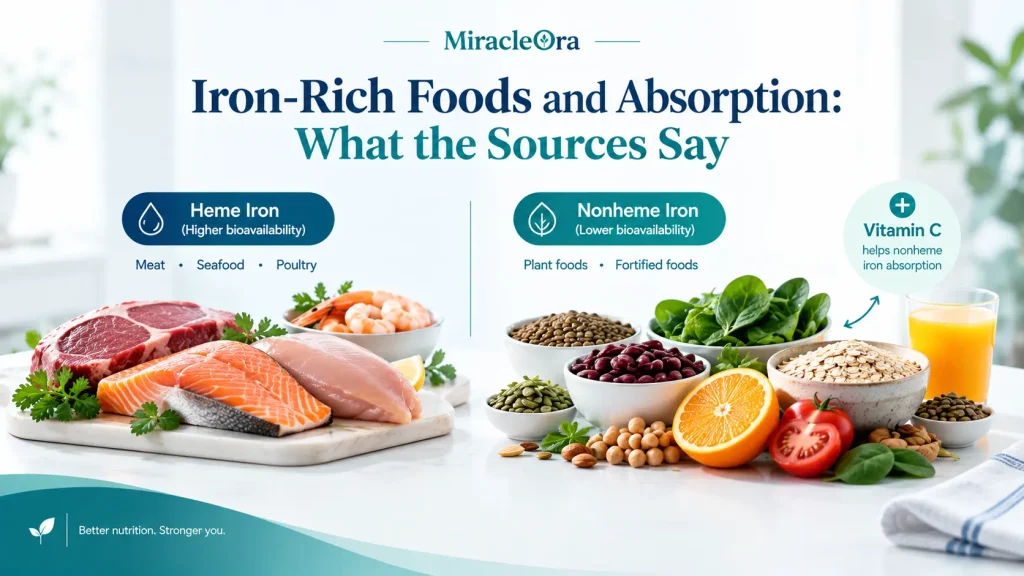
Iron-rich foods are only half of the story; absorption is the other half. StatPearls (last updated 8 January 2024) states that about 25% of dietary heme iron, the kind in meat, poultry and fish, is absorbed, against 17% or less of non-heme iron from plant foods. Vitamin C and meat increase non-heme iron absorption; tea, coffee, calcium and phytates reduce it.
This page is general nutrition education. It is not a plan for treating low hemoglobin or iron deficiency, and it cannot be one: the reason a result is low decides what helps, and that reason comes from a doctor's evaluation, not from a food list. If you are here because of a flagged result, the iron deficiency pattern on a blood test is the place to start, and the doctor who ordered the test is the person who decides what happens next.
Two kinds of iron in food
Dietary iron comes in two forms, and the difference between them is the core of the absorption question.
StatPearls' "Dietary Iron" chapter by Fady Moustarah and Sharon F. Daley (last updated 8 January 2024, read 11 September 2026) describes heme iron, from animal sources, as far better absorbed than non-heme iron from plants. It puts plant iron at roughly half the bioavailability of the animal form.
| Heme iron | Non-heme iron | |
|---|---|---|
| Where it comes from | Meat, poultry, fish and seafood | Plant foods such as beans, leafy greens and whole grains, and iron-fortified foods |
| Share absorbed, per StatPearls | About 25% | 17% or less |
| Enhancers and inhibitors StatPearls describes | Not the focus | Raised by vitamin C and by meat, fish or poultry in the same meal; lowered by phytates, polyphenols in tea and coffee, and calcium |
The practical meaning is simple. A food's iron content, the figure in a food table, is not the amount a person absorbs from it. Two meals with the same iron on paper can deliver quite different amounts, depending on the form of the iron and what else is on the plate.
Iron-rich foods on the official lists
MedlinePlus's "Iron in diet" page (updated 21 January 2025, editorial update 9 September 2025, read 11 September 2026) lists among the best sources: dried beans, dried fruits, eggs, iron-fortified cereals, liver, lean red meat, oysters, poultry, salmon, tuna and whole grains. Its plant list includes spinach, kale, collards, broccoli, asparagus, soybeans, kidney beans, lima beans, almonds, Brazil nuts, raisins, prunes, apricots, wheat, millet, oats and brown rice.
The NHLBI's iron-deficiency anemia page (updated 24 March 2022, read 11 September 2026) names beans, dried fruits, eggs, lean red meat, salmon, iron-fortified breads and cereals, peas, tofu and dark green leafy vegetables. The NHS page on iron deficiency anemia (last reviewed 26 January 2024, read 11 September 2026) names dark-green leafy vegetables, fortified cereals, meat, dried fruit and pulses.
For a reader in Bangladesh, several of those items are everyday kitchen foods under local names. Pulses are the family that includes the lentils in dal; dark leafy greens include many kinds of shak; fish, eggs, liver and meat need no translation. What none of these lists says is how much of the iron in each food a person actually absorbs, and that depends on the rest of the meal and on the person.
What increases absorption
The sources agree on two enhancers, and StatPearls describes both in terms of non-heme iron, the plant form.
Vitamin C. StatPearls describes vitamin C as increasing non-heme iron uptake by converting the iron to a more absorbable form. MedlinePlus states that foods rich in vitamin C also increase iron absorption. The NHLBI names oranges, strawberries and tomatoes as vitamin C-rich foods that help the body absorb iron.
Meat, fish or poultry in the same meal. StatPearls calls this the "MFP factor" and describes it as increasing absorption two to three fold when combined with plant foods. MedlinePlus makes the same point in plainer words: combining lean meat, fish or poultry with beans or dark leafy greens improves how well the plant iron is absorbed.
MedlinePlus adds a third, less obvious one: cooking foods in a cast-iron skillet can also help.
What reduces absorption
This is the half of the story most food lists leave out.
The WHO anemia fact sheet (updated 10 February 2025, read 11 September 2026) includes self-care guidance that names foods and drinks that inhibit iron uptake when consumed with iron-rich foods: bran in cereals such as wholewheat flour and oats, tea, coffee, cocoa and calcium.
- Tea. MedlinePlus states that black teas contain substances that bind to dietary iron so the body cannot use it. StatPearls places tea and coffee among the polyphenols that block absorption.
- Coffee and cocoa. Named by the WHO, and coffee also by the NHS and StatPearls.
- Calcium, milk and dairy. Named by the WHO, StatPearls and the NHS.
- Phytates. StatPearls names phytates, and the NHS refers to foods high in phytic acid.
Where tea with milk arrives with a meal or straight after it, two of the WHO's named inhibitors, tea and calcium, arrive together. That does not make the meal worthless. It is simply one of the reasons iron content on paper and iron absorbed can differ so much.
There is an apparent contradiction on these lists that is worth stating plainly. Whole grains appear on MedlinePlus's list of iron sources, while bran in wholewheat flour appears on the WHO's list of inhibitors. Both are true at once. A food can contain iron and also contain substances that hold some of it back, which is exactly why content is not the same as absorption.
The part food lists skip: the body sets its own rate
Food lists treat absorption as something the meal decides. StatPearls explains that the body has a say too.
According to StatPearls, the body controls its iron mainly through absorption rather than excretion, and the key regulator is hepcidin, a peptide made by the liver. In the chapter's words: "High iron levels in the body stimulate hepcidin production, which decreases iron absorption and promotes cellular iron sequestration."
Two consequences follow, and both matter to someone reading a blood report.
First, food is not a dose. How much iron is absorbed from the same plate depends on the person eating it, including how full their iron stores already are. A food list cannot say what a particular person will absorb, and it cannot be read as a treatment amount.
Second, a low result is not automatically a diet problem. The NHLBI lists causes of iron-deficiency anemia that have nothing to do with the plate: bleeding in the digestive tract from conditions such as an ulcer, inflammatory bowel disease or colon cancer; heavy menstrual periods or bleeding in childbirth; regular use of medicines such as aspirin or other NSAIDs; and intestinal conditions such as celiac disease, ulcerative colitis and Crohn's disease that make it harder for the body to absorb iron.
The WHO does name inadequate dietary iron as the main driver of iron deficiency, which it calls the most common nutritional deficiency leading to anemia. It also lists deficiencies of vitamin A, folate, vitamin B12 and riboflavin as contributors. Diet is a common cause. It is not the only one, and a cause such as hidden blood loss is found by a doctor, not by changing what is on the plate.
Why food cannot answer a low blood result by itself
Not every low hemoglobin is about iron at all. One alternative this site covers in detail is thalassemia trait, which can produce small red cells on a CBC much as iron deficiency does, without being an iron problem. How a CBC separates thalassemia trait from iron deficiency explains why the two need telling apart before anything else is decided.
Whether iron is actually low is answered by blood tests rather than by symptoms or a food diary. What a ferritin result measures covers the iron-store test, and serum iron, TIBC and transferrin saturation covers the panel that can come with it.
Pregnancy changes the picture again, because the body's needs change. Anemia in pregnancy and what the numbers mean covers that separately, and in pregnancy the OB or midwife is the person to ask.
More iron is not automatically better
MedlinePlus's iron in diet page also lists symptoms of iron poisoning, including fatigue, loss of appetite, dizziness, nausea, vomiting, headache, weight loss, shortness of breath and a grayish color to the skin. Several of those overlap with the symptoms of anemia itself, which is one more reason tiredness is a poor guide to whether someone needs more iron.
Iron tablets and supplements are a decision for a doctor, who can match them to the cause and check the response with repeat blood tests. This page does not recommend any supplement, dose or diet.
What to ask the doctor
- Is my low result actually iron deficiency, or could it be something else, such as thalassemia trait?
- If it is iron, what is the likely cause: diet, blood loss or absorption?
- Do I need ferritin or iron studies?
- Does anything I usually eat or drink with meals matter in my case?
Frequently Asked Questions
Which foods are high in iron?
MedlinePlus (updated 21 January 2025) lists dried beans, dried fruits, eggs, iron-fortified cereals, liver, lean red meat, oysters, poultry, salmon, tuna and whole grains among the best sources, with spinach, kale, soybeans and kidney beans among its plant options. The NHS adds pulses, the family that includes lentils. How much iron the body absorbs from each depends on its form and the rest of the meal.
Does vitamin C help iron absorption?
StatPearls (last updated 8 January 2024) states that vitamin C increases non-heme iron uptake by converting it to a more absorbable form, and MedlinePlus states that vitamin C-rich foods increase iron absorption. StatPearls describes the effect in terms of non-heme iron, the form found in plant foods.
Does tea reduce iron absorption?
MedlinePlus states that black teas contain substances that bind to dietary iron so the body cannot use it, and the WHO fact sheet (updated 10 February 2025) names tea, coffee, cocoa and calcium among inhibitors when consumed with iron-rich foods.
Can diet alone fix low hemoglobin?
This page cannot answer that for any reader, because it depends on the cause. The NHLBI lists causes of iron-deficiency anemia that diet does not address, including bleeding in the digestive tract, heavy periods and conditions that block absorption, and not every low hemoglobin is iron deficiency. The doctor who ordered the test decides what the result needs.
The short version
- StatPearls: about 25% of heme iron and 17% or less of non-heme iron is absorbed.
- Vitamin C and meat, fish or poultry in the same meal increase non-heme absorption; tea, coffee, calcium and phytates reduce it, per StatPearls, the WHO, MedlinePlus and the NHS.
- The body regulates its own absorption through hepcidin, so food is not a dose.
- A low result can come from blood loss, absorption problems or a non-iron cause such as thalassemia trait. That is a doctor's evaluation, not a food list's.