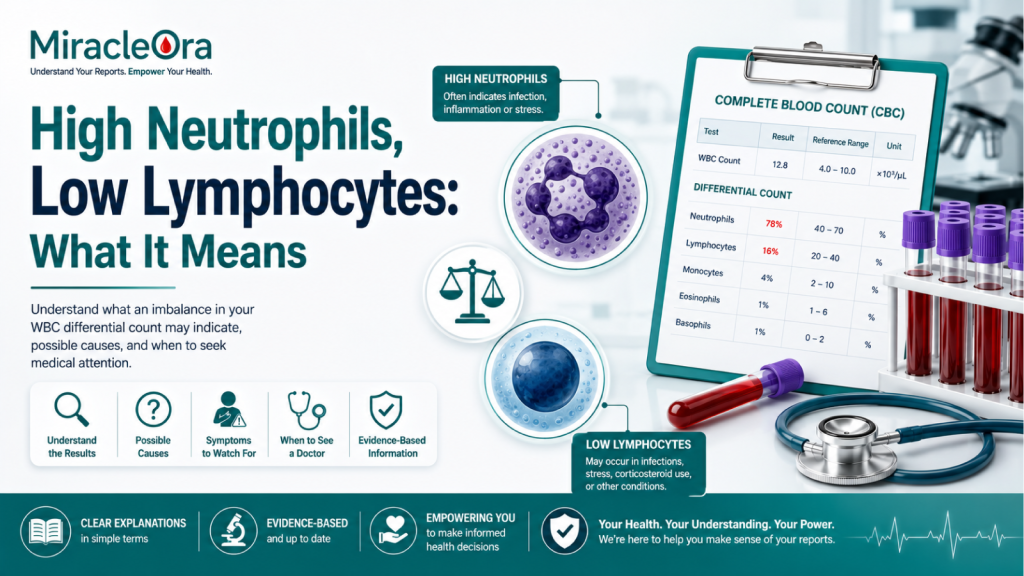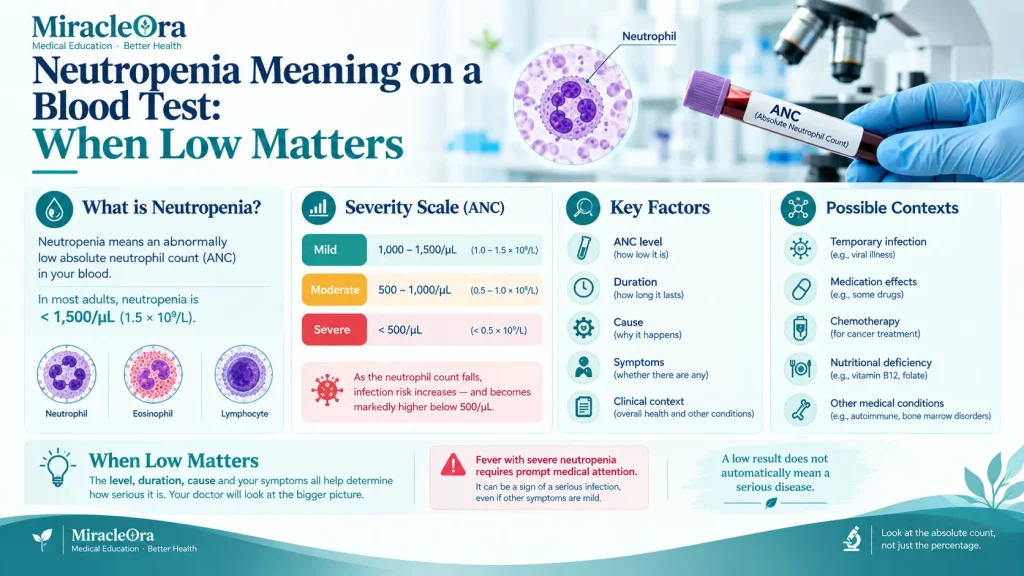
Neutropenia means the blood holds fewer neutrophils than expected. Neutrophils are the white cells Cleveland Clinic describes as the body's first line of defense against infection. StatPearls (last updated 7 June 2024) puts the usual line at an absolute neutrophil count below 1.5 × 10⁹/L, which is the same as 1,500 per microliter, and grades it by how far below. How much it matters depends on the grade, the cause and, above all, whether there is a fever.
This page explains what the word means on a report, what the grades are, and what causes them. It cannot tell you what your own result means; that is the job of the doctor who ordered the test.
Fever with a low neutrophil count: the rule that comes first
Before anything else on this page, the one situation where waiting is the wrong choice.
StatPearls' neutropenia chapter by Preeti Rout, Samuel B. Reynolds and Patrick M. Zito (last updated 7 June 2024, read 11 September 2026) describes febrile neutropenia, a fever in someone with neutropenia, as a medical emergency requiring immediate evaluation.
The National Cancer Institute's page on infection and neutropenia (reviewed 23 January 2020, read 11 September 2026) lists these signs of infection to report: a fever of 100.5 °F (38 °C) or higher; chills; cough or sore throat; diarrhea; ear pain, headache or sinus pain, or a stiff or sore neck; skin rash; sores or a white coating in the mouth or on the tongue; swelling or redness, especially where a catheter enters the body; and urine that is bloody or cloudy, or pain when urinating. It states that infections during cancer treatment can be life threatening and require urgent medical attention.
St. Jude's patient page on ANC (reviewed August 2026, read 11 September 2026) gives the same instruction for children: contact a health care provider or go to the emergency room right away for a fever or other signs of infection.
If you have been told your neutrophil count is low and you develop a fever, go to hospital or contact your doctor straight away.
If the fever could be dengue, the WHO's dengue fact sheet (21 August 2025, read 11 September 2026) lists the warning signs of severe dengue as severe abdominal pain, persistent vomiting, rapid breathing, bleeding gums or nose, fatigue, restlessness, blood in vomit or stool, being very thirsty, pale and cold skin, and feeling weak, and says people with these symptoms should seek care immediately. If any of those signs appear, go to hospital. Dengue platelet counts and the warning signs covers the platelet side of the same illness.
What neutropenia means on a blood test report
The word describes one line of the white cell differential: the neutrophils. It is not the same as a low total white cell count, although the two can appear together.
MedlinePlus's WBC count page (review date 3 February 2025, read 11 September 2026) calls a low total count leukopenia and defines it as a count below 4,500 cells per microliter. Neutrophils make up the largest share of the white cells in MedlinePlus's reference figures, so a fall in neutrophils can pull the total down, but a low total can also come from other cell types. The differential is what separates them.
Neutropenia is judged on the absolute neutrophil count, not the percentage. MedlinePlus's blood differential page (same review date) gives the neutrophil share as 40% to 60% of white cells, but a share can fall simply because another cell type has risen. The absolute count is the total white count multiplied by the neutrophil percentage, and it is the number the grades below refer to.
MedlinePlus also notes that normal value ranges may vary slightly among different labs. The interval printed on your report is the one that applies to it.
How low is low: the published grades
StatPearls classifies neutropenia by absolute neutrophil count. St. Jude uses the same grades and adds a "profound" category.
| Grade | StatPearls (× 10⁹/L) | Same in per microliter |
|---|---|---|
| Mild | 1.0 to 1.5 | 1,000 to 1,500 |
| Moderate | 0.5 to 1.0 | 500 to 1,000 |
| Severe | below 0.5 | below 500 |
| Agranulocytosis (StatPearls) | below 0.2 | below 200 |
| Profound (St. Jude) | not used | below 100 |
A microliter and a cubic millimeter are the same volume, so a report printed "per cumm" uses the same numbers as the right-hand column.
These are published classifications, not a self-assessment tool. A grade says how far below the line a count sits. It does not say why, and the why is most of what matters.
Why the count affects infection risk
StatPearls states that the risk of infection increases substantially when the neutrophil count falls below 1.5 × 10⁹/L. St. Jude puts it more simply: the lower a person's ANC, the higher the risk of infection, particularly bacterial and fungal infections, and even minor infections can become serious.
That relationship is the whole reason neutropenia is watched closely. It is also the reason fever is treated so differently in someone with a low count: the usual defense is thinner, so an infection that would otherwise be ordinary is not assumed to be.
What causes neutropenia
StatPearls groups the causes into two broad kinds.
The bone marrow is making too few neutrophils. This group includes inherited genetic conditions, infiltration of the marrow by diseases such as leukemia or lymphoma, nutritional deficiencies of vitamin B12, folate or copper, and suppression of the marrow by medicines.
The marrow is working, but neutrophils are being destroyed or used up. This group includes autoimmune destruction and increased consumption, as happens in sepsis and other infections.
MedlinePlus's differential page lists the causes of decreased neutrophils as aplastic anemia, chemotherapy, viral infections such as influenza, radiation, and severe bacterial infection (sepsis). Its WBC count page also lists ethnic or genetic traits among the causes of a low count.
Two of those causes connect directly to other pages on this site. StatPearls names vitamin B12 and folate deficiency among the nutritional causes, and vitamin B12 deficiency and your blood count and folate deficiency on a CBC cover how those deficiencies show up on a report.
Medicines deserve a specific word. StatPearls names particular drugs among the causes, including some antibiotics such as cephalosporins, penicillins and vancomycin, and the psychiatric medicine clozapine. That is a list of associations, not a reason to change anything. No medicine should be stopped or changed because of a blood result and a web page; the prescriber has the whole picture and makes that decision.
Viral fevers, dengue and a low count
MedlinePlus lists viral infections such as influenza among the causes of decreased neutrophils, so a low count taken during or after a viral illness has an explanation on the authoritative lists.
Dengue is the viral fever many readers in Bangladesh will have in mind. The CDC's clinical page on dengue (updated 24 February 2026, read 11 September 2026) lists leukopenia, a low white cell count, among the common laboratory findings, and notes that during recovery the white cell count usually starts to rise, followed by the platelet count. A low count in dengue is therefore an expected finding, and it is the warning signs above, not the count, that the WHO uses to say when care is needed immediately.
What a count can and cannot establish about infection in general is covered in can a CBC detect infection.
A low count in someone who feels well
Some neutropenia results turn up on routine tests in people who feel completely fine. That combination is not a contradiction.
Reference intervals are built so that some healthy people fall outside them, which an abnormal blood test when you feel fine explains in detail. StatPearls also describes Duffy antigen null neutropenia, formerly called benign ethnic neutropenia: a count below 1,500 per microliter without an increased infection risk. It calls this a diagnosis of exclusion and one of the most common causes in people of African, Arabic, Yemenite Jewish and West Caribbean descent.
None of that means a low result should be ignored. It means the ordinary next step is a doctor's review, which may include a repeat count and a look at the rest of the report, rather than alarm. A stable mild reduction and a falling count are different findings, and only more than one result tells them apart.
What to ask the doctor
- What is my absolute neutrophil count, and which interval does this lab use?
- Is this a single result or part of a trend? Bring previous reports if you have them.
- Could a recent illness, a nutritional cause or a medicine explain it?
- What should I do if I get a fever while my count is low, and where should I go?
Frequently Asked Questions
What does neutropenia mean on a blood test?
It means the absolute number of neutrophils, the white cells that Cleveland Clinic calls the body's first line of defense against infection, is lower than expected. StatPearls (last updated 7 June 2024) puts the usual line at 1.5 × 10⁹/L, which is 1,500 per microliter. It is judged on the absolute count, not the percentage.
What level of neutrophils is considered neutropenia?
StatPearls classifies it as mild at 1,000 to 1,500 per microliter, moderate at 500 to 1,000, severe below 500, and agranulocytosis below 200. Laboratories print their own intervals, and the doctor who ordered the test decides what a particular result means.
Is neutropenia serious?
It depends on the grade, the cause and whether there is an infection. StatPearls states that infection risk increases substantially below 1.5 × 10⁹/L and describes fever with neutropenia as a medical emergency. With a low count and a fever, go to hospital or contact your doctor straight away.
Can a viral infection cause low neutrophils?
Yes. MedlinePlus (review date 3 February 2025) lists viral infections such as influenza among the causes of decreased neutrophils, and the CDC lists a low white cell count among the common laboratory findings in dengue, with the count usually starting to rise during recovery.
The short version
- Neutropenia means a low absolute neutrophil count; StatPearls puts the line at 1.5 × 10⁹/L, or 1,500 per microliter.
- StatPearls grades it as mild, moderate, severe and agranulocytosis. Grades describe depth, not cause.
- Causes range from viral infections and nutritional deficiencies to medicines, autoimmune conditions and marrow disease.
- Fever with neutropenia is a medical emergency per StatPearls. Go to hospital.
- In dengue, a low white count is a common finding per the CDC; the WHO warning signs are what mean go to hospital.