The short answer: the reticulocyte count measures young red blood cells, recently released from the bone marrow, so it shows how actively the marrow is making new red cells. MedlinePlus lists higher counts with bleeding, hemolytic anemia and pregnancy, and lower counts with iron, vitamin B12 or folate deficiency, bone marrow failure, chronic kidney disease and cirrhosis. In someone with anemia, the question is not only "high or low" but "high enough for how anemic this person is." That adjustment, and what the result means for you, belongs to the clinician who ordered the test.
First: signs that need care soon
A reticulocyte count is usually ordered because anemia has already been found, so the relevant warning signs are those of anemia. The MedlinePlus Medical Encyclopedia entry on anemia (review date January 29, 2026, read on September 27, 2026) says to "Contact your provider if you have any symptoms of anemia or unusual bleeding," and lists symptoms including unusual tiredness, lightheadedness when standing up, pale skin and "Shortness of breath with mild activity or even at rest." The National Heart, Lung, and Blood Institute (NHLBI) anemia symptoms page (last updated March 24, 2022, read on September 27, 2026) also lists dizziness and fainting, bleeding, and jaundice, a yellowing of the skin.
Fainting, chest pain, a racing heart, severe breathlessness, heavy bleeding, or vomiting blood are reasons for emergency care rather than a routine appointment. This page cannot triage anyone. A clinician or emergency service can.
What a reticulocyte is
Red blood cells are made in the bone marrow. Around the time they are released into the bloodstream, they pass through a stage called the reticulocyte. MedlinePlus describes reticulocytes as "slightly immature red blood cells." They still hold a trace of internal material that laboratory stains can show, which is how they are told apart from mature cells.
Because the reticulocyte stage is a passing one, the number in the blood at any moment reflects recent production. That is what makes the test useful. Most lines on a CBC describe the red cells you already have. The reticulocyte count describes the ones being made now.
Cleveland Clinic, on its reticulocyte count page (last updated April 18, 2022, read on September 27, 2026), says the test is ordered to help diagnose the cause of anemia, to check whether the bone marrow is producing enough new red cells, and to monitor marrow function after chemotherapy or a bone marrow transplant.
How the result is reported
Reticulocytes are most often reported as a percentage of all red cells. Some laboratories also report an absolute count or additional reticulocyte measures alongside it.
Two named sources give two different adult ranges for the percentage:
| Source | Adult range | Note |
|---|---|---|
| MedlinePlus, reticulocyte count (review date February 27, 2026, read on September 27, 2026) | 0.77% to 2.26% | "for healthy adults who are not anemic" |
| Cleveland Clinic (last updated April 18, 2022) | 0.5% to 2.5% | Gives 2% to 6% for infants |
Neither is wrong. MedlinePlus notes that "Normal value ranges may vary slightly among different laboratories," and the range printed on your own report is the one that applies to you.
The MedlinePlus wording holds the key to the whole test, though: its range is for people who are not anemic. When someone is anemic, reading the raw percentage against that range can mislead, as the next sections explain.
Reticulocyte count meaning: high results
MedlinePlus lists these among the causes of a higher-than-normal reticulocyte count:
- Bleeding
- Hemolytic anemia, where red cells are broken down faster than usual
- Pregnancy
- Kidney cysts or tumors that increase erythropoietin, the hormone that signals the marrow
- Erythroblastosis fetalis, a blood condition in a fetus or newborn
In the first two, a high count is the marrow doing its job. Cells are being lost or destroyed, and the marrow is replacing them faster. Cleveland Clinic describes hemolytic anemia as a state where red cells do not last their normal 120-day life span, with the marrow compensating by making more reticulocytes.
So a high reticulocyte count, in someone with anemia, is often read as "the factory is working, and the problem is downstream." Whether cells are being lost to bleeding or broken down in the body is the next question, and it is the clinician's. How anemia can happen without visible blood loss is covered in low hemoglobin without obvious bleeding.
Reticulocyte count meaning: low results
MedlinePlus lists these among the causes of a lower-than-normal count:
- Iron deficiency anemia
- Vitamin B12 or folate deficiency anemia
- Bone marrow failure
- Chronic kidney disease
- Cirrhosis of the liver
Cleveland Clinic groups the low-count causes as hypoproliferative anemias, meaning the marrow cannot make enough red cells, and names anemia of chronic disease, nutritional anemias, aplastic anemia, myelodysplastic syndrome and megaloblastic anemia.
A low count in someone with anemia is often read as "the factory is short of something, or is not being signalled properly." That can mean missing building blocks, such as iron, B12 or folate, or a weaker signal, as the kidney-related causes on the list suggest. A low count on its own does not point to anything more serious; several of the listed causes are common nutritional ones.
Why a normal percentage can still be too low
This is the part most reticulocyte pages skip, and it is the part that confuses people holding a result that says "normal."
A percentage depends on two things: how many reticulocytes there are, and how many red cells there are in total. In anemia, the total is low. So even a modest number of reticulocytes can produce a percentage that looks normal, or even high, simply because the denominator has shrunk.
A 2021 paper in the Pan African Medical Journal, "Reticulocyte count: a simple test but tricky interpretation!" by Gaur and Sehgal (read on September 27, 2026), describes two corrections clinicians use:
- A correction for the degree of anemia. The raw percentage is multiplied by the patient's hemoglobin or hematocrit divided by a standard value. If a patient's hematocrit is half the standard used, the corrected figure is half the raw percentage.
- A correction for maturation time. The authors note that "if the patient has moderate or severe anemia, the bone marrow will release reticulocytes prematurely into the blood." These early-released cells remain recognizable as reticulocytes for longer, which inflates the count. The reticulocyte production index (RPI) divides the corrected figure by the maturation time to account for this.
The StatPearls chapter on Anemia, on the NIH's NCBI Bookshelf (Regalla and Killeen, last updated July 5, 2026, read on September 27, 2026), states how the RPI is commonly read: "An RPI less than 2 generally suggests an inadequate marrow response, whereas an RPI greater than 3 supports an appropriate marrow response."
In plain terms: the question a clinician asks is not "is this percentage inside the range?" but "given how anemic this person is, is the marrow responding as much as it should?" A result printed as normal can, after correction, turn out to be an inadequate response. That is why this page does not suggest calculating an RPI from your own report. The corrections involve choices about standard values and maturation times that belong to the laboratory and the clinician.
Where the reticulocyte count fits with the rest of the report
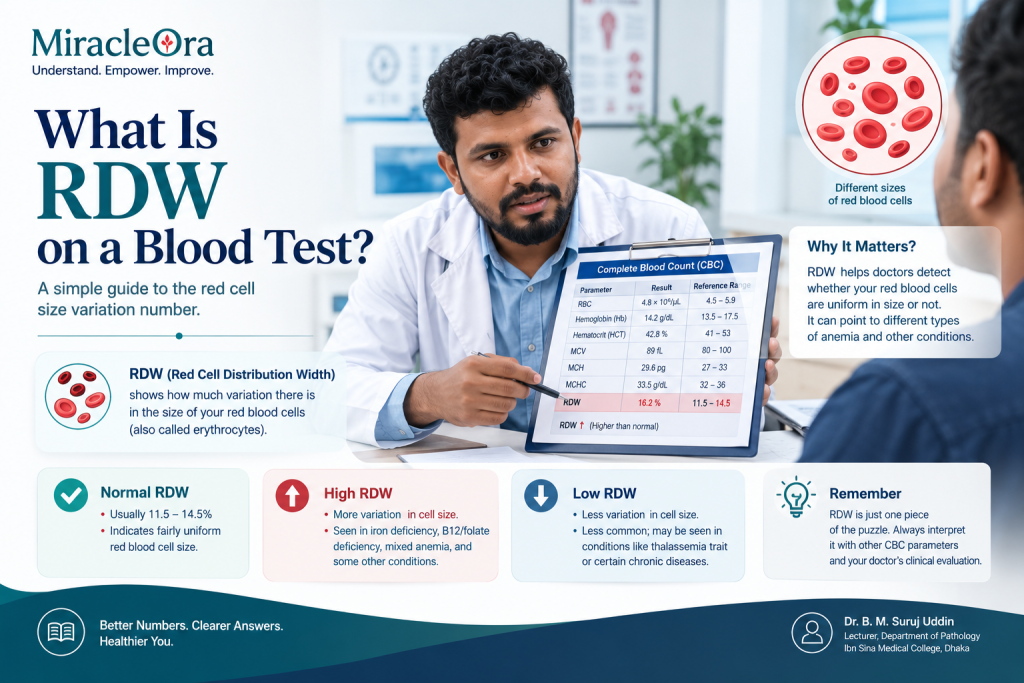
The reticulocyte count is rarely read alone. It usually sits beside:
- Hemoglobin and hematocrit, which show how anemic someone is, and feed into the correction above.
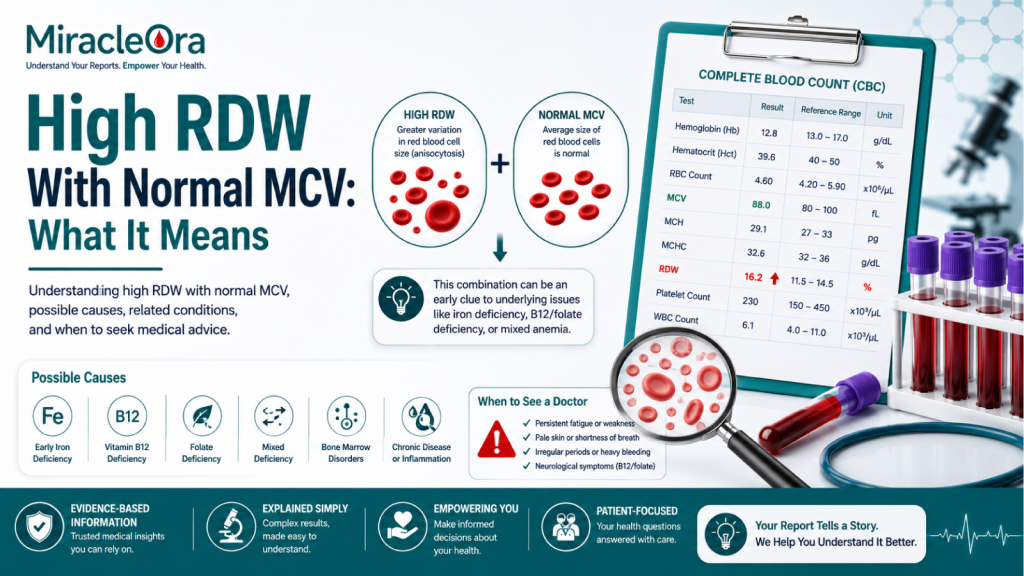
- MCV, which sorts anemia by cell size. The reticulocyte count is especially useful when the MCV is normal and gives no direction, a situation discussed in low hemoglobin with a normal MCV.
- A blood smear, where a trained reader looks at the cells directly. Why a smear might be ordered is explained in peripheral blood smear: what it is and why it was ordered.
- Other tests, chosen by the clinician depending on whether production or loss looks like the main problem.
For an overview of how anemias are grouped in the first place, types of anemia, explained in plain language is a useful companion.
Making the appointment more useful
A few notes before the visit can help the clinician read the reticulocyte count in context:
- Any recent bleeding, heavy periods, or dark or black stools
- Any yellowing of the skin or eyes, or unusually dark urine
- Whether you are pregnant or could be
- Every medicine and supplement you take
- Any known kidney or liver condition
- Copies of previous blood counts, so the trend is visible
This list is for describing what is happening. Decisions about testing and treatment belong to the clinician, and this page does not suggest any treatment or dose.
The honest limits of this page
A laboratory report should not create fear. It should create understanding. This page cannot tell you whether your reticulocyte count is adequate for you, what is causing your anemia, or what should happen next. It can explain what reticulocytes are, why two sources print two ranges, what high and low results are associated with, and why a "normal" percentage in someone with anemia is a starting point for the clinician's arithmetic rather than the answer.
Frequently asked questions
What does the reticulocyte count tell you?
It shows how actively the bone marrow is producing new red cells. Cleveland Clinic says the test helps diagnose the cause of anemia and check whether the marrow is making enough red cells.
What does a high reticulocyte count mean?
MedlinePlus lists bleeding, hemolytic anemia and pregnancy among causes, along with some kidney cysts or tumors. In anemia, a high count often suggests the marrow is responding to cells being lost or destroyed.
What does a low reticulocyte count mean?
MedlinePlus lists iron, vitamin B12 or folate deficiency anemia, bone marrow failure, chronic kidney disease and cirrhosis. A low count in anemia suggests the marrow is not producing enough new cells.
What is a normal reticulocyte count?
MedlinePlus gives 0.77% to 2.26% for healthy adults who are not anemic, and Cleveland Clinic gives 0.5% to 2.5%. Your laboratory's own range is the one that applies to your report.
Why does my doctor correct the reticulocyte count?
In anemia there are fewer red cells overall, which can make the percentage look higher than the marrow's real output. Clinicians adjust for the degree of anemia and for early-released cells; StatPearls describes an RPI below 2 as generally suggesting an inadequate marrow response.