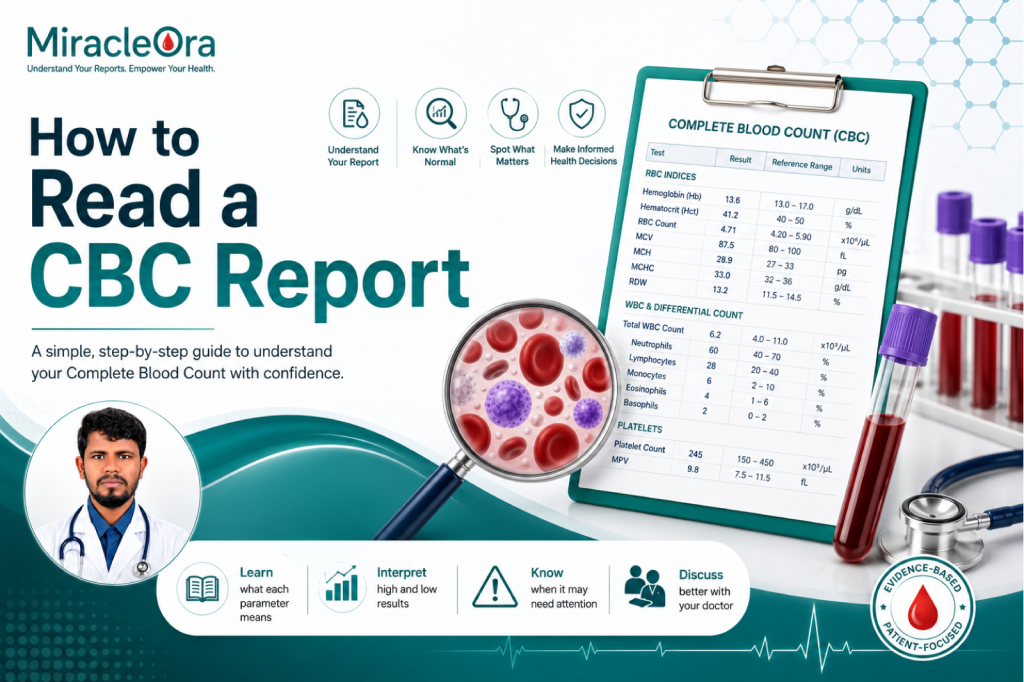
The borderline blood test results meaning is usually calmer than the flag on your report suggests. A borderline result is a number that sits just above or just below the reference range your lab printed beside it. Those ranges are built from the middle of results in healthy people, so some healthy people land just outside them by design. MedlinePlus, the consumer health site of the U.S. National Library of Medicine, states that "it's common for healthy people to sometimes have results outside the reference range." A borderline value is a reason for your clinician to look at context, not a diagnosis on its own.
That single sentence is the heart of this article. The rest explains why it is true, what clinicians tend to weigh, and the specific signs that mean a number should not wait for a routine follow-up.
Borderline blood test results meaning: what the label covers
Most lab reports do not have a box marked "borderline." What you usually see is a value, a reference range, and sometimes a letter flag: H for high or L for low. If you want a refresher on those letters, our guide to H and L flags on a blood test walks through them.
"Borderline" or "slightly out of range" is a description people use, often clinicians themselves, when a value has crossed the line but only by a small margin. A hemoglobin a fraction below the lower limit, or a white cell count a little above the upper limit, would both fit that description.
The flag itself is mechanical. The lab's software marks any value outside the printed range, whether it is a whisker over the line or far beyond it. The flag does not know your age, your symptoms, your medicines or your last five results. That is why a flag is a starting point for interpretation, and the interpretation belongs to the person who ordered the test.
Where reference ranges come from, and why the edge is soft
Testing.com, a patient education site on laboratory testing, explains that for many tests, reference ranges include "the middle 95% of the reference population." To set those limits, a lab tests "a large number (minimum of 120) of people who fit the profile of the reference population." Testing.com spells out the consequence plainly: "5% of people in that same population will have results that fall outside the limits."
In other words, the edges of a reference range are statistical cut points, not a cliff between healthy and unwell. A person whose value sits one step past the line is, in most cases, much more like the people just inside the line than like someone with a clear disease.
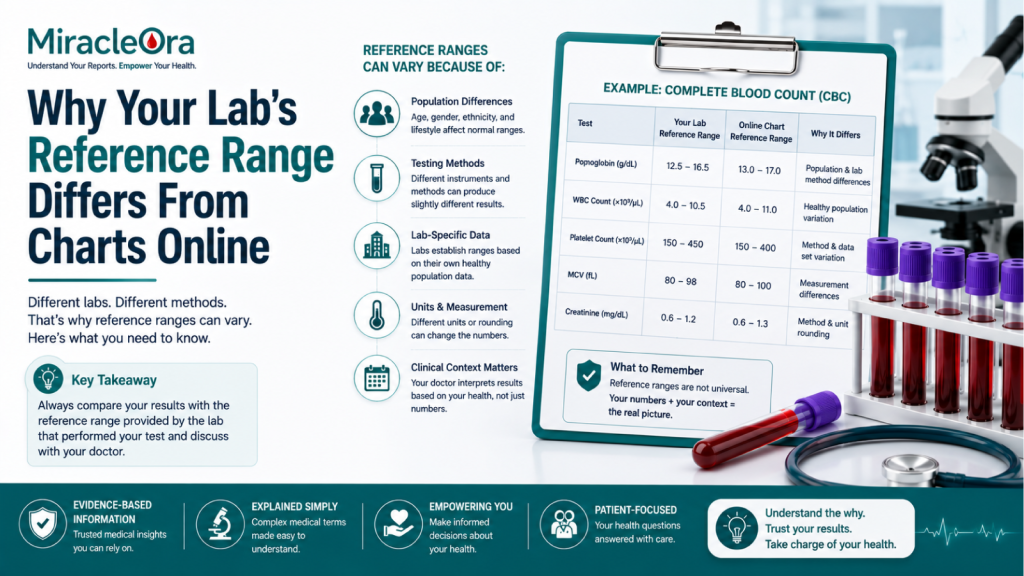
There is a second reason the edge is soft. Different labs use different equipment, methods and reference populations, so the same blood can produce a range that differs slightly from one lab to another. Testing.com notes that "there are no universally standardized reference ranges." Our article on why your lab's reference range differs from charts online covers this in more detail. The practical point: compare your result with the range printed on your own report, not with a number from a website.
A 2006 paper in the Journal of Clinical Pathology by W. S. A. Smellie, titled "When is 'abnormal' abnormal? Dealing with the slightly out of range laboratory result" (read on October 2, 2026), goes further. It notes that many analytes vary with age, sex and other demographic factors, and that ranges depend on the testing method, so "the reference interval is at best a loose approximation."
Why one flag on a long report is close to expected
Here is the part most articles on this topic skip, and it is the most reassuring piece of arithmetic in laboratory medicine.
If each reference range is drawn so that roughly 1 in 20 healthy people falls outside it, then the more values a report contains, the more likely it is that at least one lands outside its range by chance alone. Smellie's paper makes exactly this point: with 95% reference intervals, only a few common panels together, such as electrolytes, liver tests and a full blood count, produce around 20 values, which makes it "statistically likely that one of these will lie outside this interval."
As a simple illustration, if 20 values were completely independent of each other, the chance that all 20 would land inside their ranges in a healthy person is 0.95 multiplied by itself 20 times, which works out to roughly 36 percent. That leaves roughly a 64 percent chance of at least one flag. Real blood values are linked to each other (hemoglobin and hematocrit tend to move together, for example), so the true figure for any given report differs from this tidy number. The direction of the lesson holds, though: a single borderline flag on a long report is common, and on its own it says little.
This is also why a CBC can show a flag in someone who feels completely well. Our piece on a blood test that is abnormal when you feel fine looks at that situation directly.
Everyday things that can nudge a result over the line
A value near the edge can be tipped across it by ordinary circumstances on the day of the draw. MedlinePlus, in its guide to understanding your lab results (updated September 4, 2025, read on October 2, 2026), lists factors that can affect results, including:
- Eating and drinking certain foods and drinks
- Taking certain medicines or supplements
- Exercising hard before the test
- Having a menstrual period at the time of the test
- Whether preparation instructions, including fasting, were followed
Timing can matter too; our article on whether the time of day affects blood test results explains which values are known to shift across a day. Testing.com adds that biological factors such as age, diet, hormones and activity level shape results, and that some healthy people simply run a little higher or lower than the population average as their usual baseline.
None of this means a borderline value should be dismissed. It means the value needs to be read alongside the circumstances of the draw, which is exactly what your clinician is placed to do. If you take a medicine or supplement, the useful step is to mention it to the clinician who ordered the test. Any decision about a medicine belongs with the prescriber, never with a single lab value.
What clinicians tend to weigh with a borderline value
There is no single rule, and the approach differs by test, by patient and by setting. In general terms, though, a clinician looking at a slightly out-of-range value is likely to consider:
- How far outside the range it is. Just past the line is a different conversation from well beyond it.
- Whether you have symptoms that fit the value, or none at all.
- Your history and previous results. A value that has always sat slightly low for you reads differently from one that has recently moved.
- The rest of the report. One isolated borderline value is different from several related values drifting the same way.
- Your circumstances on the day: recent illness, exercise, hydration, medicines, pregnancy.
Smellie's paper describes a common response for people who have no symptoms and no other clinical signs of disease: for results between the 95th and 99.9th centiles, "interval retesting should be considered." The reasoning is a statistical effect called regression toward the mean. A value that happened to be measured at a high or low moment often drifts back toward the middle on the next test, and the paper notes that "many slightly out-of-range results" return to normal on retesting.
How a borderline result is usually followed up
Depending on the test and the person, the follow-up may be one of several things:
- Nothing new right now, with the value noted and compared at your next routine test
- A repeat test after a set interval, sometimes with preparation instructions
- A comparison with earlier results, to see whether this is your usual pattern
- A related test that adds detail, ordered by your clinician
Testing.com notes that for a result just outside the range, a provider may "reorder the test" to see whether the value reflects a real change or a passing circumstance. A request to repeat a test is a normal part of this process, not a hint that something has been found.
When a borderline number is not the whole story
A calm reading of a borderline number does not extend to symptoms. How you feel matters more than how close a value sits to a line, and some situations should not wait for a routine follow-up appointment.
MedlinePlus lists warning signs of a medical emergency in adults (page reviewed January 8, 2025, read on October 2, 2026), including:
- Bleeding that will not stop
- Breathing problems, such as difficulty breathing or shortness of breath
- Chest pain or discomfort lasting two minutes or more
- Fainting or loss of consciousness
- A change in mental status, such as confusion or unusual behavior
- Coughing up or vomiting blood
- Sudden dizziness, weakness or change in vision
- Sudden, severe pain anywhere in the body
If any of these are happening, they call for emergency care, whatever your lab report says. Separately, if the clinic or lab contacts you and asks you to come in sooner than planned, that request comes from someone who can see your full record and should be followed. And if a symptom is new, worsening or worrying you, contacting the clinician who ordered the test is reasonable even if your value is only slightly off.
Questions worth asking the clinician who ordered the test
A short conversation often settles a borderline result. Questions that tend to help:
- Is this value far enough outside the range to matter for me, given my history?
- Have my earlier results for this test been similar?
- Could anything on the day, such as food, exercise, a recent illness or a medicine, explain it?
- Does this need a repeat, and if so, when and with what preparation?
- Which symptoms would make you want to see me sooner?
The answers depend on your own health picture, which is why no article, including this one, can tell you what your specific number means for you.
A calmer way to read the flag
When a value is slightly out of range, a steadier sequence is: check the range printed on your own report, notice how far outside it the value is, look at whether other related values moved too, and then hand the interpretation to your clinician with your questions ready. A laboratory report should not create fear; it should create understanding. A borderline flag is information that invites a closer look, and in many cases that closer look ends with the number back inside the line.
This article is general information, not medical advice, and it cannot interpret your individual results. Your ordering clinician is the right person to explain what a borderline value means for you.
Frequently asked questions
Is a borderline blood test result something to worry about?
Usually it is a reason for a closer look rather than worry. Reference ranges are drawn from the middle 95 percent of healthy people, according to Testing.com, so some healthy people fall just outside them. Your clinician reads the value alongside your symptoms, history and other results. New or severe symptoms are a separate matter and should not wait.
Why would a healthy person have an out-of-range result?
Because of how ranges are built. Testing.com explains that about 5 percent of a healthy reference population falls outside the limits, and MedlinePlus states that it is common for healthy people to sometimes have results outside the range. Food, exercise, medicines, a menstrual period or skipped fasting can also shift a value.
Will my doctor repeat a borderline test?
Often, but not always. A 2006 Journal of Clinical Pathology paper by Smellie notes that many slightly out-of-range results return to normal on retesting and that interval retesting is a reasonable approach in people without symptoms. Your clinician decides based on the test and your situation.
Does a result inside the range mean I am definitely healthy?
No. MedlinePlus notes that a result within a reference range "isn't always a guarantee of good health." That is why symptoms are always worth raising with your clinician, whatever the numbers show.