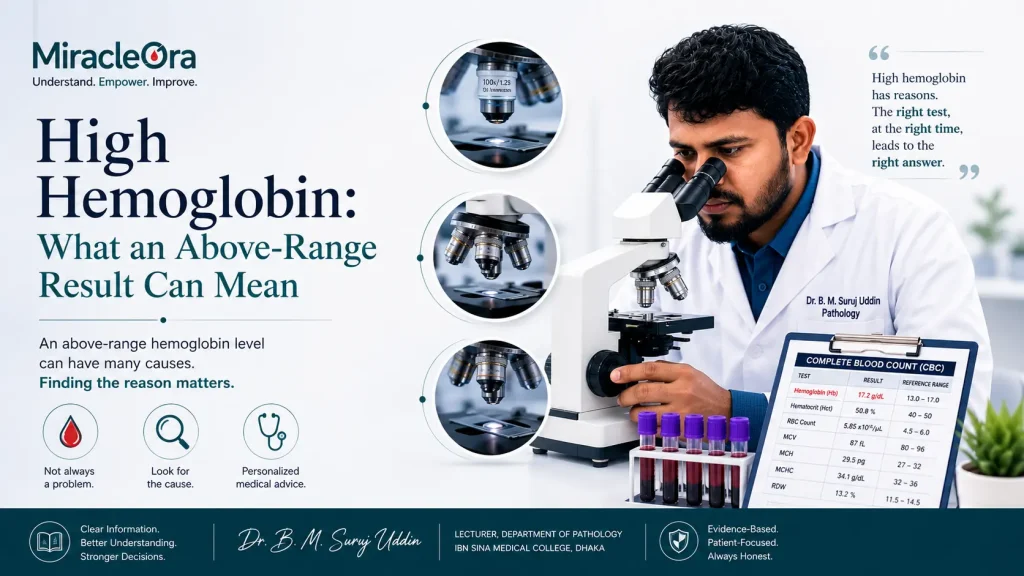
A hemoglobin above your laboratory's reference interval means the concentration of oxygen carrying protein measured in that sample was higher than the interval the laboratory built for the population it serves. It does not name a reason. Named sources list causes as different from each other as too little fluid in the blood, living at altitude, smoking, heart and lung conditions, kidney disease, hormone treatment and a bone marrow disorder called polycythemia vera. Which of those applies to you, if any of them does, is a question for the clinician who ordered the test.
This is general health education, not medical advice. It cannot tell you what your own result means, and it is not a reason to start or stop anything.
There Is No One Number That Makes a Hemoglobin "High"
This is the part most pages skip, and it is worth knowing before you compare your result with anything.
The World Health Organization's 2024 guideline, the reference this site uses for the low side, is a guideline on hemoglobin cutoffs to define anemia. Its cutoffs are all lower limits, one per group. WHO does not publish a matching upper cutoff in that document, so there is no equivalent global threshold that declares a hemoglobin high the way 12.0 g/dL declares a non-pregnant adult woman anemic.
What exists instead is a set of figures from individual clinical publishers, and they do not agree with each other:
| Source | Figure given for a high hemoglobin in adults |
|---|---|
| Cleveland Clinic, "High Hemoglobin Count" | above 16.5 g/dL in an adult male, above 16 g/dL in an adult female |
| Cleveland Clinic, "Erythrocytosis (Polycythemia)" | above 17.5 g/dL in men, above 15.3 g/dL in non-pregnant women |
| Mayo Clinic, "High hemoglobin count" | more than 16.6 g/dL for men, more than 15 g/dL for women |
Two of those come from the same institution, on two different pages. That is not sloppiness. A page about a flagged laboratory value and a page about a diagnosed condition are answering different questions, and each picks the figure that fits its own.
The consequence is the one that applies on the low side too. A guideline cutoff is one number with one direction, set by a body for a stated purpose. A laboratory reference interval has two ends and is built from your laboratory's own instruments and population. The upper limit printed beside your result is the one it was actually flagged against, and why those printed limits differ between laboratories is set out in why your lab's reference range differs from charts online. If your report used a letter rather than a number, what H and L mean on a blood test explains the notation.
Cleveland Clinic gives figures for younger patients on the same page, above 16.6 g/dL in a child and above 18 g/dL in an infant. A pediatric result belongs with the pediatric team that ordered it.
Hemoglobin Is a Concentration, So the Fluid Counts
Neither hemoglobin nor hematocrit counts the red cells in your body. Both describe red cells relative to the fluid they are suspended in, so anything that changes the fluid moves the printed number without anything happening to the cells.
Clinical Methods, on the NCBI Bookshelf, states it directly: "If a patient is severely dehydrated, the hemoglobin and hematocrit will appear higher than if the patient were normovolemic; if the patient is fluid overloaded, they will be lower than their actual level."
Cleveland Clinic gives this its own name, relative erythrocytosis, and lists vomiting, diarrhea and medicines called diuretics among the causes. MedlinePlus, the patient service of the US National Library of Medicine, makes the same point in its CBC article, naming "a lack of enough water and fluids, such as from severe diarrhea, excessive sweating, or water pills." The circumstances of the draw are therefore worth mentioning at the appointment, a point covered in how dehydration affects blood test results.
The Categories Clinicians Sort the Causes Into
Cleveland Clinic groups the causes of erythrocytosis into three, and the grouping is more useful than a flat list, because the three lead to completely different investigations.
Relative. The red cell mass is not increased; the fluid it is measured in is reduced. Cleveland Clinic names vomiting, diarrhea and diuretics.
Absolute, primary. Something in the bone marrow itself. Cleveland Clinic names polycythemia vera and other myeloproliferative neoplasms, and inherited genetic changes affecting the marrow.
Absolute, secondary. The marrow is responding to a signal from elsewhere. Cleveland Clinic names conditions that reduce oxygen delivery, including lung disease, heart disease and sleep apnea, along with kidney conditions and transplants, tumors that secrete erythropoietin, carbon monoxide exposure and smoking, and anabolic steroids and testosterone. MedlinePlus lists an overlapping set: kidney disease with high erythropoietin production, a long standing low oxygen level from heart or lung disease, polycythemia vera, smoking and the use of testosterone.
We are deliberately not ranking these by likelihood. Some pages do, and the ranking is drawn from populations rather than from you. It cannot tell you which group your own result sits in. Working that out is the job of a clinician who has your history, your examination and the rest of your blood count in front of them.
Two Adjustments That Change the Comparison
Two things in WHO's 2024 hemoglobin guideline rarely appear on consumer charts, and both raise hemoglobin without any illness involved.
WHO recommends adjusting hemoglobin concentrations for the elevation of a person's place of residence, in increments of 500 meters, because living higher raises hemoglobin. It also recommends adjusting for smoking, and reports that mean hemoglobin was 3.3 g/L higher in smokers than in non-smokers.
Those adjustments were written for the anemia cutoffs, so they exist to identify a low result correctly. They still describe a real effect on the number, and whether your laboratory or clinician takes altitude or smoking into account is a fair question to ask if either applies to you.
What Looking Into a High Hemoglobin Can Involve
This describes tests a named source associates with one specific condition. It is not a prediction of what will happen to you.
MedlinePlus, describing polycythemia vera, says providers may order a complete blood count with differential, a comprehensive metabolic panel, an erythropoietin level, genetic testing for the JAK2 variant, blood oxygen saturation, vitamin B12 and a bone marrow biopsy. It defines polycythemia vera as "a bone marrow disease that leads to an abnormal increase in the number of blood cells," often linked to a variant gene called JAK2 V617F, and states that this variant is not an inherited disorder.
Not every raised hemoglobin leads near that list. A repeat sample is a common next step for any single out of range value.
Symptoms, and the Honest Limit of Any Web Page
Cleveland Clinic lists symptoms separately for the two absolute categories. For secondary causes it names headaches, confusion, trouble sleeping, weakness and fatigue. For primary causes it names high blood pressure, night sweats, weight loss, joint pain and gout, bleeding problems, itchy skin, tingling sensations and burning or redness. MedlinePlus adds, for polycythemia vera specifically, itchiness especially after a warm bath, reddened facial skin, shortness of breath, vision problems, tinnitus and joint pain.
Cleveland Clinic's own escalation language is that immediate attention is warranted for signs of a deep vein thrombosis, a pulmonary embolism, a stroke or a heart attack, including chest pain, shortness of breath, dizziness, loss of balance, muscle weakness or leg swelling. Its standing advice is to call your provider if you develop new symptoms, and, if you already know you have a high hemoglobin, to call if symptoms worsen.
No page can triage you, and this one is not trying to. Those are the escalation criteria the named sources publish, quoted so you can check them at the source. Whether any of them describes what you are experiencing is a judgment for a clinician or an emergency service, not for a reader working from a list. For the opposite direction on the same measurement, our pillar on what a low hemoglobin means covers the reading most people arrive with.
Frequently Asked Questions
What is considered a high hemoglobin level?
It depends which source you read. Cleveland Clinic's high hemoglobin count page gives above 16.5 g/dL in adult males and above 16 g/dL in adult females, its erythrocytosis page gives above 17.5 g/dL in men and above 15.3 g/dL in non-pregnant women, and Mayo Clinic gives more than 16.6 g/dL for men and more than 15 g/dL for women. WHO's 2024 guideline sets cutoffs to define anemia and does not publish a matching upper threshold. The interval printed on your own report is the one your result was compared against.
Can dehydration alone cause a high hemoglobin?
Clinical Methods states that in severe dehydration hemoglobin and hematocrit appear higher than they would if the person were normovolemic. Cleveland Clinic calls this pattern relative erythrocytosis and names vomiting, diarrhea and diuretics among the causes. Whether that is what happened in your sample is something the clinician who ordered the test can weigh, since they know the circumstances of the draw.
Does a high hemoglobin mean I have polycythemia vera?
A single value cannot establish that. MedlinePlus describes polycythemia vera as a bone marrow disease often linked to the JAK2 V617F variant, and lists tests used to investigate it including an erythropoietin level, JAK2 genetic testing and a bone marrow biopsy. Cleveland Clinic places it in only one of three categories of cause, alongside relative and secondary causes that are investigated in entirely different ways.
Is a high hemoglobin dangerous?
That is not a question a page can answer for an individual, because the answer depends on the cause. Cleveland Clinic states that more serious causes of erythrocytosis can thicken the blood and raise the risk of clots, and its emergency guidance covers signs of a deep vein thrombosis, pulmonary embolism, stroke or heart attack. Which of those, if any, is relevant to your result is a clinical assessment.
Medical disclaimer: This content is for general education only and is not a substitute for professional medical advice, diagnosis, or treatment. It cannot interpret your individual results. Talk to a qualified healthcare provider about your own hemoglobin level and your symptoms. See our full Medical Disclaimer.