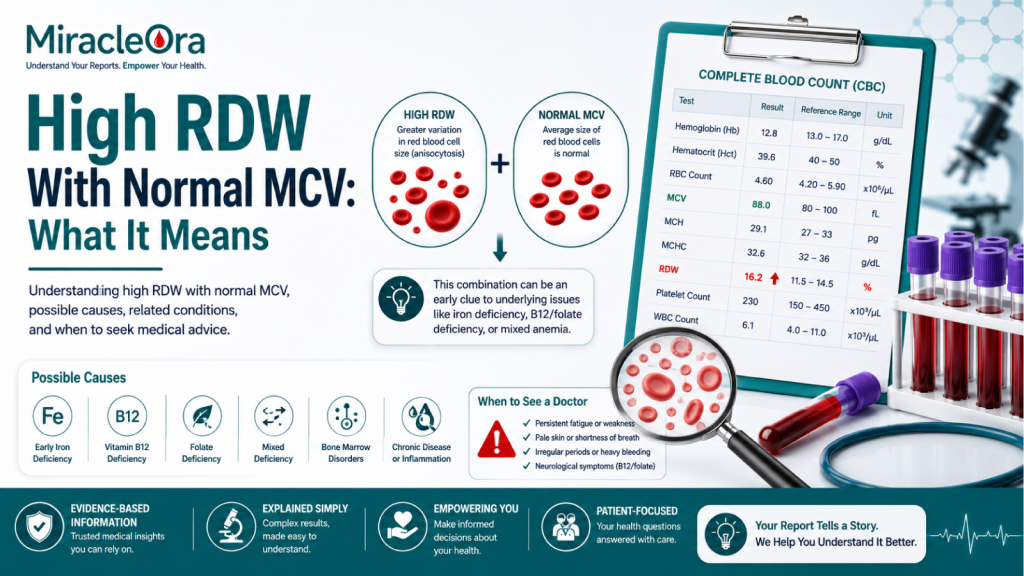
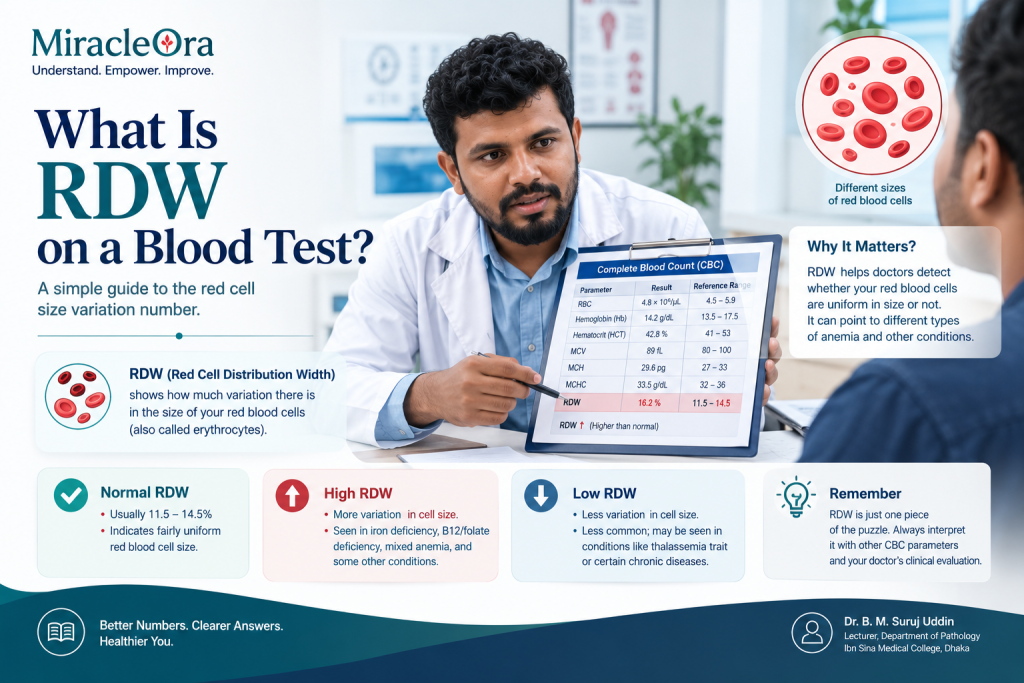
The short answer: a high RBC count means the laboratory counted more red blood cells in a set volume of your blood than its reference range expects. It is a finding, not a diagnosis. MedlinePlus lists causes that range from dehydration and cigarette smoking to living at high altitude, lung and heart conditions, some kidney problems, certain medicines, and a bone marrow condition called polycythemia vera. A low count most often points toward anemia. The number is read together with hemoglobin, hematocrit and MCV, and interpreting it belongs to the clinician who ordered the test.
First: signs that should not wait for an appointment
A high red cell count by itself rarely announces itself, but the MedlinePlus Medical Encyclopedia entry on polycythemia vera (review date February 3, 2025, read on September 27, 2026), one of the possible causes, lists blood clots, stroke and heart attack among its possible complications. The US Centers for Disease Control and Prevention (CDC), on its venous thromboembolism page (dated March 5, 2025, read on September 27, 2026), lists these signs of a clot:
- In an arm or leg: swelling, pain or tenderness, warmth, and redness or discoloration. CDC states: "If you have any of these signs or symptoms, you should see your doctor as soon as possible."
- In the lungs: difficulty breathing, a faster than normal or irregular heartbeat, chest pain that usually worsens with a deep breath or coughing, coughing up blood, and very low blood pressure, lightheadedness or fainting. For these, CDC states: "you should seek medical help immediately."
Signs of a possible stroke or heart attack are also a reason for emergency care, not a routine appointment. This page cannot triage anyone. A clinician or emergency service can.
What the RBC count actually counts
The red blood cell count, often printed as RBC, is the number of red cells in one microliter of blood, reported in millions. Red cells carry oxygen from the lungs to the rest of the body, using the protein hemoglobin.
It sits at the top of the red cell section of a complete blood count (CBC), next to lines that describe the same cells from other angles:
| Line | What it describes |
|---|---|
| RBC | How many red cells there are |
| Hemoglobin (Hb) | How much oxygen-carrying protein there is |
| Hematocrit (Hct) | What share of the blood's volume is red cells |
| MCV | How large the average red cell is |
These lines usually move together, but not always. When they disagree, the disagreement is often the most useful thing on the report, and it is where this article spends much of its time. If the abbreviations are new, the guide to hemoglobin versus hematocrit explains why both appear.
Why the "normal" range depends on who you ask
Two respected patient resources print two different ranges for the same test.
| Source | Men | Women |
|---|---|---|
| MedlinePlus, RBC count (review date February 27, 2026, read on September 27, 2026) | 4.2 to 5.7 million cells/mcL | 3.8 to 5.1 million cells/mcL |
| Cleveland Clinic, "High Red Blood Cell Count" (last updated April 25, 2022, read on September 27, 2026) | 4.7 to 6.1 million per microliter | 4.2 to 5.4 million per microliter |
Cleveland Clinic also gives a range for children of 4.0 to 5.5 million per microliter.
Read side by side, a man with a count of 5.9 million is above the MedlinePlus range and inside the Cleveland Clinic one. A woman at 5.2 million is in the same position. Neither source is wrong. MedlinePlus says plainly that "Normal value ranges may vary slightly among different labs," and each laboratory sets its interval from its own instruments and population.
The practical point is simple: the range printed on your own report is the one that applies to your result. Why charts online and your laboratory disagree is covered in more detail in why your lab's reference range differs from charts online.
High RBC count meaning: the common causes
MedlinePlus lists these as causes of a higher-than-normal RBC count:
- Dehydration
- Cigarette smoking
- Low blood oxygen levels, and exposure to high altitude
- Congenital heart disease, and cor pulmonale (strain on the right side of the heart from lung disease)
- Pulmonary fibrosis
- Kidney cysts or tumors
- Polycythemia vera
- Certain medicines, including anabolic steroids, erythropoietin, gentamicin and testosterone
Cleveland Clinic adds heart failure, other lung diseases such as emphysema and COPD, and sleep apnea to its own list.
It helps to sort these into groups rather than read them as one long worry list.
Less fluid, same cells. Dehydration concentrates the blood. The number of red cells has not changed, but there is less plasma around them, so each microliter holds more. This is one reason a clinician may simply repeat the test. Dehydration and blood test results explains which lines shift and why.
The body asking for more oxygen. Smoking, high altitude, and lung, heart or sleep-breathing problems share a theme on these lists: each can lower the oxygen reaching the tissues, and MedlinePlus names low blood oxygen itself as a cause. In this group the count rises because the body is compensating.
A signal from outside the marrow. Some kidney cysts or tumors, and some medicines, including testosterone and erythropoietin, appear on the MedlinePlus list as causes that can push the count up.
The marrow itself. Polycythemia vera is a bone marrow condition in which too many red cells are made. It is the cause people fear most on this list, and it is one of several, not the default. Distinguishing it from the other groups takes the clinician's history, repeat testing and often further tests.
On the medicine point, these are associations a source describes. They are not a reason to stop or change any medicine. That decision belongs to the prescriber.
The pattern that surprises people: many red cells, small cells
This is the part most "high RBC" pages skip, and on a report from South Asia, the Middle East or the Mediterranean it is often the most relevant.
Sometimes the RBC count is flagged high while hemoglobin is normal or slightly low and the MCV is low. More cells, but each one smaller. That is not the picture of the body building extra oxygen-carrying capacity. It is a different pattern, and a well-described one in thalassemia trait, a common inherited difference in how hemoglobin is made.
A 2012 letter in the Turkish Journal of Hematology, "A Search for Beta Thalassemia Trait in India" by Veda Parthasarathy (read on PubMed Central on September 27, 2026), reported that "The mean RBC count was highest in the BTT cases (5.7 x 10¹²/L), and slightly lower in those with IDA and ACD (4.8 x 10¹²/L)." BTT is beta thalassemia trait, IDA is iron deficiency anemia and ACD is anemia of chronic disease. The author concluded that "a combination of MCV, RDW, and the RBC count is more effective for identifying BTT and differentiating it from other non-thalassemic microcytosis."
Two things follow from that, and both are steadying in their own way:
- A high RBC count does not always mean "too much blood." Read with a low MCV, it can reflect a normal or higher number of smaller cells.
- The same small-cell pattern is also seen with iron deficiency, and the two are handled very differently. Telling them apart is a job for the clinician and, where needed, further tests. Thalassemia trait versus iron deficiency walks through how a CBC points one way or the other.
No page can tell you which pattern your report shows. What it can do is make sure the MCV line gets read alongside the RBC line, rather than the RBC line alone.
When the count is low instead
The low direction is searched just as often, and it is usually the more familiar story. MedlinePlus lists causes of a lower-than-normal RBC count including anemia, bleeding, bone marrow failure, erythropoietin deficiency, hemolysis (red cells broken down faster than usual), malnutrition, pregnancy, overhydration, deficiencies of iron, copper, folic acid, vitamin B6 or vitamin B12, and conditions such as leukemia and multiple myeloma. It also names medicines, including chemotherapy drugs, chloramphenicol, hydantoins, methyldopa, NSAIDs and quinidine.
Pregnancy and overhydration are worth noticing on that list. Both involve more fluid in the blood, which can lower the count per microliter without any change in how the marrow is working.
In practice, a low RBC count is rarely read on its own. It is read alongside hemoglobin, which is the number most anemia definitions use, and alongside MCV, which sorts anemia into its families.
How clinicians usually read the red cell number
A single RBC value on its own says less than people expect. What a clinician weighs typically includes:
- Does it agree with hemoglobin and hematocrit? If all three are high together, the red cell mass may genuinely be raised, or the blood may be concentrated. If RBC is high and hemoglobin is not, cell size becomes the question.
- What is the MCV? Small, normal and large cells point in different directions.
- Is it a one-off or a trend? A repeat test can help show whether the first result reflected hydration on the day.
- What is the context? Smoking, altitude, sleep, medicines, heart or lung history, and family background all change how the same number is read.
That is why two people with the same RBC count can leave the appointment with completely different next steps.
Making the appointment more useful
A few notes before the visit can help the clinician read the number in context:
- Whether you smoke or have recently stopped
- Where you live, and any recent time at high altitude
- Snoring, pauses in breathing at night, or daytime sleepiness
- Every medicine and supplement you take, including any hormone treatment
- Whether you were unwell, fasting or short of fluids before the test
- Any family history of thalassemia, anemia or blood disorders
- Copies of previous blood counts, so the trend is visible
This list is for describing what is happening. Decisions about testing and treatment belong to the clinician.
The honest limits of this page
A laboratory report should not create fear. It should create understanding. This page cannot tell you whether your RBC count is normal for you, what is causing it, or which further tests you need. It can explain what the number counts, why two trusted sources print two different ranges, which groups of causes sit behind a high result, and why the MCV line beside it matters as much as the count itself.
Frequently asked questions
What does a high RBC count mean?
It means more red blood cells were counted per microliter of blood than the laboratory's range expects. MedlinePlus lists causes including dehydration, smoking, high altitude, low blood oxygen, heart and lung conditions, kidney cysts or tumors, some medicines and polycythemia vera. The clinician works out which applies.
Can dehydration cause a high RBC count?
Yes. MedlinePlus lists dehydration among the causes. Less plasma means the same red cells are more concentrated, so the count per microliter rises. A repeat test is one way clinicians check for this.
Is a high RBC count with low MCV a concern?
It is a recognized pattern rather than a verdict. Many small cells are described in thalassemia trait, and small cells are also seen with iron deficiency. A 2012 paper in the Turkish Journal of Hematology found the mean RBC count highest in beta thalassemia trait. The clinician decides whether further tests are needed.
What is a normal RBC count?
It depends on the source and the laboratory. MedlinePlus gives 4.2 to 5.7 million cells/mcL for men and 3.8 to 5.1 for women, while Cleveland Clinic gives 4.7 to 6.1 and 4.2 to 5.4. The range on your own report is the one that applies.
When should a high RBC count be checked urgently?
CDC advises seeing a doctor as soon as possible for arm or leg swelling, pain, warmth or redness, and seeking medical help immediately for difficulty breathing, chest pain, coughing up blood or fainting, which can signal a blood clot.