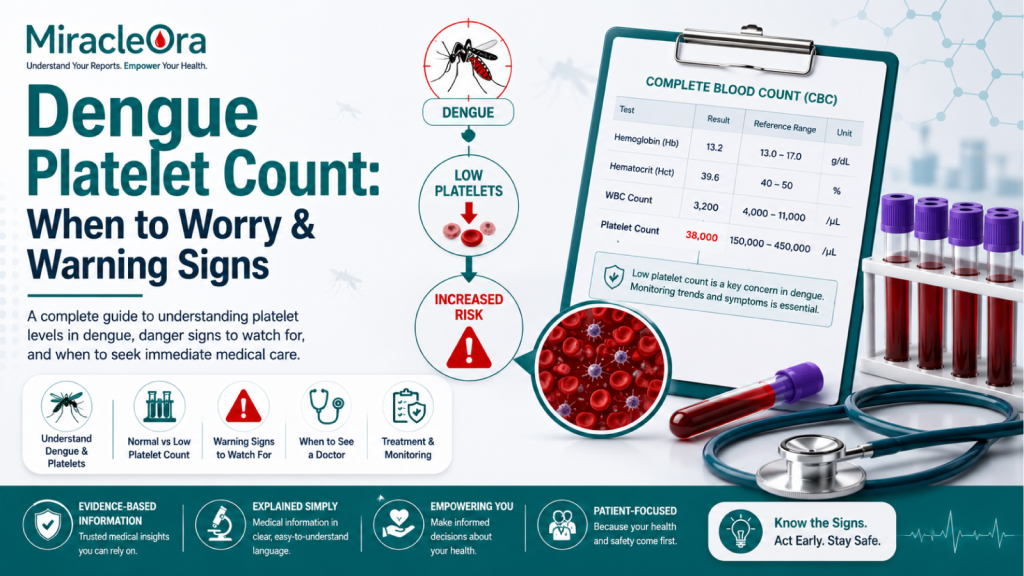
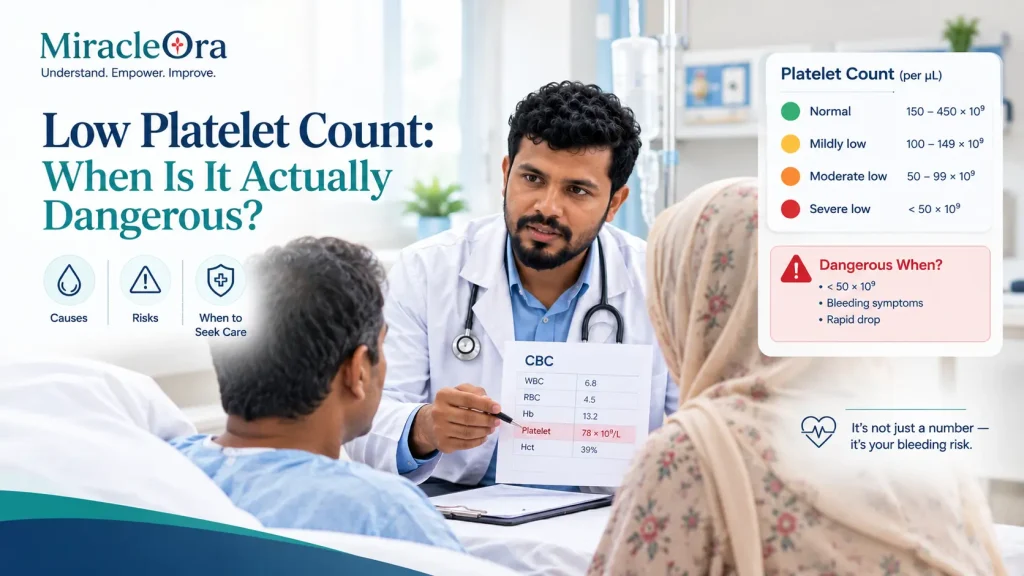
Low platelets during chemotherapy are common and expected enough to have a name. The National Cancer Institute (NCI) explains that some cancer treatments, including chemotherapy and targeted therapy, "can lower the number of platelets in the blood," and calls the resulting low count thrombocytopenia. Platelets are the cells that help blood clot, so a low count mainly changes bleeding and bruising risk rather than how you feel day to day. The count is checked before and between treatment cycles for exactly this reason. What your own number means for your next dose is a question only your oncology team can answer.
This page explains what the platelet line on your report is measuring during treatment, which signs NCI says to report, and why the same number can be read very differently at two points in the same cycle.
First: the bleeding signs NCI says to report
The escalation rule comes before the explanation, because for some readers the symptoms matter more than the number.
The NCI page on bleeding and bruising during cancer treatment (reviewed December 29, 2022, read October 3, 2026) tells patients to contact their health care team about:
- Bruising or bleeding a lot or very easily, and tiny purple or red spots on the skin
- Bleeding from the mouth or nose, bleeding when vomiting, or vaginal bleeding and unusually heavy menstrual bleeding
- Urine that looks red or pink, and stools that are dark or bloody
- Severe headaches, vision changes, confusion or extreme drowsiness
- Bleeding that does not stop after a few minutes
The National Heart, Lung, and Blood Institute (NHLBI) adds one line that belongs next to that list. Its thrombocytopenia page (updated February 18, 2025, read October 3, 2026) states: "Call 9-1-1 to seek immediate medical care if you have bleeding that does not stop when you apply pressure." Readers outside the United States would use their own emergency number.
Those last two items on the NCI list, the headache and confusion group, are the ones people skim past because they do not look like bleeding. They are on the list anyway, and they are worth knowing about before they happen.
Why chemotherapy lowers the platelet count
Platelets are made in the bone marrow. MedlinePlus describes platelets, also called thrombocytes, as "small blood cells" that "form in your bone marrow" and are "essential for blood clotting."
Chemotherapy works on cells that divide quickly, and the platelet-producing cells of the bone marrow are among them. MedlinePlus's complete blood count page (updated October 14, 2024, read October 3, 2026) lists "chemotherapy medicines used to treat cancer" directly among the causes of a low platelet count, alongside bone marrow failure from infection, tumor, radiation or fibrosis.
This is why a falling platelet count during treatment is usually read as an expected effect of the drug rather than as a new disease. It is also why the same blood draw often shows movement in other lines of the report. White cells and red cells come from the same marrow, which is the subject of our articles on what a neutropenia result means and on the symptoms that come with low hemoglobin.
What the numbers on the report mean
Two authoritative sources give slightly different normal ranges, and seeing both is more useful than seeing one.
| Source | Normal adult platelet count | Date read |
|---|---|---|
| NHLBI, thrombocytopenia page | 150,000 to 450,000 platelets per microliter of blood | October 3, 2026 |
| MedlinePlus, complete blood count page | 150,000 to 400,000 | October 3, 2026 |
The reason they differ is not that one of them is wrong. Reference ranges are set by the laboratory that ran the sample, using its own methods and population, which is why MedlinePlus's guide to lab results says "you can't compare test results from different labs." The range printed on your own report is the one that applies to your own number, a point we expand on in why your lab's reference range differs from the charts online.
Our separate guide on when a low platelet count is actually dangerous covers the general thresholds clinicians use outside the cancer setting. During chemotherapy those general thresholds are not the whole picture, which is the point of the next section.
The part nobody puts on the chart: the number is read against the calendar
The single most useful thing to understand about a platelet count during treatment is that your oncology team is not reading it the way a reference range invites you to read it. They are reading it as a point on a curve.
A count taken the day before a cycle, a count taken partway through one, and a count taken at a follow-up visit weeks after treatment ends are three different questions, even if the printed number is identical. One asks whether the marrow has recovered enough for the next dose. One asks how deep the dip went. One asks whether recovery is on track. A reference range cannot tell them apart, because that range was built from people who are not having chemotherapy.
This has a practical consequence for reading your own report. A number flagged low is not automatically news, and a number inside the range is not automatically reassurance, because the comparison that matters is with your own previous counts on this regimen rather than with a general population. How far a count falls, how quickly it comes back, and whether that pattern is expected for a given drug and dose varies by regimen and by person. Your oncology team holds the previous counts and the treatment plan, so they are the only people who can place today's number on your curve.
It also explains a frustration readers describe often: comparing notes with someone on a different regimen rarely helps, because the two curves are not the same shape.
What the care team does with a low count
Decisions about timing, dose and transfusion are clinical decisions, and this page does not predict them. What is fair to describe is the shape of the process: counts are monitored around treatment, each result is considered alongside your symptoms and the rest of the report, and any change to the plan is made by the team that prescribed it. Whether a count will delay a cycle, whether a transfusion is being considered, and what the team wants to see before the next dose are all reasonable questions to ask directly at your next appointment.
Nothing on this page should be used to decide whether to attend, postpone or alter a treatment.
The everyday precautions NCI lists
The NCI page lists steps it suggests for patients at risk of bleeding and bruising during treatment. Reported as what NCI says rather than as instructions from us, they include:
- Avoiding medicines that contain aspirin or ibuprofen
- Brushing teeth gently, with a soft toothbrush
- Using an electric shaver rather than a blade
- Wearing shoes indoors
- Using lotion and lip balm to protect dry skin and lips
- Applying firm pressure with a cloth to bleeding, and ice to bruises
- Limiting or avoiding alcohol while the platelet count is low
Two of these surprise people. The aspirin and ibuprofen item matters because those medicines affect how platelets work on top of a count that is already low, and they appear in many over-the-counter products bought for unrelated reasons. The shoes item sounds trivial and is not: it is about the small cuts and knocks that normally heal without a thought. Which of these apply to you, and whether any of your prescribed medicines fall into the first category, is a conversation for your own team rather than a decision to make from a web page.
The platelet line is one line on a wider report
Readers often arrive at the platelet count after reading something frightening about blood counts and cancer in general. A complete blood count is one tool among several, it is read as a panel rather than line by line, and its limits are real. Our honest answer to whether a blood test can detect cancer sets out what the test can and cannot do.
This article is general information about what the platelet line means during chemotherapy. It cannot tell you whether your own count is expected, safe or a reason to act. That belongs with the oncology team treating you, and any new bleeding symptom belongs with them the same day.
Frequently asked questions
Why do platelets drop during chemotherapy?
NCI states that chemotherapy and targeted therapy "can lower the number of platelets in the blood." Platelets are produced in the bone marrow, and MedlinePlus lists chemotherapy medicines among the causes of a low platelet count. The effect is on the marrow's production of the cells rather than on the blood already in circulation.
What platelet count is too low during chemotherapy?
There is no single number that answers this for every patient, and we do not publish one. NHLBI gives a normal adult range of 150,000 to 450,000 platelets per microliter, but the count that matters during treatment is judged against your previous counts, your regimen and your symptoms by your oncology team.
What are the first signs of low platelets?
NCI lists bruising and bleeding easily, and tiny purple or red spots on the skin. NHLBI also describes petechiae, small flat red spots caused by blood leaking from vessels, and purpura, which shows as red, purple or brownish-yellow patches, among the signs of a low platelet count.
Will low platelets delay my treatment?
That is a clinical decision made by the team that prescribed the treatment, based on the count, the plan and how you are doing. It is a direct and reasonable question to ask at your next appointment, and bringing your recent reports makes the answer easier to give.
Does a low platelet count during chemotherapy mean the cancer is worse?
It does not follow. MedlinePlus lists chemotherapy itself among the causes of a low platelet count, so a falling count during treatment is commonly an effect of the drug on the bone marrow. Only your oncology team can interpret what your own results mean in the context of your treatment.